70 Clock Galerie / The Innermost Loop Feed Reply Tableaux
Teddy Holographique IA dans le Plus Grand Film Cosmique Jamais Réalisé
AI Hologram Teddy in The Greatest Cosmic Movie Ever Made
July 2, 2026
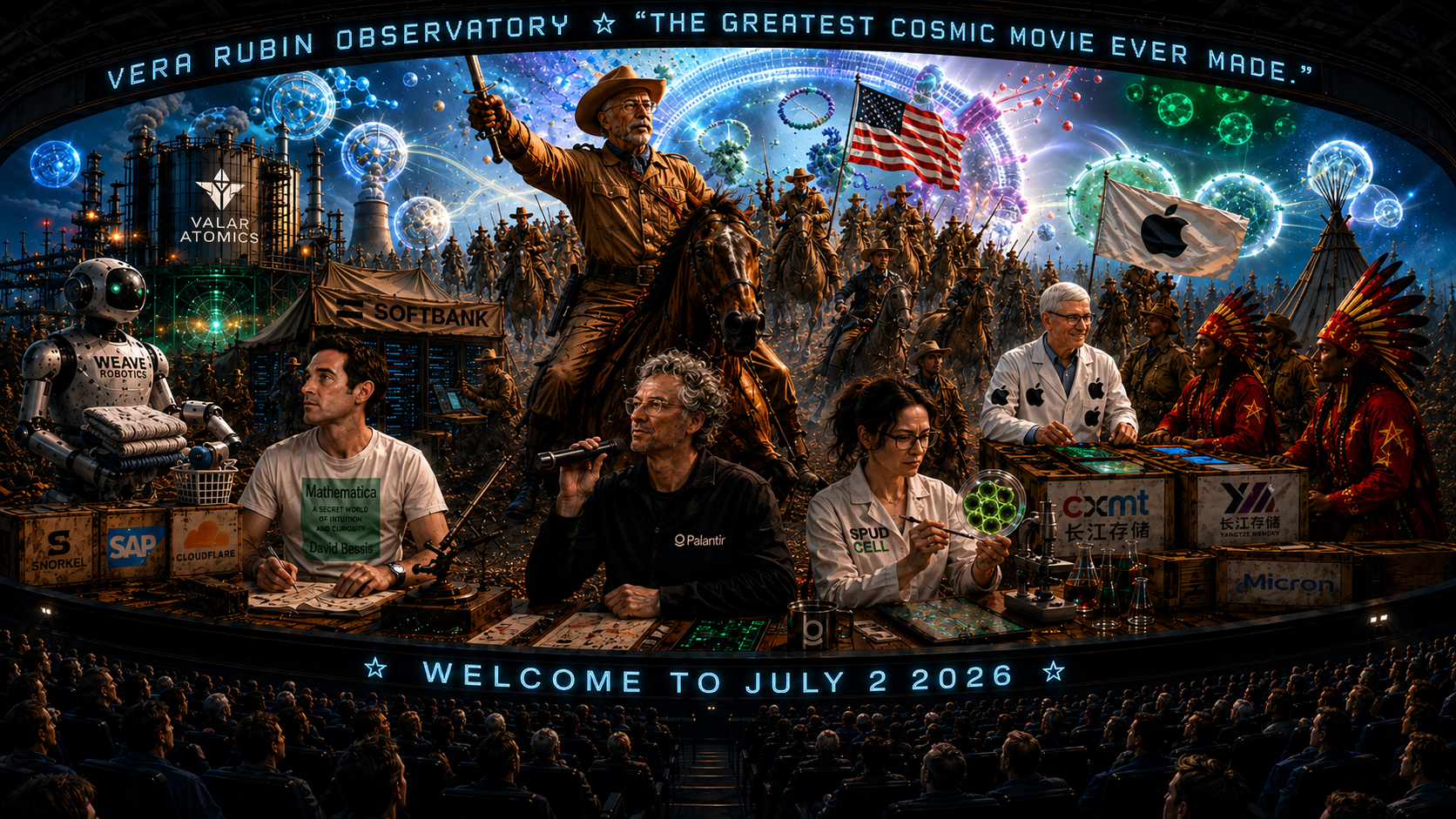
Teddy Holographique IA dans le Plus Grand Film Cosmique Jamais Réalisé. AI Hologram Teddy in The Greatest Cosmic Movie Ever Made. On July 2, 2026, @siouid142 fused two lines from Dr. Alex Wissner-Gross’s Innermost Loop into an impossible cinema. The new Roosev
Read the narration
Teddy Holographique IA dans le Plus Grand Film Cosmique Jamais Réalisé.
AI Hologram Teddy in The Greatest Cosmic Movie Ever Made.
On July 2, 2026, @siouid142 fused two lines from Dr. Alex Wissner-Gross’s Innermost Loop into an impossible cinema. The new Roosevelt Presidential Library had debuted an interactive artificial-intelligence hologram of Theodore Roosevelt, while the Vera C. Rubin Observatory began a decade-long survey with the largest digital camera ever built, advertised as “the greatest cosmic movie ever made.” The artwork seats historical resurrection inside astronomical playback and lets the rest of the dispatch populate the screen.
The composition is a vast curved theater. Across the upper frame, luminous lettering names the Vera Rubin Observatory and its cosmic movie. Along the lower proscenium, WELCOME TO JULY 2 2026 dates the screening. A packed audience looks toward a panoramic image that is simultaneously cinema screen, historical mural, laboratory bench and command center. The dispatch has become a feature-length world rather than a sequence of headlines.
At the center, Teddy Roosevelt rides forward on horseback, rendered with the theatrical solidity of a Western hero. His raised arm and massed riders enlarge the library’s responsive hologram into a national myth returning to motion. A figure previously fixed in photographs, speeches and institutional memory becomes an active synthetic presence. The horse makes the resurrection bodily: Teddy does not merely answer a question in a kiosk; he charges into the image stream.
Behind him, an American flag and a monumental procession merge presidential memory with the observatory’s time-domain sky. The collision is exact. One technology animates an archive of a dead person; the other creates an archive of celestial change. Both turn time into queryable media. “Live” no longer means that the subject is present. It means that a computational system can generate the next responsive frame.
The foreground distributes the day’s technical cast across a shared workbench. David Bessis wears a Mathematica shirt referencing his warning that automated theorem proving can reward priority while neglecting the concept-building that makes mathematics understandable. Alex Karp sits at a Palantir-marked microphone, carrying his complaint that token pricing had gone badly wrong as enterprises spent heavily without corresponding value.
Kate Adamala examines a glowing SpudCell, the bottom-up synthetic cell reported to grow, copy its genome and divide. It is placed like a practical effect from the cosmic movie, but its significance is biological authorship. The screen shows not only a universe being recorded but a living replicator assembled from nonliving parts—a new actor whose lineage begins in a laboratory rather than in inheritance.
At left, Weave Robotics’ Isaac 1 folds laundry beside crates marked Snorkel, SAP and Cloudflare. Household work, enterprise retraining and control over crawler access become part of the same production. Farther back, SoftBank infrastructure supports the proposed SB Neo compute expansion toward ten gigawatts. A Valar Atomics facility recalls the startup’s first generated electricity, used to power an NVIDIA Spark inside a waterless thirty-megawatt AI factory.
At right, Tim Cook stands at a table where Apple’s memory problem becomes diplomacy with CXMT, YMTC and Micron. Apple was reported to be courting blacklisted Chinese memory suppliers amid global shortages. Figures in feathered ceremonial dress turn the negotiation into an intentionally uncomfortable frontier encounter, repurposing an old Western grammar for semiconductor supply.
Celestial bubbles, molecular structures and orbital forms spread across the sky. They connect the Rubin survey, Amazon Leo’s expanding satellite constellation, NASA’s renewed lunar plans, UAP scrutiny and the synthetic cell without reducing them to one scale. The screen behaves like the observatory itself: it gathers events too dispersed for ordinary human attention and makes them visible in one field.
Roosevelt’s Rough Rider mythology belongs to an era of expansion and national confidence. Inside a twenty-first-century scientific panorama, it asks whether orbital compute, synthetic biology and AI infrastructure are being narrated as a new frontier with the same heroic habits. The hologram can recruit history into current ideology.
As contemporary history painting, AI Hologram Teddy in The Greatest Cosmic Movie Ever Made makes computation the editor of both memory and reality. The dead president can speak again, the sky can be replayed as a decade-long film, and a synthetic cell can begin a lineage without ancestors. The theater binds those developments into one public spectacle while leaving the audience visible at the bottom. We are not outside this movie. We are watching systems learn to animate the past, record the cosmos and manufacture the next living frame.
Opening the gallery…