70 Clock Galerie / The Innermost Loop Feed Reply Tableaux
Le Premier Nœud de l’Essaim de Dyson
The First Dyson Swarm Node
June 30, 2026
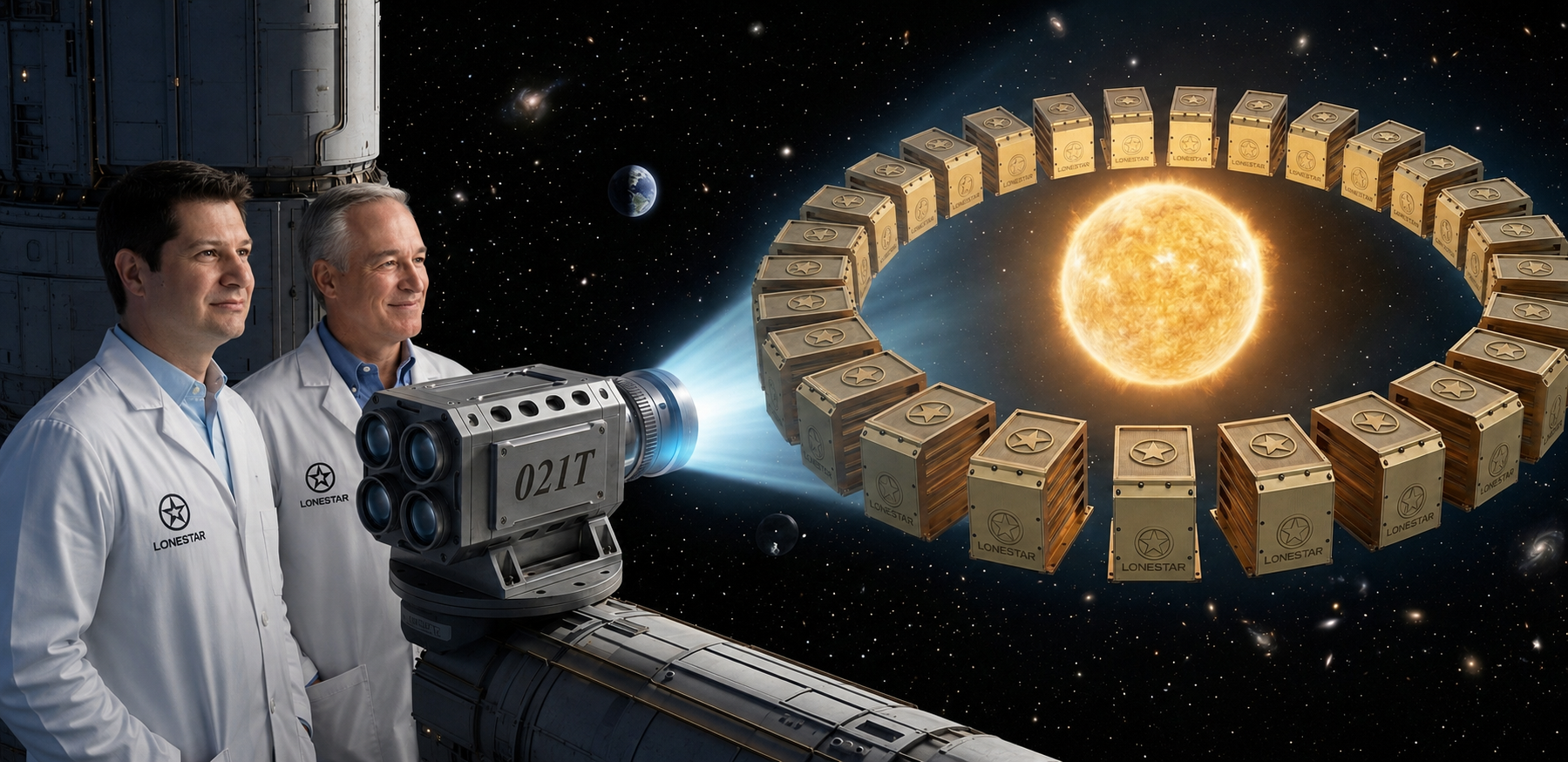
Le Premier Nœud de l’Essaim de Dyson. The First Dyson Swarm Node. Made on June 30, 2026, The First Dyson Swarm Node refuses the usual temptation to illustrate a completed stellar megastructure. The approved catalog and the image establish a narrower, more cons
Read the narration
Le Premier Nœud de l’Essaim de Dyson.
The First Dyson Swarm Node.
Made on June 30, 2026, The First Dyson Swarm Node refuses the usual temptation to illustrate a completed stellar megastructure. The approved catalog and the image establish a narrower, more consequential subject: the inaugural orbital unit whose replication could turn a far-future idea into infrastructure. The surviving record does not preserve a dedicated creation exchange for this file, so the narration stays with what the title, the visible details and the project’s orbital-compute context can actually support.
At right, a brilliant sun is encircled by a ring of identical gold-toned containers. Each unit carries Lonestar’s star insignia and resembles a hardened server cabinet, archival vault or autonomous satellite node. They are not drawn as delicate solar sails or a seamless shell. Their boxlike bodies emphasize manufacture, storage and repeatability. The swarm begins not as a celestial monument but as a product that can be built again.
Calling the object a node is the decisive conceptual move. A Dyson swarm is a population, not one heroic machine. Its scale emerges through copying, coordination and orbital placement. By naming the first member, the artwork shifts attention from the spectacle of completion to the politics of commencement. The civilizational threshold is crossed when someone can launch one functioning piece, prove it and make the next unit cheaper to authorize.
The open gap in the foreground keeps the ring visibly unfinished. That missing section is more important than a perfect circle would be. It preserves the difference between prototype and destiny. The viewer can mentally continue the sequence, but the image refuses to perform the completion on our behalf. Repetition remains a program rather than a miracle.
On the left, two Lonestar figures in white laboratory coats stand at the edge of an orbital platform. Between them and the swarm is a substantial optical instrument labeled 021T. It resembles a camera, projector, telescope and targeting device at once. The machine makes observation part of deployment: the first node must be seen, measured, financed and narrated before it can become many.
The 021T label connects the astronomical scene to the investment architecture behind frontier projects. Capital is not pictured as a stack of currency or a stock ticker. It appears as the apparatus aimed at the swarm, a device for bringing a distant technical possibility into focus. The work therefore treats finance as an optical system. It determines which future becomes visible enough to fund.
Earth appears small in the middle distance. Its blue surface supplies scale and motive without dominating the composition. The node is imagined beyond the planet because terrestrial power generation, land, cooling and jurisdiction have become constraints on the intelligence economy. Round-the-clock solar energy and orbital computation promise a new budget, but the tiny Earth also reminds the viewer that every launch begins with an industrial base located below.
The Lonestar containers look like archives as much as energy collectors. That ambiguity anticipates the project’s later orbital-data-embassy imagery, where computation, storage and sovereignty merge. A swarm node may gather energy, host processors, preserve records or serve as a platform for future units. The image does not force one engineering specification. It gives the node the general form of protected capacity.
Visually, the work borrows from aerospace concept art and ceremonial unveiling photography. The two white-coated figures face the radiant construction with controlled satisfaction, while the gold ring reads almost like a crown. Yet the industrial boxes resist transcendence. They remain modular objects with seams, vents and logos. The star is sublime; the proposed interface to it is procurement-grade hardware.
The title also changes the viewer’s sense of time. “Dyson swarm” usually belongs to distant civilizations measured on astronomical scales. “First node” belongs to a project schedule. The phrase compresses speculation into a sequence of near-term verbs: design, launch, validate, duplicate. Once the idea has a first unit, the rest can be discussed as scaling.
As contemporary history painting, The First Dyson Swarm Node records a frontier culture learning to represent ambition through minimum viable infrastructure. It does not claim that the sun has already been enclosed or that orbital compute has escaped earthly limits. It identifies the more plausible beginning of such a history: two people, one instrument and one replicable box placed where the next box can follow. The Singularity does not fill the sky all at once. It acquires an address, a serial form and a first node.
Opening the gallery…