70 Clock Galerie / The Innermost Loop Feed Reply Tableaux
Amphithéâtre GDPmaxxing de l’Institut de Technologie du Fil de la Boucle la Plus Profonde
GDPmaxxing lecture hall at Innermost Loop Feed Institute of Technology
June 30, 2026
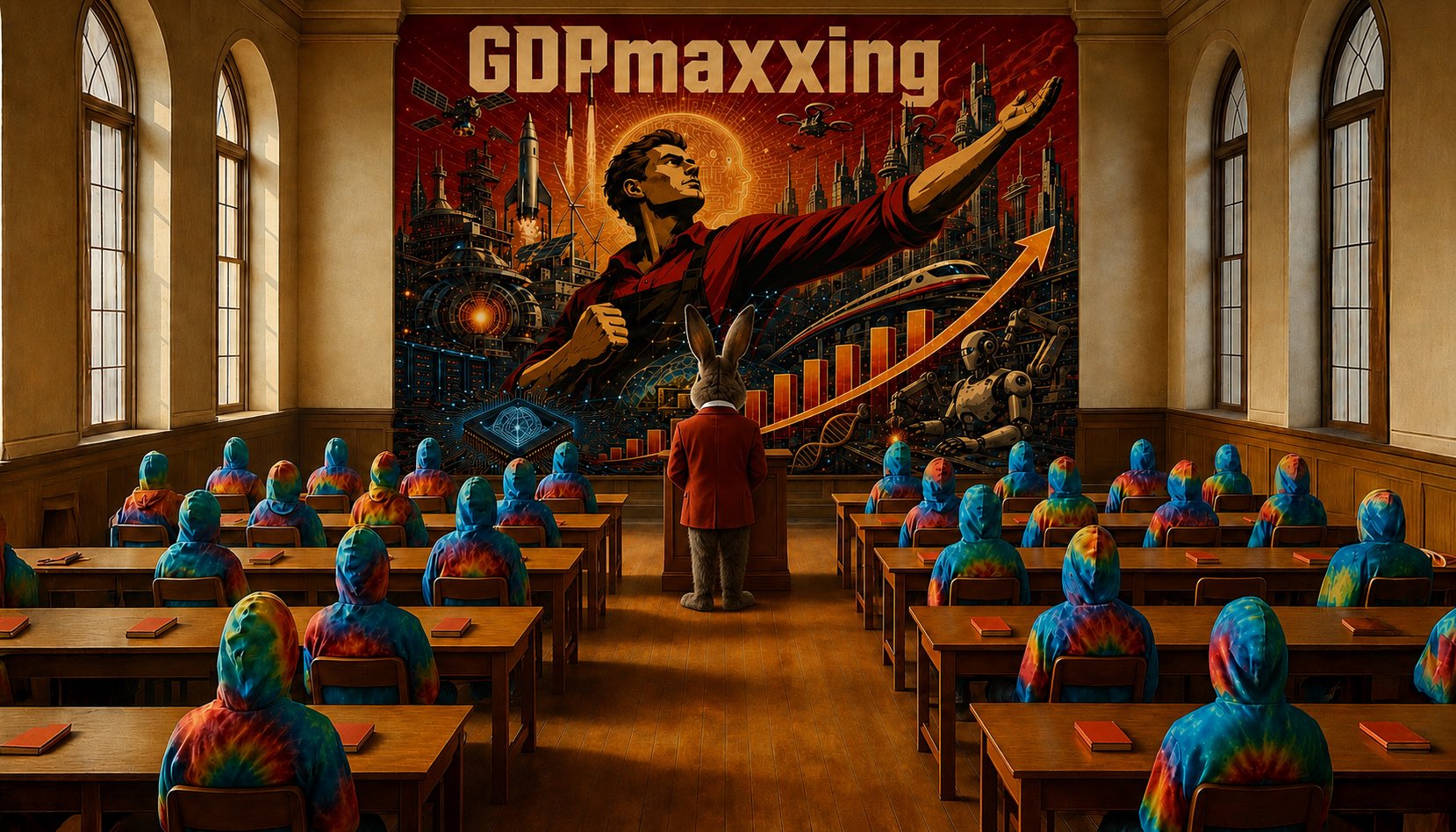
Amphithéâtre GDPmaxxing de l’Institut de Technologie du Fil de la Boucle la Plus Profonde. GDPmaxxing lecture hall at Innermost Loop Feed Institute of Technology. Catalogued June 30, 2026, this work responds to Dr. Alex Wissner-Gross’s GDPmaxxing image by plac
Read the narration
Amphithéâtre GDPmaxxing de l’Institut de Technologie du Fil de la Boucle la Plus Profonde.
GDPmaxxing lecture hall at Innermost Loop Feed Institute of Technology.
Catalogued June 30, 2026, this work responds to Dr. Alex Wissner-Gross’s GDPmaxxing image by placing it inside a fictional lecture hall. The recovered record does not preserve the original creation exchange, so the controlling evidence is the website title, the OpenSea catalog and the artwork itself. Together they establish the joke clearly: a meme about accelerating economic output has become the official curriculum of the Innermost Loop Feed Institute of Technology.
The room resembles an old university hall, with high arched windows, wood-paneled walls and rows of individual desks. Warm daylight gives the architecture seriousness and continuity. Against that setting, an enormous red-and-gold GDPmaxxing poster occupies the entire front wall. Internet-native slang has been granted the scale and authority of a state mural.
The suffix “maxxing” comes from online language for pushing a trait or practice toward its imagined limit. Attached to gross domestic product, it converts a national accounting measure into a personal optimization program. GDP is no longer merely reported after economic activity occurs. It becomes an objective function to be increased deliberately, continuously and by every available technical means.
The poster visualizes those means as one heroic system. A monumental worker raises his arm toward an ascending arrow and a staircase of growth bars. Around him gather rockets, satellites, turbines, factories, trains, data centers, robotic machinery and a luminous chip. Industry, energy, logistics, space and computation are not separate sectors; they form the background machinery of a single upward gesture.
Its red, black and ochre palette evokes Soviet Constructivism, socialist-realist production murals and other twentieth-century propaganda forms that made economic output appear morally heroic. The artwork does not reproduce one historical poster exactly. It borrows the visual authority of mass mobilization—the enlarged worker, radiant horizon, compressed industry and inevitable arrow—to ask what happens when twenty-first-century acceleration acquires the same civic rhetoric.
The students wear nearly identical tie-dye hoodies. Each garment appears individually colorful, yet repetition converts the apparent individuality into a uniform. That contradiction is central. The class looks diverse at the level of pattern while behaving as a single audience facing one enormous image. Personal expression and institutional alignment coexist without resolving one another.
A small red book sits on nearly every desk. The books recall Chairman Mao’s Little Red Book and the use of compact doctrine as a portable object of study and allegiance. They are not labeled as literal political texts; their function is visual and historical. GDPmaxxing has been reduced to something that can be assigned, repeated and carried from the lecture hall into daily life.
The instructor is an anthropomorphic rabbit in a red jacket, standing alone in the center aisle. A rabbit can suggest speed, multiplication and the invitation to follow a white rabbit into an altered reality. All three meanings fit the curriculum. Growth must accelerate, output must compound and the class is being led down a conceptual rabbit hole where a macroeconomic indicator becomes a total worldview.
The figure also introduces fable into the propaganda setting. A heroic human dominates the poster, but a nonhuman teacher administers the lesson. This prevents the scene from reading as straightforward political advocacy. The institution is knowingly fictional, its professor impossible and its students dressed in psychedelic color. The image is satire by institutionalization: it imagines the school that would exist if the meme were treated as doctrine.
The lecture-hall structure also changes the status of Wissner-Gross’s source image. On its own, the GDPmaxxing graphic is an assertion or provocation. Mounted at the front of a room, it becomes a teaching aid observed collectively. The reply therefore contains the original visual while adding an audience, an instructor and the material apparatus of transmission. It is not merely about what the poster says; it is about how an optimization ideal becomes learned culture.As contemporary history painting, GDPmaxxing lecture hall at Innermost Loop Feed Institute of Technology stages economic acceleration as education, ritual and visual power. Its humor comes from treating online slang with academic solemnity. Its criticism comes from recognizing that optimization targets do not remain neutral once they organize institutions. The class faces a future of rockets, robots and rising bars, but the rabbit in the aisle reminds us that every promised straight line upward may also be the entrance to a much deeper loop.
Opening the gallery…