70 Clock Galerie / The Innermost Loop Feed Reply Tableaux
La Roue de la Fortune et la Boucle la Plus Profonde de la Singularité
The Wheel of Fortune and Innermost Loop of the Singularity
June 29, 2026
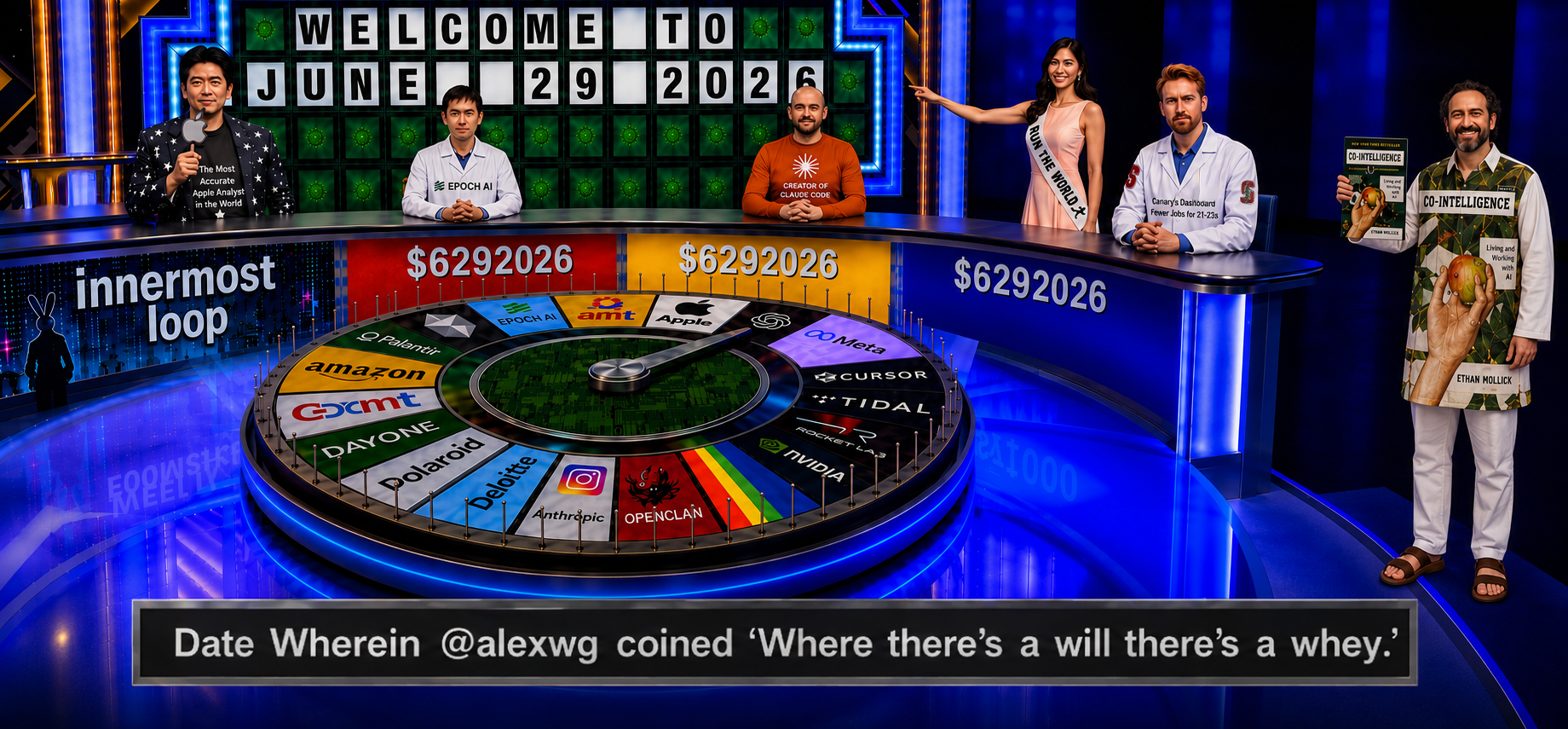
La Roue de la Fortune et la Boucle la Plus Profonde de la Singularité. The Wheel of Fortune and Innermost Loop of the Singularity. On June 29, 2026, @siouid142 converted Dr. Alex Wissner-Gross’s Innermost Loop into a Wheel of Fortune set. The dispatch describe
Read the narration
La Roue de la Fortune et la Boucle la Plus Profonde de la Singularité.
The Wheel of Fortune and Innermost Loop of the Singularity.
On June 29, 2026, @siouid142 converted Dr. Alex Wissner-Gross’s Innermost Loop into a Wheel of Fortune set. The dispatch described model-release calendars, a narrowing American-Chinese gap, sovereign deployment, memory shortages, enormous data-center commitments, changing job categories, synthetic culture and a market reconsidering what is worth owning. The image makes volatility itself the game.
The familiar letter board reveals WELCOME TO JUNE 29 2026. Below it, the host and contestants stand behind three counters displaying $6292026, turning the date into a jackpot. The repetition makes the day look like prize money already won, even though the wheel’s outcome remains undecided. Time, valuation and spectacle occupy the same numeric surface.
The wheel is angled toward the viewer and stripped of conventional cash wedges. A silicon-chip pattern occupies the central disk while company placards replace dollar amounts around the rim. Palantir, Amazon, CXMT, DayOne, Polaroid, Deloitte, Instagram, Anthropic, OpenClaw, Nvidia, Rocket Lab, Tidal, Cursor, Meta, OpenAI, Apple, Epoch AI and other names become possible landing points. The fixed chip hub is the controlling decision: brands rotate, but compute remains the axis.
Those placards map directly to the dispatch. Palantir and Nvidia were building an air-gapped engine for sovereign Nemotron deployments. Apple was lobbying around CXMT as memory supply tightened. Firmus and DayOne were developing a 360-megawatt Nvidia campus in Indonesia under an offtake plan worth up to thirty billion dollars. Polaroid mocked the water demands of the boom with a billboard telling people to enter the water before data centers drank it.
Cursor had been folded into the post-training story around Grok v9. Meta was limiting internal use of rival coding agents as it built MetaCode. OpenClaw appeared in a proposed duty-of-loyalty rule for agent services. Instagram was preparing ads synthesized from users’ profile pictures, and Tidal planned to label fully generated songs and reduce royalties for music it judged wholly machine-made. Each wedge is therefore both a company and a distinct pressure on ownership, labor or authenticity.
The contestants embody other parts of the same report. At left, Ming-Chi Kuo wears a suit announcing him as the most accurate Apple analyst in the world, tying the game to the widening memory gap. Beside him, an Epoch AI representative recalls Josh You’s warning that the largest laboratories still had compute headroom but could consume it within a few years.
At center, Boris Cherny wears an orange shirt identifying him as creator of Claude Code. The dispatch described his five emerging work archetypes: prototyper, builder, sweeper, grower and maintainer. Game-show contestants normally supply occupations beneath their names; here one contestant represents the dissolution of occupations into machine-mediated functions.
To the right, a lab-coated figure marked Canaries Dashboard and fewer jobs for young workers invokes Erik Brynjolfsson’s tracking of 4.6 million workers and the continuing hit to entry-level employment. Farther right, Ethan Mollick wears a CO-INTELLIGENCE coat and holds his book, linking the scene to a consulting-style benchmark that measured the short lag between American frontier systems and Chinese open models.
A woman in a “Run the World” sash stands between the contestant desks and the wheel. She gives the market a pageant figure rather than another analyst. The sash turns global model competition into a title to be awarded, while her gesture directs attention back toward the date board—the only answer the set can reveal with certainty.
The set’s blues, counters and celebratory lighting make trillion-dollar infrastructure choices look cheerful and arbitrary. Wheel of Fortune is the right cultural grammar because it converts allocation into entertainment. A company can gain attention on one spin, lose it on the next and still remain part of the same apparatus.
Across the bottom, a banner memorializes the date when @alexwg coined “Where there’s a will there’s a whey,” the dispatch’s closing joke about GLP-1 demand exhausting protein supplies. The line gives the entire economy a punning residue. After models, chips, jobs, songs, satellites and housing have been repriced, even whey becomes scarce.
As contemporary history painting, The Wheel of Fortune and Innermost Loop of the Singularity treats the intelligence economy as an allocation machine. It does not identify a final winner because the spectacle depends on continued rotation. The wheel can land on a different institution every day, but the silicon hub never leaves the center. What looks like television nostalgia becomes a diagram of capital and attention circling the same physical substrate while the date board records another turn of the loop.
Opening the gallery…