70 Clock Galerie / The Innermost Loop Feed Reply Tableaux
La Chine se Réveille, Starpipe et la Ford Thunderbird de Thelma et Louise de 1966
China is Waking Up, Starpipe, and the 1966 Thelma and Louise Ford Thunderbird
June 28, 2026
La Chine se Réveille, Starpipe et la Ford Thunderbird de Thelma et Louise de 1966. China is Waking Up, Starpipe, and the 1966 Thelma and Louise Ford Thunderbird. On June 28, 2026, @siouid142 transformed Dr. Alex Wissner-Gross’s Innermost Loop into an industria
Read the narration
La Chine se Réveille, Starpipe et la Ford Thunderbird de Thelma et Louise de 1966.
China is Waking Up, Starpipe, and the 1966 Thelma and Louise Ford Thunderbird.
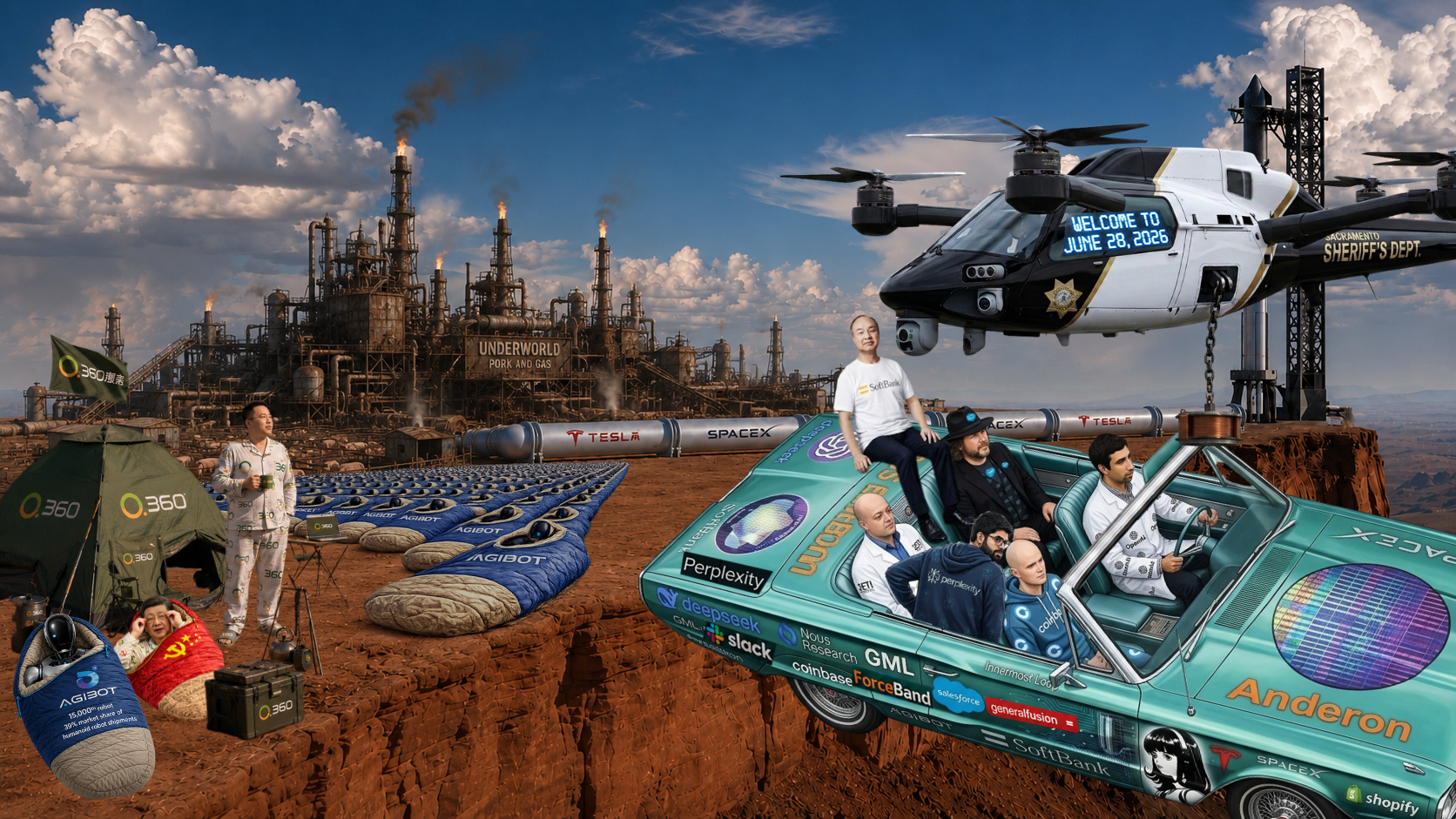
On June 28, 2026, @siouid142 transformed Dr. Alex Wissner-Gross’s Innermost Loop into an industrial road-movie cliffhanger. The day’s account of Chinese robotics, enterprise loop engineering, methane infrastructure, launch systems and drone intervention is organized around a famous car approaching an edge. The previously finished text-to-speech analysis remains the controlling core of this chapter.
This tableau for Welcome to June 28, 2026 is a masterfully dark, forensic explication of the Singularity’s current geopolitical and industrial stakes. By reframing the newsletter's themes through the lens of a waking China and a high-stakes cinematic rescue, the visual narrative captures the brutal speed of the current frontier.
The 360 command center, on the left, shows Zhou Hongyi of 360 in a tent, calmly having coffee, signaling the start of his firm’s waking efforts in the race to fill the Mythos-shaped hole. Nestled in the dirt are 15,000 AGIBOT units in sleeping bags, representing the massive scale of their 39 percent market share in humanoid shipments. The sleeping sovereign, Xi Jinping, is shown asleep in a branded China sleeping bag, a pointed visual metaphor for a nation that has finally woken up to the reality of the technological arms race, now ready to sprint toward capability parity.
In the background lies the Underworld industrial complex, modeled after the pig-methane factory from Mad Max. It serves as a stark, visceral reminder of the newsletter's discussion of exotic and abundant power generation. An eight-mile Starpipe connects this industrial underworld directly to the SpaceX launch site, illustrating the desperate, massive-scale effort to pump methane into the Starship launch ecosystem. The pipe runs horizontally across the scene like the material baseline beneath every software ambition.
The foreground vehicle is a direct reference to the 1966 Ford Thunderbird in Thelma & Louise. It is headed off a cliff, symbolizing the industry’s loop-engineering race toward an uncertain endgame. The car is driven by OpenAI’s Noam Brown, accompanied by Brian Armstrong of Coinbase, Marc Benioff of Salesforce, Andrew Siemion of the SETI Institute, Aravind Srinivas of Perplexity, and Masayoshi Son of SoftBank.
In a subversion of the original cinematic ending, the car is being saved by a Sacramento Sheriff’s drone, which uses a magnet to lift the vehicle from the air. This is a direct, satirical nod to the department's pioneering use of drones to disarm suspects. The magnet introduces a different final frame: acceleration does not have to end in impact if another machine can intervene quickly enough.
The vehicle is wrapped in the branding of the most disruptive players in the Singularity landscape. Beyond the passenger manifest, it displays Anderon, ForceBand, Perplexity, DeepSeek, Nous Research, GML, Slack, Coinbase, Salesforce, General Fusion, SoftBank, Shopify and other marks, serving as a comprehensive visual audit of the firms dominating the enterprise flywheel and loop-engineering economy. A wafer image fills the hood, making silicon the car’s literal engine cover.
The car’s crowded body matters formally. Companies, investors, researchers and institutions do not stand in a neat line; they are compressed into passengers and decals on one accelerating object. The composition shows an ecosystem whose members retain distinct identities but share trajectory, risk and dependence on the same rescue mechanism.
The contrast between sleep and speed organizes the entire scene. Xi and the AGIBOT field lie horizontal at left while the Thunderbird projects outward over open space at right. Zhou’s quiet coffee sits between them. “China is waking up” therefore unfolds as a sequence of states: dormant inventory, alert strategist, industrial complex, fuel pipe and vehicle in motion.
The industrial landscape also gives the phrase “atoms are catching up to bits” a physical body. Tents, sleeping robots, refinery towers, methane pipe, launch gantry, car, chain and magnet occupy nearly every layer. Software companies may dominate the names, but the image insists that acceleration ultimately requires steel, fuel, rotors and terrain.
The composition is a layered forensic audit of an era where atoms are catching up to bits. By replacing the tragic, inevitable death of Thelma & Louise with a technologically enabled rescue, it captures the central irony of the 2026 Singularity: the same agents that drive civilization toward the edge are also deploying automated shields to pull it back. The line between industrial disaster and miraculous rescue becomes a matter of who controls the magnet—and whether it arrives before momentum wins.
Opening the gallery…