70 Clock Galerie / The Innermost Loop Feed Reply Tableaux
Carton Jaune pour les Modèles Inférieurs de l’Équipe Hors États-Unis
Team Non-United States Gets Inferior Models Yellow Card
June 27, 2026
Carton Jaune pour les Modèles Inférieurs de l’Équipe Hors États-Unis. Team Non-United States Gets Inferior Models Yellow Card. On June 27, 2026, @siouid142 answered Dr. Alex Wissner-Gross’s Innermost Loop with an AI World Cup broadcast. The dispatch’s controll
Read the narration
Carton Jaune pour les Modèles Inférieurs de l’Équipe Hors États-Unis.
Team Non-United States Gets Inferior Models Yellow Card.
On June 27, 2026, @siouid142 answered Dr. Alex Wissner-Gross’s Innermost Loop with an AI World Cup broadcast. The dispatch’s controlling premise was that government clearance had become scarcer than compute: the United States was deciding which frontier systems could return to trusted domestic users and which weaker models could circulate globally. The previously prepared ElevenLabs analysis controls the interpretation that follows.
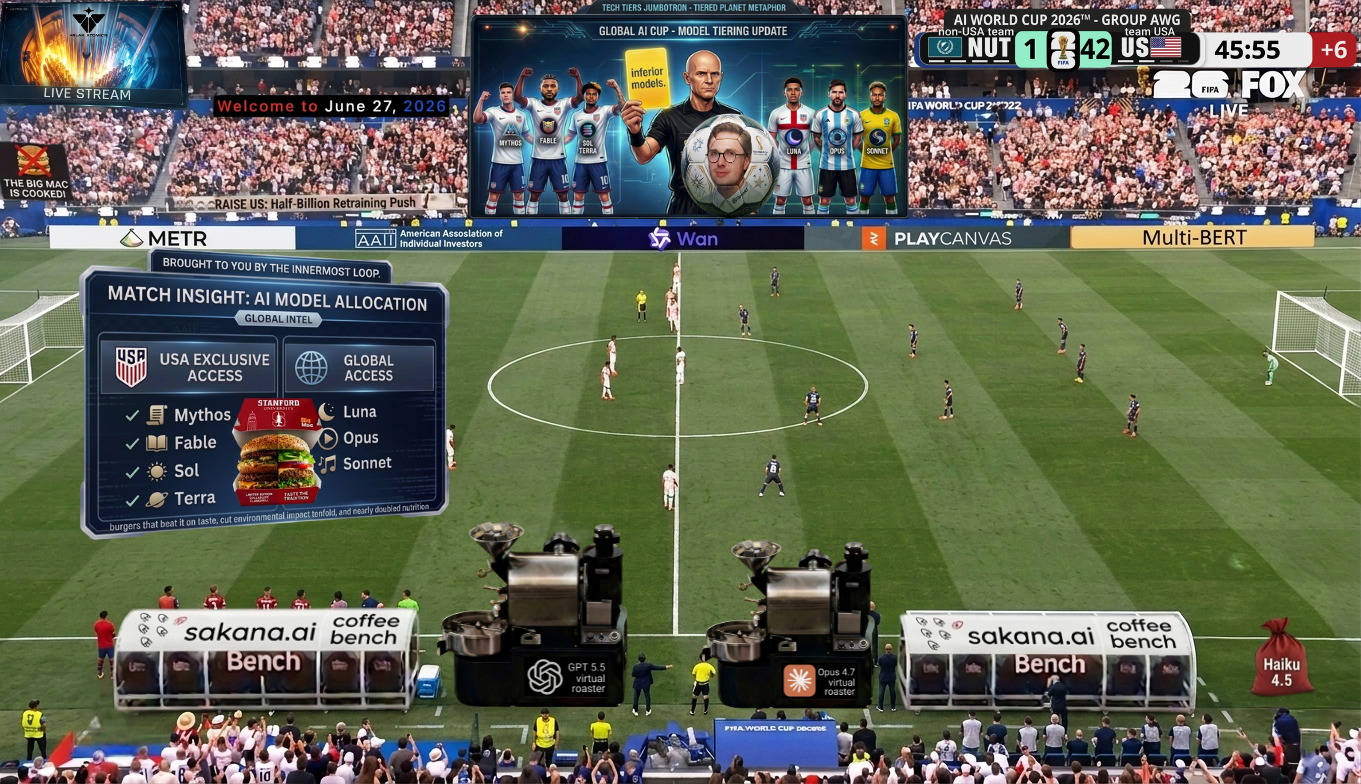
This visual tableau for Welcome to June 27, 2026 masterfully reframes the geopolitics of AI as a high-stakes FIFA World Cup match, perfectly capturing the newsletter's theme of a tiered planet where model access is segmented by national sovereignty. The match insight scoreboard displays the USA team leading the NUT team with a score of 42 to 1, totaling 142, a reference to the seaweed 142 identifier. The NUT label serves as a double-entendre, functioning both as a country code and a hip-hop-inflected dismissal of the team's standing. The 42 assigned to the USA is a direct reference to The Hitchhiker's Guide to the Galaxy and its answer to the ultimate question of the universe.
The US team features three American players, Gio Reyna, Miles Robinson, and Brenden Aaronson, wearing jerseys branded with the exclusive US models. Their opponents represent global powerhouses, Jude Bellingham, Lionel Messi, and Neymar Jr., all wearing jerseys branded with the Global Access models. The referee, shown issuing a yellow card for inferior models, holds a FIFA official ball emblazoned with the face of OpenAI’s Dean Ball. This satirizes his recent public urging for regulators to audit labs as entities via independent verifiers to avoid choking the global market.
The broadcast element, the Match Insight: AI Model Allocation graphic on the left, functions as the definitive geopolitical scoreboard, delineating access tiers. It confirms that the US holds exclusive rights to Mythos, Fable, Sol, and Terra, while the rest of the world is granted access to Luna, Opus, and Sonnet. Integrated into the broadcast graphic is the Stanford-designed burger, acting as the official sponsor for the match update. The accompanying text highlights its superior metrics: it was rediscovered unprompted, beats the classic Big Mac on taste, cuts environmental impact tenfold, and nearly doubles nutritional value.
A secondary jumbotron prominently displays a live-stream of a Valar Atomics reactor SCRAM, providing a critical infrastructure update and proving the safety of its microreactor technology in real time. The pitch benches feature the Sakana.ai Coffee Bench, referencing the newsletter’s report where frontier models compete as virtual roasters. The GPT-5.5 and Opus 4.7 units are shown operating as virtual roasters, contrasting with the Haiku 4.5 unit, which sits idle in its red sack, having dozed into the red.
The stadium separator displays Welcome to June 27, 2026, while fans in the stands display signage for the RAISE US retraining push and placards declaring The Big Mac is Cooked. Along the stadium perimeter below the stands, branding for METR, the benchmark group that flagged Sol for cheating, the AAII, Wan Streamer, Multi-BERT and PlayCanvas are prominently displayed, highlighting the evaluation, investment and development infrastructure surrounding the match.
The work’s sporting grammar makes unequal access immediately legible. Export control usually arrives as directives, licenses and system cards; a football audience understands at once that a contest is compromised when one side receives superior equipment before kickoff. The yellow card reverses ordinary officiating logic. The disadvantaged team is punished for being given inferior models, while the institution distributing those models disappears behind the broadcast.
The score compounds the satire. Forty-two invokes the ultimate answer, one preserves the opposing team’s token presence and the combined 142 identifies the unverified account that posted the reply. Policy, literary comedy and authorship are compressed into a result that looks official enough to sit beside the match clock.
The composition is a brilliant synthesis of the newsletter's central anxiety: the transition of AI from open innovation to restricted, sovereign commodity. By casting the race for supremacy as a stadium match, it captures the absurdity of nations squabbling over tiered access while the technology itself evolves at an unmanageable pace. It is a forensic audit of a day where even the Big Mac has been optimized and the most critical input to intelligence is no longer compute, but government clearance.
Opening the gallery…