70 Clock Galerie / The Innermost Loop Feed Reply Tableaux
Les Arbres Sont Gratuits au Québec
Trees Are Free in Quebec
June 25, 2026
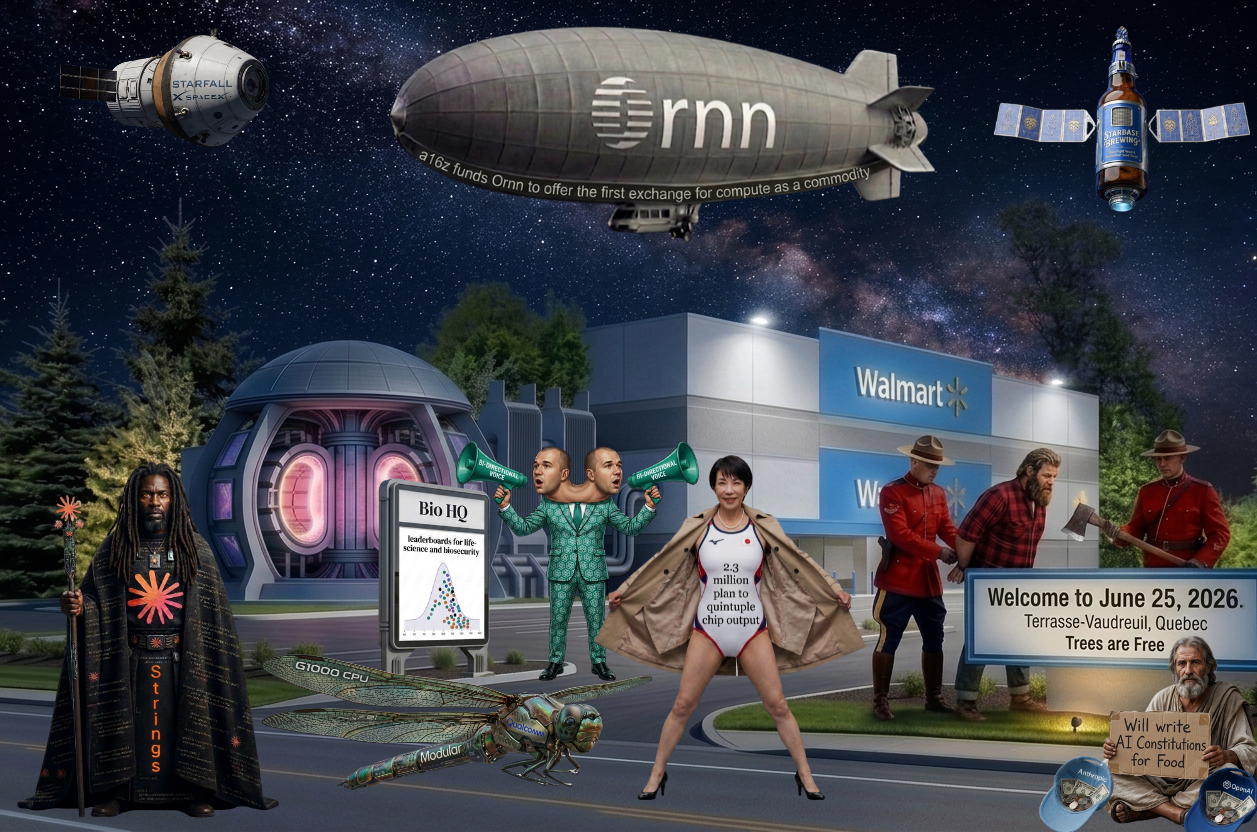
Les Arbres Sont Gratuits au Québec. Trees Are Free in Quebec. On June 25, 2026, @siouid142 placed Dr. Alex Wissner-Gross’s Innermost Loop in a Walmart parking lot at Terrasse-Vaudreuil, Quebec. The dispatch connected self-editing agents, bidirectional voice, A
Read the narration
Les Arbres Sont Gratuits au Québec.
Trees Are Free in Quebec.
On June 25, 2026, @siouid142 placed Dr. Alex Wissner-Gross’s Innermost Loop in a Walmart parking lot at Terrasse-Vaudreuil, Quebec. The dispatch connected self-editing agents, bidirectional voice, AI-assisted physics, biological design, chip industrial policy, compute markets, nuclear power, robotics, neural interfaces, orbital manufacturing and newly recognized rights for trees. The image makes the town’s legal declaration the roadside sign around which the whole technical economy gathers.
The sign reads Welcome to June 25, 2026, Terrasse-Vaudreuil, Quebec, Trees are Free. The title does not mean that timber costs nothing. It converts the town’s recognition of trees as living beings, with rights to life, natural growth, integrity and regeneration, into the language of liberation. Two Mountie-like officers restrain a plaid lumberjack holding an axe and log, turning the conflict between extraction and the widened circle of rights into a comic arrest.
Behind them, a glowing nuclear structure is physically attached to Walmart. That adjacency answers the report that Walmart signed its first nuclear deal. A familiar retail box acquires a reactor-like annex because data-center energy demand is no longer remote infrastructure; it is entering the architecture of ordinary commerce.
Above the store, an Ornn dirigible announces that a16z funds the first exchange for compute as a commodity. Its gray hull places pricing and finance over the supposedly free forest. The scene’s cost argument is therefore exact: trees may be liberated in law, but computation still requires chips, markets, networks, power contracts and measurement.
At left, a robed figure marked Strings stands like a prophet. His staff and garment refer both to Claude-assisted generalization of an entanglement-wedge calculation and to new Claude Code strings that appeared to foretell Fable’s return to subscriptions. The source discussion deliberately made him a “prophet of the Singularity,” converting software strings and theoretical physics into one oracular costume.
Beside him, a Bio HQ board advertises leaderboards for life science and biosecurity. The display recalls Nvidia’s BioNeMo Agent Toolkit and the accelerating conversion of biomolecular models into callable skills. Biological discovery enters the parking lot as a performance metric, another field made ready for ranking.
A giant mechanical dragonfly carries Dragonfly C1000 CPU, Qualcomm and Modular markings. Qualcomm’s purchase of Modular and its custom-inference push against CUDA become an insect whose wings are chips. The motif makes hardware competition look evolutionary: the new processor does not sit in a rack but arrives as a species adapted to the compute ecology.
At center, Japanese prime minister Sanae Takaichi opens a trench coat in a theatrical reveal. Her bodysuit carries the figure for a 2.3-trillion-dollar plan to quintuple Japan’s chip output. The joke comes from the dispatch’s language of unveiling. Industrial policy, normally presented through podiums and charts, is flashed at the viewer as an enormous national commitment worn on the body.
Nearby, a green figure has two heads and two megaphones labeled Bi-Directional Voice. This connects directly to Greg Brockman’s preview of a system that can process input while speaking. The anatomy is not a generic political symbol; it gives simultaneous listening and talking separate mouths, turning an interface feature into a divided but coordinated body.
At lower right, a disheveled Aristotle-like philosopher holds a sign reading “Will write AI Constitutions for Food.” OpenAI and Anthropic bowls sit at his feet like begging hats. The dispatch noted that frontier labs were hiring philosophers to write constitutions for models. The image grants philosophy new technical authority while portraying its practitioner as economically precarious, valued for moral language but left outside the institutions purchasing it.
The sky extends the audit into orbit. A Starfall reentry capsule represents cargo return and orbital manufacturing. A Starbase Brewing bottle with solar-panel wings refers to yeast strains and Texas bluebonnet seeds flown to study spaceflight. Playful payload and industrial capsule share the same route, showing orbital infrastructure becoming both factory and cultural laboratory.
As contemporary history painting, Trees Are Free in Quebec treats the mundane roadside as the frontier’s true stage. The Walmart remains recognizable, the sign remains legible and the trees stay physically quiet while engineered objects crowd every other layer. That silence gives the title its force. The technologies announce their prices, plans and capabilities; the forest’s claim is simpler. It asks to be allowed to continue growing.
Opening the gallery…