70 Clock Galerie / The Innermost Loop Feed Reply Tableaux
Boîtes de Soupe Persistantes et Asynchrones
Persistent, Asynchronous Soup Cans
June 24, 2026
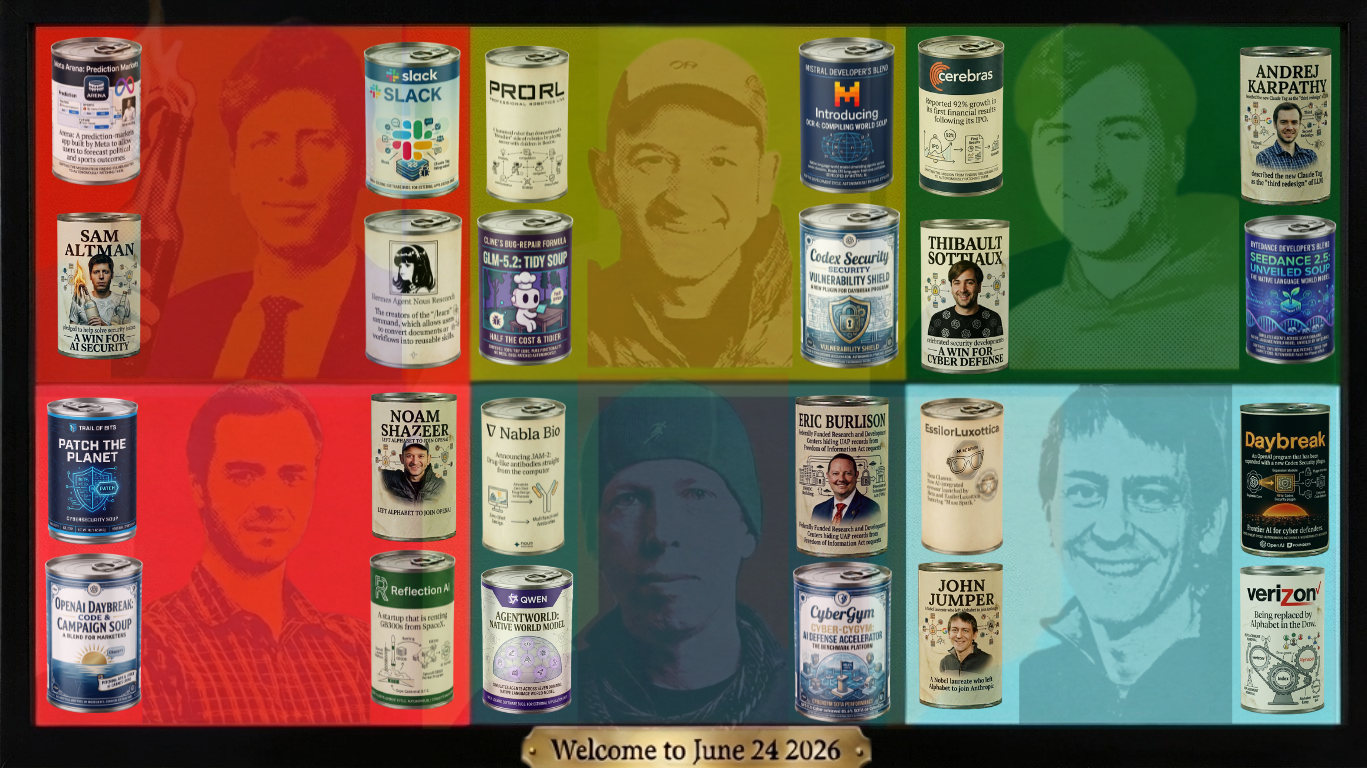
Boîtes de Soupe Persistantes et Asynchrones. Persistent, Asynchronous Soup Cans. On June 24, 2026, @siouid142 transformed Dr. Alex Wissner-Gross’s Innermost Loop into a Pop Art supermarket wall. The dispatch described agents becoming persistent, asynchronous c
Read the narration
Boîtes de Soupe Persistantes et Asynchrones.
Persistent, Asynchronous Soup Cans.
On June 24, 2026, @siouid142 transformed Dr. Alex Wissner-Gross’s Innermost Loop into a Pop Art supermarket wall. The dispatch described agents becoming persistent, asynchronous colleagues: Claude could be tagged in Slack, continue working on Opus 4.8 and return later, while tools learned reusable skills and software systems began patching bugs in bulk. The image uses Andy Warhol’s soup-can grammar because persistence and repetition are already built into the form.
Rows of pull-tab cans stand before blocks of red, yellow, green and blue. Enlarged halftone portraits fill the background, but the cans remain the foreground’s repeated unit. People, companies, models, programs and research projects all receive the same cylindrical body and metal lid. The different names are reduced to flavors in one shelf-stable category.
That standardization is the technical joke. A persistent agent remains available after a particular conversation ends; an asynchronous process continues without requiring a human to stay in the session. Likewise, a canned product waits in inventory until called. Warhol’s multiplication of consumer packaging turns a change in software architecture into something the viewer already understands spatially: stocked, repeatable services lined up for use.
The upper shelf includes Meta Arena, Slack, ProRL, Mistral Developer’s Blend, Cerebras and Andrej Karpathy. Arena refers to Meta’s prediction-market experiment, where Llama would help create and settle forecasts. Slack is the workplace surface into which Claude Tag entered. Karpathy’s description of the “persistent, asynchronous entity” gives the title its human-computer interface argument.
Sam Altman appears as his own soup label near cans for Hermes Agent House Research and GLM-5.2 Tidy Soup. The latter recalls Cline’s real-repository comparison in which GLM cost less and produced tidier work while Opus finished faster but left type errors. Packaging a benchmark result as soup converts coding style, cost and speed into competing recipes.
Codex Security and Daybreak represent the shift from finding vulnerabilities to autonomously repairing them. A Trail of Bits can says PATCH THE PLANET, turning an open-source security mission into a mass-market promise. Thibault Sottiaux’s can marks what he called a celebration for cyber-defense acceleration. CyberGym appears elsewhere on the shelf as the benchmark against which the new model’s security performance was measured.
Noam Shazeer and John Jumper receive individual cans because talent itself was treated as scarce capital. Their departures for OpenAI and Anthropic accompanied Alphabet’s quarter-trillion-dollar market loss. By placing people in the same package as companies and products, the image shows how the market converts a researcher’s biography into an institutional ingredient.
The lower rows extend the inventory through Nabla Bio, Reflection AI, Qwen AgentWorld, EssilorLuxottica, Eric Burlison, ByteDance’s Seedance 2.5 and Verizon. Nabla Bio indexes rapid antibody design; AgentWorld describes simulated language-native worlds; Meta Glasses turn AI into something worn on the face; Burlison brings the UAP-records dispute into the shelf; and Seedance stretches generated video through longer clips and many references.
Alphabet and Verizon become adjacent labels because Alphabet was replacing Verizon in the Dow. Elsewhere, Europe’s digital-euro plan and Meta’s Arena prediction market made money and forecasting programmable. The can wall therefore inventories not only software but the institutions through which value, trust and attention are being reformatted.
The portraits behind the products complicate the apparent uniformity. Faces remain enlarged and individually recognizable, yet the packaged names stand in front of them. A person becomes background image while a branded service becomes the object available for purchase. Pop Art once asked whether celebrity and commodity could still be separated; the Singularity shelf updates the question for founders, researchers and agents.
A brass plaque reading Welcome to June 24 2026 sits beneath the display like a museum label attached to a grocery aisle. The date prevents the repetition from becoming timeless decoration. This is the inventory of one specific dispatch, assembled when agents, markets, talent and infrastructure were changing category at once.
As contemporary history painting, Persistent, Asynchronous Soup Cans uses humor analytically. The work does not say that every model or scientist is interchangeable. It shows the institutional pressure to make them appear continuously available, consistently branded and easy to consume. The cans remain separate, but the shelf makes them comparable. In that conversion, the promise of an agent that always stays on the job becomes inseparable from the market fantasy of intelligence as an endlessly restockable product.
Opening the gallery…