70 Clock Galerie / The Innermost Loop Feed Reply Tableaux
Indices de Prix des Jetons Ornn – Le Premier Indice de Prix des Jetons IA
Ornn Token Price Indices – The First AI Token Price Index
June 15, 2026
Indices de Prix des Jetons Ornn – Le Premier Indice de Prix des Jetons IA. Ornn Token Price Indices – The First AI Token Price Index. Catalogued June 15, 2026, this work responds to a separate announcement by Dr. Alex Wissner-Gross rather than to a conventiona
Read the narration
Indices de Prix des Jetons Ornn – Le Premier Indice de Prix des Jetons IA.
Ornn Token Price Indices – The First AI Token Price Index.
Catalogued June 15, 2026, this work responds to a separate announcement by Dr. Alex Wissner-Gross rather than to a conventional daily Innermost Loop dispatch. The surviving design discussion was recorded the following day. Wissner-Gross announced the Ornn Token Price Indices, or OTPI, as the first benchmarks intended to price frontier-lab inference tokens from executed transactions rather than posted rate cards. @siouid142 gave that invisible market a single public vessel.
The distinction between compute and tokens governs the work. The Ornn Compute Price Index measures the input side of the AI economy: rented GPU capacity such as H100, H200, B200 and RTX 5090 time. OTPI measures the output side: the realized dollars paid per million inference tokens after caching, routing, input-output differences and customers’ changing mix of premium and budget models.
For each lab, the proposed index weights models by paid token volume and divides total dollars by total tokens. That makes it a unit-value index whose composition moves with the market. A posted rate is a seller’s declaration; a transacted price is a discovery. The announcement compared this gap to commodity history, when standard units and realized prices made previously inconsistent trades comparable.
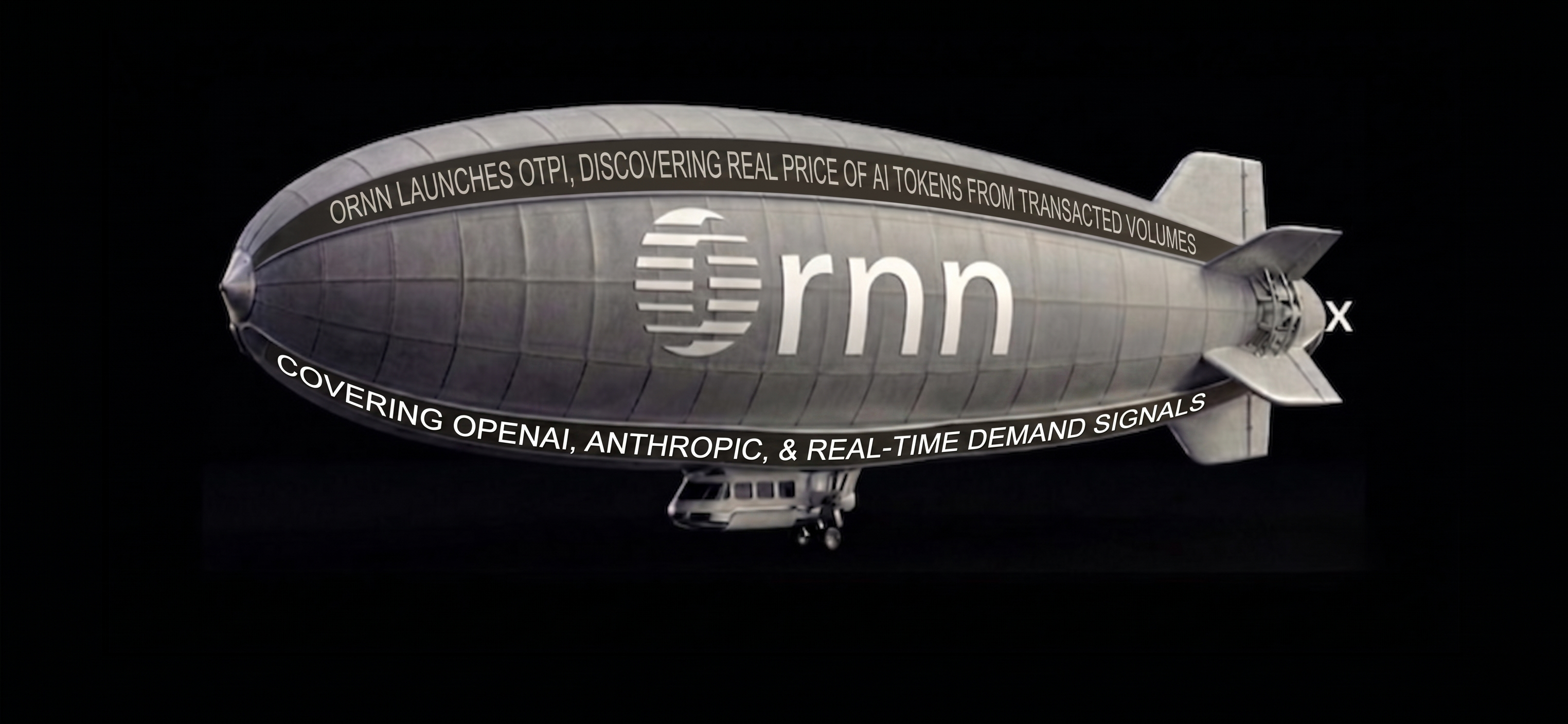
The airship invents an icon for a commodity that has no barrel, coin or silo. Its gray envelope suggests stored capacity and standardized volume, while the gondola and fins keep the abstraction attached to an operating machine. The index floats, but it is not weightless. It requires executed traffic, data collection, methodology and continuing demand to remain aloft.
Across the upper hull runs the announcement: “ORNN LAUNCHES OTPI, DISCOVERING REAL PRICE OF AI TOKENS FROM TRANSACTED VOLUMES.” The lower band reads, “COVERING OPENAI, ANTHROPIC, AND REAL-TIME DEMAND SIGNALS.” Those sentences were chosen in the creation discussion as the shortest complete statement of method, coverage and purpose. Typography becomes the airship’s structure rather than a caption placed outside it.
The Ornn mark occupies the center like an exchange seal. With no landscape, cast or date marquee competing for attention, branding behaves as industrial heraldry. The black field turns the dirigible into announcement, charter and monument at once. It resembles a vintage advertisement for a future commodity market, an object from an era that has only just acquired its unit of account.
The recurring airship also connects OTPI to earlier Ornn imagery surrounding GPU pricing and futures. Reusing the vessel matters because benchmarks gain authority through continuity. The hull can carry new information while remaining recognizable as the institution tasked with navigating price discovery. In later daily tableaux, the same dirigible will appear overhead as infrastructure rather than protagonist.
The announcement’s commodity history deepens the airship metaphor. Oil could not become a consistent market until producers standardized the barrel at forty-two gallons; a price index likewise requires a unit and a method for weighting observations. Bishop William Fleetwood could average historical prices in 1707, while Laspeyres and Paasche later formalized weighted baskets. OTPI chooses another route by allowing the live model mix to enter the number. The moving airship is therefore more apt than a fixed monument: its composition changes as paid traffic moves.
The work does not claim that a benchmark guarantees accuracy, liquidity or permanence. It visualizes the ambition expressed by the launch: enterprises budgeting AI use, investors testing demand and labs comparing monetization could consult a number grounded in paid inference. Because volume weighting reveals how traffic migrates among models after a release, the index also gestures toward a demand signal normally hidden inside providers.
As contemporary institutional art, Ornn Token Price Indices – The First AI Token Price Index makes measurement itself the event. Compute is what the AI economy buys; tokens are what it sells. The airship gives the output side a body large enough to be seen before the market has settled around it. Its humor lies in treating a methodology like a majestic public launch. Its seriousness lies in the proposition beneath the spectacle: abundance must still be measured, and the price of intelligence cannot be discovered by reading the menu when the real transaction is happening elsewhere.
Opening the gallery…