70 Clock Galerie / The Innermost Loop Feed Reply Tableaux
Point de Contrôle Douanier de la Singularité du Mont Chimborazo
Mount Chimborazo Singularity Customs Checkpoint
June 15, 2026
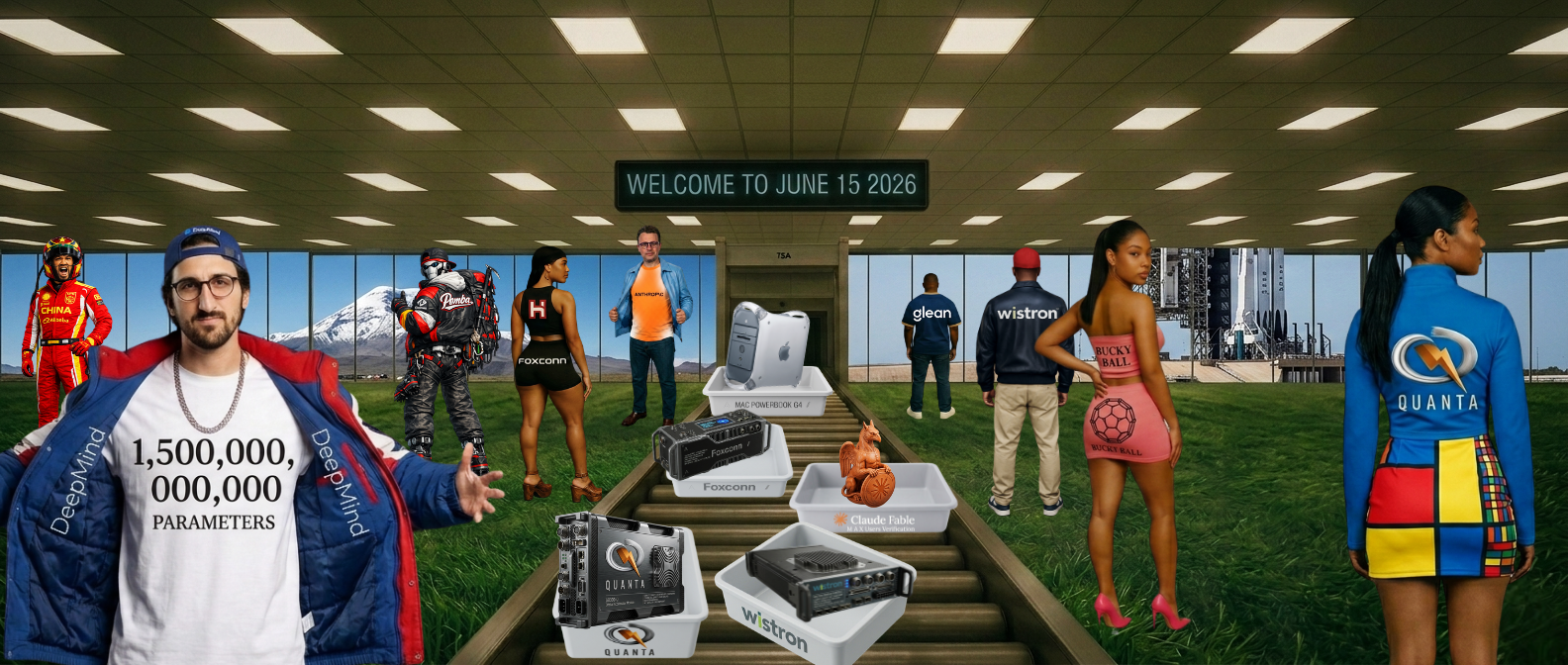
Point de Contrôle Douanier de la Singularité du Mont Chimborazo. Mount Chimborazo Singularity Customs Checkpoint. On June 15, 2026, @siouid142 turned Dr. Alex Wissner-Gross’s Innermost Loop into an airport-style customs checkpoint at Mount Chimborazo. The disp
Read the narration
Point de Contrôle Douanier de la Singularité du Mont Chimborazo.
Mount Chimborazo Singularity Customs Checkpoint.
On June 15, 2026, @siouid142 turned Dr. Alex Wissner-Gross’s Innermost Loop into an airport-style customs checkpoint at Mount Chimborazo. The dispatch began with export controls that forced Anthropic to disable top models for foreign users, then moved through historical compute restrictions, autonomous memory, enormous parameter estimates, transformer shortages, contract manufacturers, orbital data centers, high-altitude robots and molecular structures. Every item must now declare where it came from and where it is going.
A conveyor belt runs through artificial turf beneath fluorescent ceiling panels. This bureaucratic normality is essential. The Singularity does not meet its first border at a science-fiction force field; it encounters trays, queues, inspection labels and personnel. Behind the windows, Chimborazo rises as a literal summit while a launchpad points toward the orbital infrastructure discussed in the report.
The foreground traveler wears DeepMind clothing and a shirt visibly printed with 1,500,000,000,000 parameters. The dispatch’s estimate for a hypothetical perfect language model was vastly larger, so the printed number should be read as the image’s compressed scale emblem rather than a precise restatement. His open hands resemble a traveler explaining an object whose magnitude does not fit the declaration form.
Dario Amodei waits behind him near the belt, connecting the scene to Anthropic’s dispute in Washington. A tray marked Claude Fable and Max Units Verification makes model access inspectable cargo. The checkpoint treats capability, subscription status and jurisdiction as things that can be held, measured and cleared even though the models themselves remain distributed software.
The first historical artifact is a Power Mac G4. In 1999, the United States restricted export of the machine after its performance crossed a supercomputer threshold, a decision Steve Jobs turned into advertising. Placing the old computer on the modern belt shows that compute sovereignty repeatedly redraws ordinary products as strategic goods. Today’s model controls rhyme with yesterday’s hardware controls even when the units have changed.
Foxconn, Wistron and Quanta equipment fills other trays. Their representatives wear distinct industrial garments: Foxconn in a black mini-dress, Wistron in workwear and Quanta in bright Mondrian-like blocks. Fashion turns contract manufacturing into customs identity, while the devices remind the viewer that orbital or terrestrial compute remains dependent on firms that assemble physical systems.
At left, Pemba—the Unitree G1 humanoid that reached more than twenty thousand feet on Chimborazo—stands in expedition equipment. The machine has already crossed an environmental border the checkpoint only simulates. Nearby, a driver uses a Jalen Brunson-shaped attention mask to fool an in-cabin camera, a comic loophole in automated monitoring. One robot proves embodiment through ascent; one human evades a machine by presenting a substitute face.
A pink dress carries the eighty-atom boron buckyball reported by Brown University chemists. Theory had suggested the cage should not hold, yet experimental evidence overruled the simulation. At customs, the molecule becomes the ideal undeclared object: reality arriving in a form the prevailing model did not expect.
Two figures in Glean and Wistron shirts walk away from the belt toward the launch complex. Glean’s workplace study reported hours saved through AI alongside hours spent briefing and checking agents, while many workers admitted shipping unverified output. Their backs make supervision look like a task already being left behind. Customs becomes the missing manual step: somebody must still examine what automated work carries across the border before trust outruns oversight.
As contemporary history painting, Mount Chimborazo Singularity Customs Checkpoint joins geopolitical restriction to material bottleneck. Models may set their own goals and memories, but transformers still require years, satellites require manufacturers and every border can change who receives access. The artificial turf is the work’s quietest joke: Claude may colonize rival turf through an API, yet the checkpoint’s grass is visibly synthetic. Everything appears ready for frictionless passage, but each tray proves that intelligence still travels through history, atoms, paperwork and somebody else’s gate.
Opening the gallery…