70 Clock Galerie / The Innermost Loop Feed Reply Tableaux
Il y a Toujours une Meilleure Voie – Du Silicium, Pas des Incendiaires – Dresde
There Is Always a Better Way – Silicon Not Incendiaries – Dresden
June 13, 2026
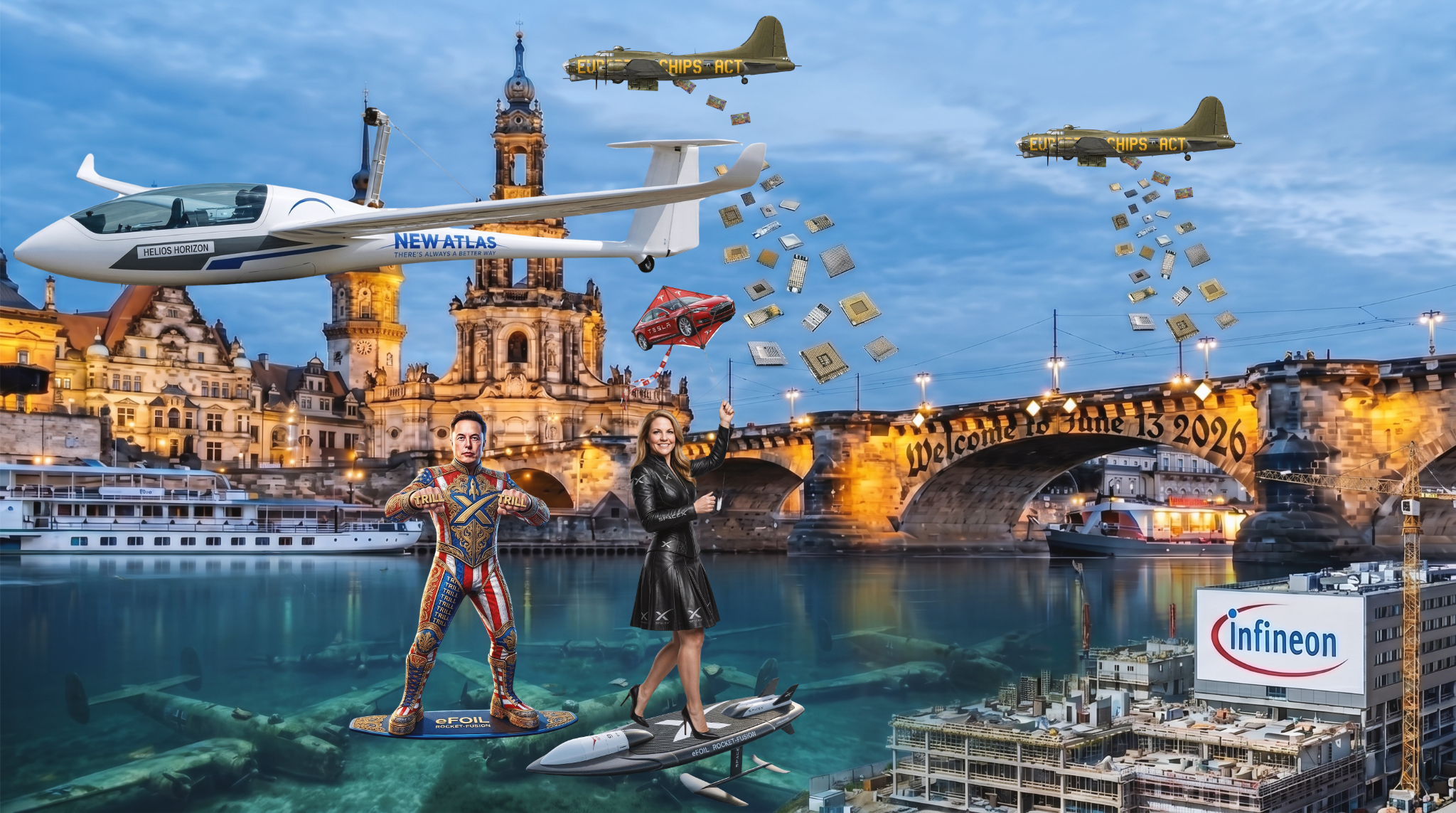
Il y a Toujours une Meilleure Voie – Du Silicium, Pas des Incendiaires – Dresde. There Is Always a Better Way – Silicon Not Incendiaries – Dresden. On June 13, 2026, @siouid142 responded to Dr. Alex Wissner-Gross’s Innermost Loop with a deliberately difficult
Read the narration
Il y a Toujours une Meilleure Voie – Du Silicium, Pas des Incendiaires – Dresde.
There Is Always a Better Way – Silicon Not Incendiaries – Dresden.
On June 13, 2026, @siouid142 responded to Dr. Alex Wissner-Gross’s Innermost Loop with a deliberately difficult counterfactual over Dresden. The dispatch described Europe’s industrial bid for technological sovereignty: Infineon’s five-billion-euro Smart Power Fab, supported by roughly one billion euros from the EU Chips Act. The artwork borrows the silhouette of wartime bombers but reverses their payload. Integrated circuits fall over an intact city instead of incendiaries.
The historical reference carries unavoidable weight. Dresden’s destruction cannot be repaired by a visual pun, and the image does not claim semiconductor investment is morally equivalent to wartime violence. Its proposition is an inversion: technical capacity can be organized to build rather than burn. The title, There Is Always a Better Way, makes that ethical distinction explicit before the aircraft enter view.
Two olive bombers cross the sky with EU CHIPS ACT written along their fuselages. Beneath each, processors and circuit packages descend in orderly columns. Their recognizable military form creates discomfort, while the harmless cargo changes what power from above means. Industrial policy becomes a supply drop, and silicon becomes the material through which Europe hopes to secure data centers, transportation and energy systems.
Below, Dresden remains illuminated and alive. The Augustus Bridge crosses the Elbe, and church towers rise behind it. “WELCOME TO JUNE 13 2026” appears across the bridge in blackletter, joining the date to the city’s older visual language. Boats, warm windows and reflected stone insist that infrastructure is valuable because people and places continue beneath it.
At lower right, the Infineon construction site gives the silicon rain a destination. Cranes and unfinished structures turn the dispatch’s five-billion-euro investment into a physical horizon. The fab is not represented as an abstract grant or corporate logo; it is a building under construction whose future output depends on policy, labor, energy and time.
A white Helios Horizon glider marked NEW ATLAS and “There’s always a better way” crosses the left sky. The dispatch described test pilot Miguel Iturmendi flying the first crewed fixed-wing aircraft powered by solid-state batteries at roughly 410 watt-hours per kilogram. The glider supplies a second kind of flight: quiet lift achieved through improved energy density rather than destructive payload.
On the river, Elon Musk and Gwynne Shotwell ride eFoils branded ROCKET-FUSION. Musk’s ornate suit repeats TRILL around a large X, referring to SpaceX’s market debut making him the first trillionaire in the dispatch’s scenario. Shotwell points upward after hinting that a Tesla relationship might make Musk’s life easier. A red Tesla hangs above them in a kite-like frame, linking electric mobility, aerospace capital and the silicon falling through the same corridor.
Their playful poses deliberately occupy the lowest, safest layer of the composition, skimming the river while bomber silhouettes remain overhead. This vertical ordering does not absolve concentrated technological power; it asks what direction that power takes. The same engineering culture can build vehicles, fabs and energy systems or place coercive capacity in the sky. “Better” is therefore not an automatic property of innovation. It is the repeated choice to redirect capability toward mobility, fabrication and civic continuity.
The eFoils skim above water, the glider floats without combustion and the chips descend without fire. These motions create alternatives to the bomber’s inherited trajectory. Energy density and power semiconductors connect aircraft, cars and watercraft at the component level, while the image connects them through shared vertical space.
As contemporary history painting, There Is Always a Better Way – Silicon Not Incendiaries – Dresden tests whether an image can reuse a destructive form without accepting its purpose. The bombers remain ominous because history remains present; the silicon is hopeful because the payload has changed. Dresden is not reduced to a backdrop for innovation. It becomes the place where the difference between capacity and intention must stay visible. Technical sovereignty matters, the work argues, only when the means built in the sky and fab are directed toward keeping the city illuminated rather than making it burn.
Opening the gallery…