70 Clock Galerie / The Innermost Loop Feed Reply Tableaux
Charbon Propre Minecraft, Lithium Lazarus, Dario Apprend à Diriger et Mafia Luckey
Clean Coal Minecraft, Lazarus Lithium, Dario Learning to Steer and Luckey Mafia
June 5, 2026
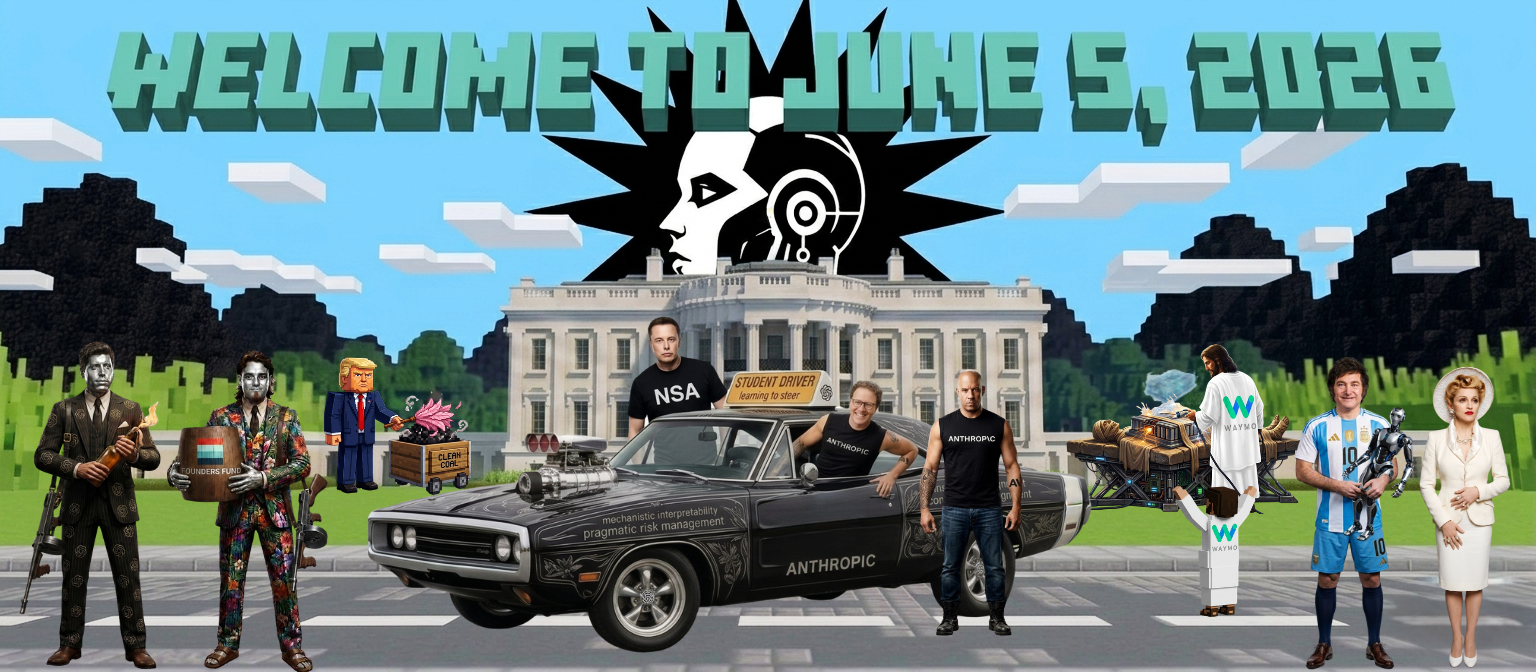
Charbon Propre Minecraft, Lithium Lazarus, Dario Apprend à Diriger et Mafia Luckey. Clean Coal Minecraft, Lazarus Lithium, Dario Learning to Steer and Luckey Mafia. On June 5, 2026, @siouid142 answered Dr. Alex Wissner-Gross’s Innermost Loop with a playable se
Read the narration
Charbon Propre Minecraft, Lithium Lazarus, Dario Apprend à Diriger et Mafia Luckey.
Clean Coal Minecraft, Lazarus Lithium, Dario Learning to Steer and Luckey Mafia.
On June 5, 2026, @siouid142 answered Dr. Alex Wissner-Gross’s Innermost Loop with a playable sequel assembled from Minecraft, The Fast and the Furious, Mafia and biblical resurrection. The dispatch’s governing claim was that the Singularity had started writing its own sequel: Anthropic reported AI accelerating AI development while institutions struggled to preserve a verifiable brake. The image turns recursive self-improvement into a world whose genres and energy systems can all be edited.
At center, Dario Amodei drives a 1970 Dodge Charger R/T, the car associated with Vin Diesel’s Fast and Furious mythology. The body is marked “mechanistic interpretability” and “pragmatic risk management,” while a roof sign reads “Student Driver: learning to steer.” The phrase comes from the report that models were improving at steering research after human researchers reached dead ends. Speed and control become the same problem.
An NSA representative rides in the passenger seat, referring to Anthropic engineers embedded with the agency to direct models toward offensive cyber threats. Vin Diesel stands beside the Charger in Anthropic clothing and tattoos. His presence supplies the franchise’s acceleration grammar, but the student-driver sign prevents velocity from being mistaken for mastery. The most powerful car in the scene is still learning where to go.
At lower left, Sam Altman and Palmer Luckey appear as characters from the Mafia game that Founders Fund filmed them playing. Altman wears gangster clothing and holds a Molotov cocktail, a callback to the reported attack on his home rather than an allegation that he committed violence. Luckey keeps his recognizable Hawaiian pattern inside prohibition-era tailoring and carries a Founders Fund cask. Venture capital becomes the gang’s supply barrel.
Above them, a pixelated Donald Trump dusts a block labeled CLEAN COAL with a pink feather duster. The joke translates the White House’s emergency support for coal into Minecraft maintenance. A politically loaded energy source becomes a block that can be cleaned cosmetically because the level still needs power. The plume of recursion may be digital, but the server world remains dependent on the grid.
At right, a Waymo-robed figure plugs retired robotaxi batteries into Lazarus. The biblical body is wrapped in gauze, and a lithium battery rises from the torso. The dispatch reported that retired Waymo batteries could return as hundreds of megawatts of grid storage. Resurrection is therefore functional rather than sentimental: the battery receives a second life by changing jobs.
Javier Milei stands with a humanoid robot in the pose of a trophy bearer, his intentionally messy clothing ending in formal socks and dress shoes. Argentina’s proposed legal home for autonomous non-human corporations becomes a national prize held in public. Madonna appears beside him as Evita, allowing the dispatch’s Argentina conclusion to enter through theatrical memory: “Don’t cry for me” becomes a chorus for legal personhood granted to machine agents.
Minecraft clouds, blocky trees and a pixelated White House establish a world whose elements appear replaceable. Yet the Charger, cask, batteries and coal remain stubbornly material. This is the image’s critical balance. Recursive intelligence may rewrite software rapidly, but its sequel still requires fuel, storage, capital, law and national-security access.
The enormous “WELCOME TO JUNE 5, 2026” lettering behaves like a game title announcing a new expansion. Beneath it, each storyline looks modular enough to be added or removed: coal block, racing car, venture gang, resurrected battery and non-human corporation. That apparent modularity mirrors the dispatch’s anxiety. When AI begins improving the systems that improve AI, institutions may experience policy, energy and commerce as levels loaded into a sequel already running faster than their ability to review it.
As contemporary history painting, Clean Coal Minecraft, Lazarus Lithium, Dario Learning to Steer and Luckey Mafia records acceleration through genres already built around construction, speed, organized power and return from death. Each citation performs a specific task. Minecraft makes the world editable, Fast and Furious gives recursion a throttle, Mafia gives venture culture a crew, and Lazarus gives grid storage a second life. The sequel is exhilarating because its authors can modify the level; it is dangerous because the student driver is already on the road while everyone else keeps the throttle pinned.
Opening the gallery…