70 Clock Galerie / The Innermost Loop Feed Reply Tableaux
Mathématiciens Assiégés
Mathematicians Under Siege
June 3, 2026
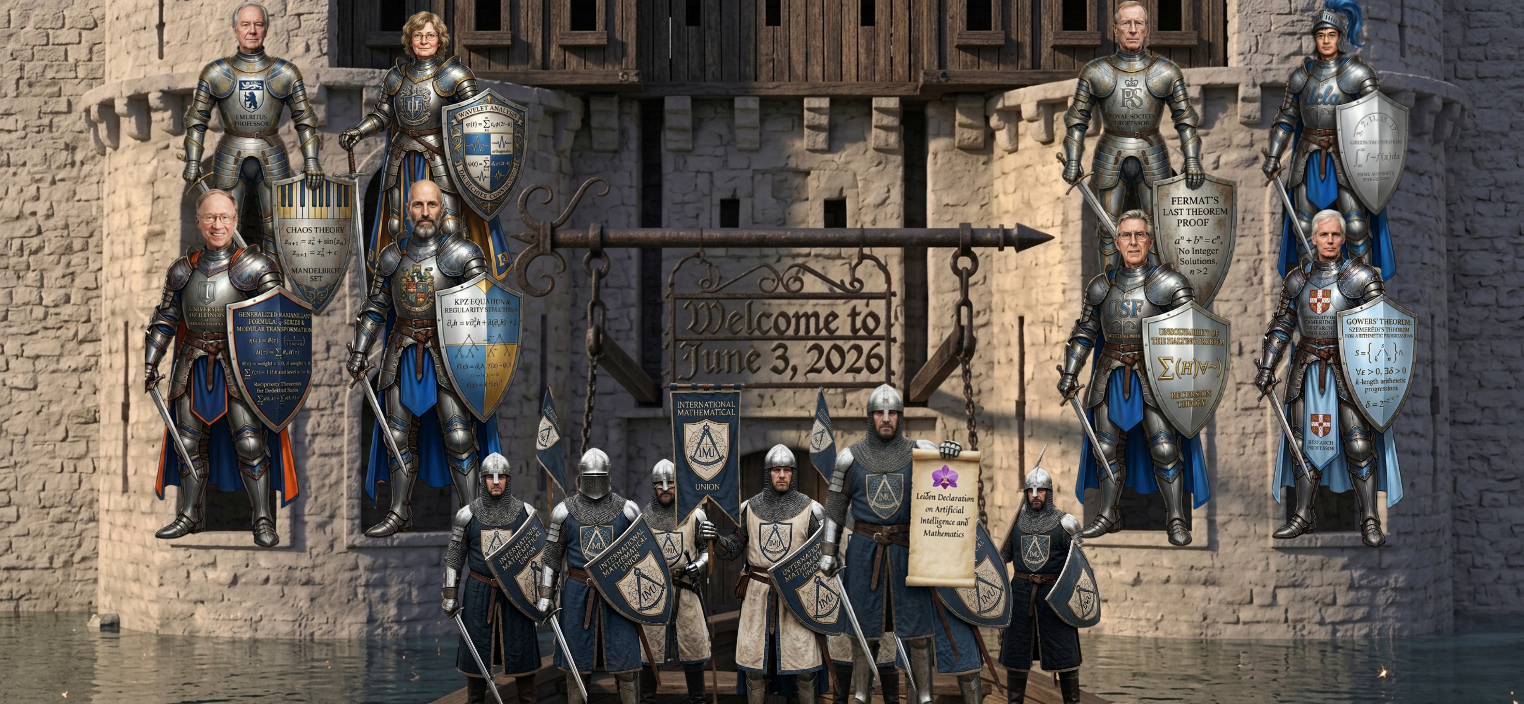
Mathématiciens Assiégés. Mathematicians Under Siege. On June 3, 2026, @siouid142 transformed Dr. Alex Wissner-Gross’s Innermost Loop into a medieval siege. Sixteen mathematicians, backed by the International Mathematical Union, had published the Leiden Declara
Read the narration
Mathématiciens Assiégés.
Mathematicians Under Siege.
On June 3, 2026, @siouid142 transformed Dr. Alex Wissner-Gross’s Innermost Loop into a medieval siege. Sixteen mathematicians, backed by the International Mathematical Union, had published the Leiden Declaration on Artificial Intelligence and Mathematics, asking researchers to disclose AI use and preserve human accountability for correctness. The declaration arrived after a model reportedly disproved an eighty-year-old Erdős conjecture. The image makes the resulting institutional unease architectural.
A stone fortress represents the accumulated record of human mathematics. Its walls are thick because proofs are not opinions: every claim must survive inspection and connect to what came before. Yet a long battering ram points directly at the barred gate. Model-driven research appears not as a visitor requesting admission, but as a force already testing whether the old boundary can hold.
Across the walls, named mathematicians wear armor and carry their intellectual contributions as heraldic shields. Ian Stewart bears chaos theory and Mandelbrot imagery. Ingrid Daubechies carries wavelet analysis. Bruce Berndt’s shield invokes Ramanujan identities, modular forms and transformations. Martin Hairer is associated with regularity structures and stochastic partial differential equations. Andrew Wiles carries Fermat’s Last Theorem. John Stillwell bears geometry, and Terry Tao appears with a Gaussian integral and UCLA colors.
These formulas are not decorative inscriptions applied to anonymous knights. They function as identity, reputation and defense. Each figure stands behind work that entered mathematics through human training, debate and proof. Turning that work into armor acknowledges its durability while exposing a new anxiety: the same archive that protects the discipline also supplies material from which automated systems learn to advance.
Below the named defenders, International Mathematical Union knights gather around a scroll titled “Leiden Declaration on Artificial Intelligence and Mathematics.” The declaration becomes both covenant and field order. It does not demand that machines be excluded from mathematics; it insists that use be disclosed and that correctness remain answerable to people. In the image, governance is the document held between the gate and the ram.
The surrounding dispatch broadens the pressure. OpenAI’s Codex could turn prompts into deployed applications, while a blind Stanford study found law professors preferred AI answers to student responses in roughly three quarters of comparisons. Mathematics is treated as the last fortress not because other professions are unimportant, but because formal proof had seemed to offer unusually clear protection against persuasive error. A breach here would have symbolic force far beyond one conjecture.
Water around the walls, raised swords and tiered battlements create an unmistakably defensive composition. Yet the attackers remain largely outside the frame. The viewer sees the human community’s formation more clearly than the intelligence pressing against it. That absence is critical: a model has no single body to duel, and the real pressure arrives through papers, tools, benchmarks and changed expectations rather than an opposing army.
The medieval form also prevents the declaration from appearing purely modern. Mathematics has repeatedly absorbed new notation, instruments, computation and institutions. Castles preserve knowledge, but they also mark the moment a field treats movement across a boundary as invasion. The image asks whether AI assistance will become another tool within the walls or reorganize who is recognized as a mathematician.
The date plaque reading “Welcome to June 3, 2026” hangs over the gate like the name of the besieged city. It makes the fortress a timestamp rather than a timeless allegory. The community is not defending mathematics in the abstract; it is responding to a particular week in which a declaration, a disproved conjecture and rapidly deployed systems became adjacent facts. Historical costume preserves the novelty of that collision by showing how old the institutional reflex of fortification remains.
As contemporary history painting, Mathematicians Under Siege records intellectual governance at the instant it becomes theatrical. Its knights are dignified rather than mocked, and the battering ram is formidable rather than triumphant. The work’s tension lies in the possibility that defense and collaboration may use the same gate. Human accountability must remain strong enough to inspect what enters, even if the next consequential proof arrives from a system that never wore a university crest or stood for a portrait on the battlements.
Opening the gallery…