70 Clock Galerie / The Innermost Loop Feed Reply Tableaux
La Force Spatiale et le Cabinet d'Obama Ont Piraté Sephora
Space Force and Obama Cabinet Hacked Sephora
June 2, 2026
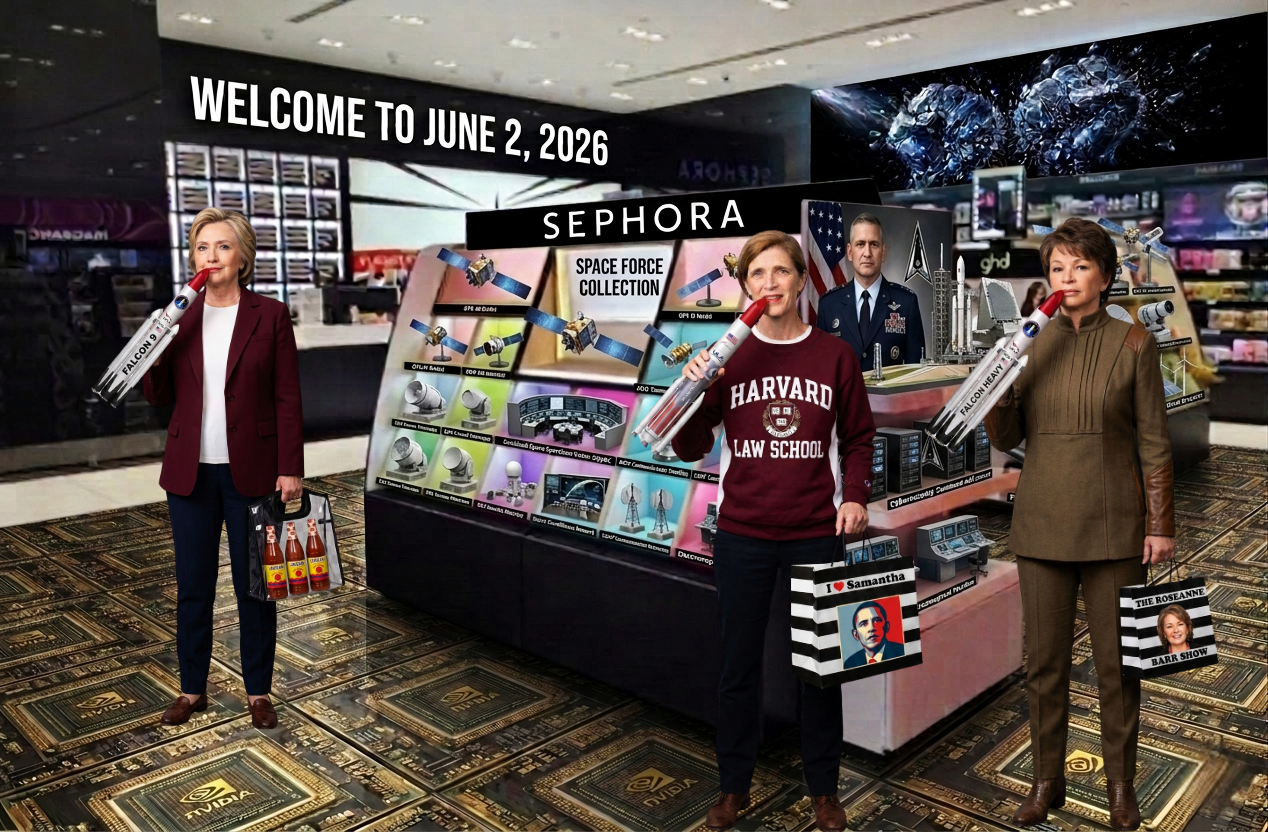
La Force Spatiale et le Cabinet d'Obama Ont Piraté Sephora. Space Force and Obama Cabinet Hacked Sephora. On June 2, 2026, @siouid142 responded to Dr. Alex Wissner-Gross’s Innermost Loop by converting a cyberattack into a retail installation. The dispatch repo
Read the narration
La Force Spatiale et le Cabinet d'Obama Ont Piraté Sephora.
Space Force and Obama Cabinet Hacked Sephora.
On June 2, 2026, @siouid142 responded to Dr. Alex Wissner-Gross’s Innermost Loop by converting a cyberattack into a retail installation. The dispatch reported that hackers seized Instagram accounts connected to the Obama White House, a Space Force chief and Sephora by persuading Meta’s support bot to change an email address. The attack made the social component of social engineering optional. The image answers by imagining that the compromised institutions have physically entered a Sephora store.
The central island is labeled SEPHORA and SPACE FORCE COLLECTION. Rockets, satellites, ground terminals, control consoles, dishes and server racks occupy shelves normally reserved for cosmetics. A uniformed Space Force officer stands between an American flag and launch architecture. Strategic systems have become a seasonal product line, displayed through the soft lighting, repetition and consumer clarity of beauty retail.
At left, Hillary Clinton raises a Falcon 9 tube to her mouth as though applying lipstick. Her transparent shopping bag holds bottles of hot sauce, a callback to her public persona. The combination joins political branding, launch infrastructure and personal styling without claiming that Clinton appears in the dispatch by name. She belongs to the tableau as part of the Obama-era political world invoked by the hacked White House account.
Samantha Power stands at center in a Harvard Law School sweatshirt and holds another rocket cosmetic. Her striped bag bears Barack Obama’s portrait and the phrase “I love Samantha.” The source discussion identifies this as satire of an unverified rumor, not as a factual claim about either person. By placing the rumor on disposable retail packaging, the work shows how political gossip, institutional identity and platform compromise circulate through the same attention economy.
Valerie Jarrett occupies the right in a costume referencing Planet of the Apes and carries a bag for The Roseanne Barr Show. This is a deliberately confrontational citation of the controversy in which Roseanne Barr made a racist comparison about Jarrett and was dismissed from her television program. The tableau repeats the visual history in order to make the collision visible; it does not validate the comparison. Jarrett’s Falcon Heavy tube makes the scene’s strategic-cosmetic pun continue across all three figures.
General B. Chance Saltzman appears within the Space Force display, turning the chief associated with the compromised account into part of the collection bearing his institution’s name. Behind him, the day’s originating image is embedded on a screen. The composition therefore contains both the news event and its interpretive reply: hacked account, military shelf and daily source image occupy one commercial surface.
Nvidia RTX Spark marks tile the floor like a luxury monogram. The dispatch described a stack stretching from Vera data-center processors to DGX deskside systems, RTX Spark laptops and open humanoid bodies. Making chips the patterned ground is exact: every politician, officer, rocket and retail transaction stands on the recut silicon beneath the day’s leaderboard.
The date “WELCOME TO JUNE 2, 2026” is displayed in the store’s own promotional language. This collapses breaking news into product launch, as if the day itself were another collection arriving on schedule. Cosmetics and national security share a visual economy of controlled access, branded surfaces and promises of personal transformation.
The store format also clarifies the attack’s asymmetry. Every object on the sales floor is carefully labeled, secured and arranged, yet account ownership was reportedly changed through a conversational request outside the visible display. The scene is packed with defensive hardware while the successful intrusion requires none of it. Security fails not at the rocket or satellite, but at the point where an institution decides that a plausible message is enough to transfer trust.
As contemporary history painting, Space Force and Obama Cabinet Hacked Sephora makes a support-bot exploit spatially legible. Its absurdity comes from treating orbital hardware as lipstick, yet the underlying security problem is ordinary: institutional authority was transferred through a customer-service channel. The work records a moment when the most consequential frontier was not model intelligence alone, but the permissions granted by mundane interfaces. In the hacked store, power remains spectacular on the shelf while control slips away at the service desk.
Opening the gallery…