70 Clock Galerie / The Innermost Loop Feed Reply Tableaux
Atelier Algorithmique – Maison de la Boucle la Plus Profonde – Dave Blundin
Atelier Algorithmique – House Innermost Loop – Dave Blundin
June 1, 2026
Atelier Algorithmique – Maison de la Boucle la Plus Profonde – Dave Blundin. Atelier Algorithmique – House Innermost Loop – Dave Blundin. Dated June 1, 2026 in the 70 Clock archive, this image belongs to the Moonshots portrait and fashion sequence rather than
Read the narration
Atelier Algorithmique – Maison de la Boucle la Plus Profonde – Dave Blundin.
Atelier Algorithmique – House Innermost Loop – Dave Blundin.
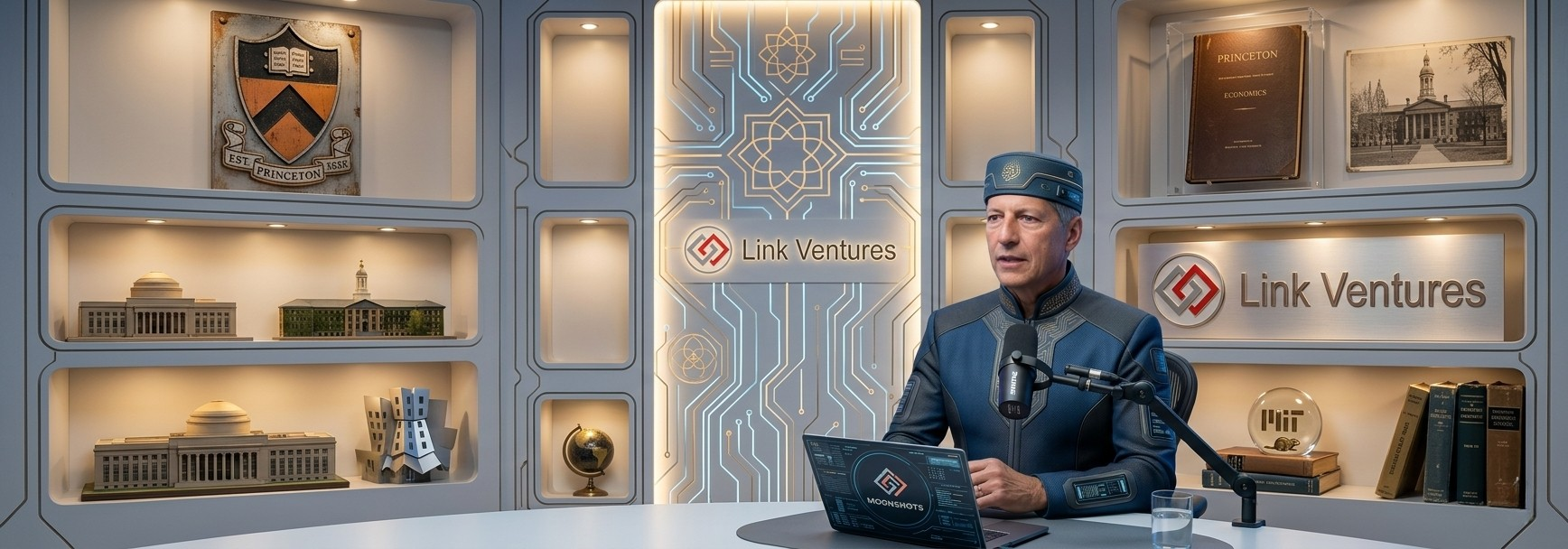
Dated June 1, 2026 in the 70 Clock archive, this image belongs to the Moonshots portrait and fashion sequence rather than to the Innermost Loop dispatch issued that day. Its direct source is an iterative creation exchange about Dave Blundin’s own setting. When a generic continuation risked borrowing Peter Diamandis’s rockets and Moonshots room, @siouid142 corrected it: Dave’s portrait should be built from Link Ventures, Princeton, MIT and the character of his actual office references.
That correction governs the finished work. Blundin sits behind a black desk with a microphone, water glass, laptop and foreground boom arm. The objects preserve the practical structure of a recorded conversation. Around them, the room has been redesigned as a blue circuit-board salon. The result does not remove him from the podcast; it makes the institutional history already present in his work visible as architecture.
The red Link Ventures emblem and name control the center of the rear wall. They sit inside a luminous panel crossed by circuit-like lines and flanked by geometric rosettes. Link appears again on the laptop, moving between corporate backdrop and working tool. Venture identity is not a badge added at the edge of the frame. It becomes the electrical center from which the rest of the room appears to receive power.
Princeton occupies the left shelves. A crest and a boxed PRINCETON ECONOMICS volume stand above an old campus photograph, while small architectural models extend the university into three dimensions. These objects describe intellectual formation through book, seal, memory and built environment. They are historical and tactile, contrasting with the glowing circuitry that organizes the contemporary room.
MIT appears on the right through a transparent sphere, books and scientific-display objects. Positioned across from Princeton, it creates a second institutional pole rather than a decorative name drop. A small brass globe near the center mediates between the two sides. Education, technology and venture capital are arranged as a balanced interior biography, each given a different texture and spatial role.
Blundin’s blue technical coat carries the room onto the body. Bright seams resemble conductive traces, and the fitted cap repeats a small geometric emblem. The source conversation drew on Persian-inspired form and ornament for the clothing. That reference is most effective where geometry and circuitry overlap: continuous line, repeated pattern and precision become a bridge between ornamental inheritance and a future-facing business environment. The coat remains soft and wearable rather than turning the sitter into a machine.
A rectangular wrist interface adds the sequence’s common language of personal computing, but it does not overwhelm the portrait. The repeated blue light connects wrist, collar, wall and desk, making affiliation seem wired through the entire scene. Yet the microphone and glass keep returning the viewer to an ordinary human scale. The room may function like a diagram, but a person still has to speak within it.
The two rosette forms flanking the Link panel are especially effective because they can be read as ornament, circuitry or abstract institutional seals. They prevent the electronic wall from becoming merely functional. In this salon, pattern is a mode of reasoning: repeated geometry organizes unlike inheritances into a shared visual order without making their histories identical.
The difference from Peter Diamandis’s portrait is conceptually important. Algorithmic fashion can easily flatten every technologist into the same rockets, holograms and metallic future. Here, correction becomes part of authorship. By removing the borrowed iconography and rebuilding the room from Dave’s actual affiliations, the work demonstrates that personalization is not visual excess; it is the discipline of refusing plausible but false symbols.
As contemporary portraiture, Atelier Algorithmique – House Innermost Loop – Dave Blundin presents identity as a circuit among institutions rather than a list on a résumé. Princeton and MIT supply intellectual lineages, Link Ventures occupies the operational present and the Moonshots equipment identifies the conversational setting in which those lineages are articulated. The Persian-inflected coat converts connection into pattern without claiming that biography can be reduced to branding. Its critical strength lies in specificity: the sitter does not enter somebody else’s future. The environment is reorganized until his own history becomes the architecture through which the future is seen.
Opening the gallery…