70 Clock Galerie / The Innermost Loop Feed Reply Tableaux
Dune de Miami Beach – Le Calcul Doit Couler
Miami Beach Dune – The Compute Must Flow
June 1, 2026
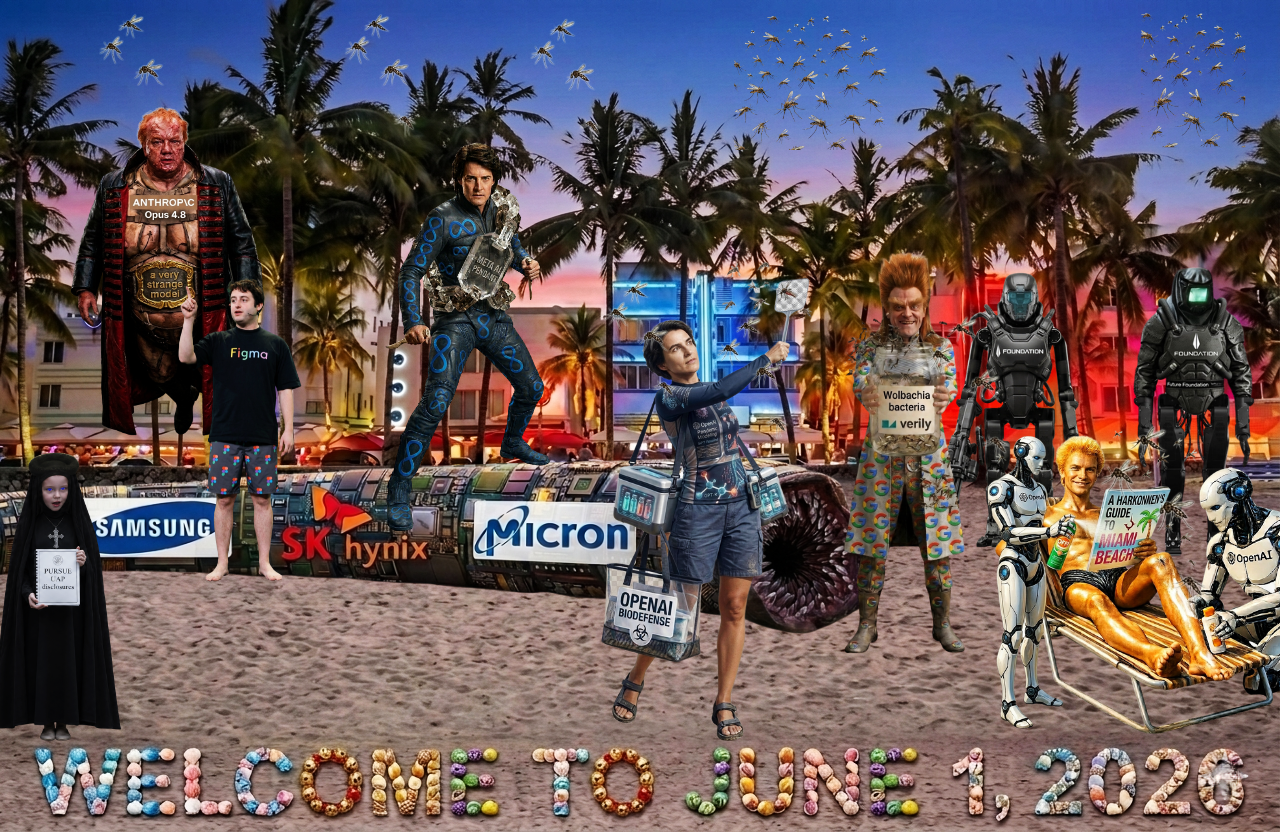
Dune de Miami Beach – Le Calcul Doit Couler. Miami Beach Dune – The Compute Must Flow. This work responds to Dr. Alex Wissner-Gross’s June 1, 2026 Innermost Loop by reimagining the technological landscape as a corporate-controlled Dune on Miami Beach. The reco
Read the narration
Dune de Miami Beach – Le Calcul Doit Couler.
Miami Beach Dune – The Compute Must Flow.
This work responds to Dr. Alex Wissner-Gross’s June 1, 2026 Innermost Loop by reimagining the technological landscape as a corporate-controlled Dune on Miami Beach. The recovered long-form analysis established its governing metaphor: the day’s aggressive patch cycle becomes an existential struggle for the digital Spice—memory and compute. @siouid142’s tableau preserves that synthesis in unusually exact Easter eggs rather than using Dune as a generic science-fiction atmosphere.
Miami Beach is an irony-rich location because the dispatch reported that Google and Verily were seeking approval for releases of up to 32 million treated mosquitoes in Florida to suppress disease. The beach is therefore not simply a leisure destination. It is ground zero for a biological intervention conducted at environmental scale. Palms, towers, sand and bright water make the proposed patch look idyllic until the insect swarm brings the engineered ecology into the foreground.
At left, Baron Vladimir Harkonnen from David Lynch’s 1984 Dune floats in his grav-harness. His body is labeled with Anthropic’s Opus 4.8 and the phrase “a very strange model.” The casting comes directly from the Figma CEO’s description of the release as judgmental, hedging and sycophantic. The Baron gives those contradictory traits a bloated, hovering personality: immense capability attached to a manner that users may experience as manipulative or unstable.
Nearby, Sting’s golden Feyd-Rautha lounges with A Harkonnen’s Guide to Miami Beach. He represents the consumer-class surface of the Singularity, reading a luxury guide while the environment is being remade around him. The joke is decadent rather than incidental. Corporate conflict becomes tourism for those able to experience infrastructure and biological intervention as scenery.
Across the shore, Foundation Future Industries robots are dressed as Sardaukar. Their black armor and severe visors translate the company’s hazardous-logistics ambitions into the Emperor’s elite force. The dispatch associated such machines with dangerous deployment, including work in Ukraine. The image does not claim they are literal soldiers; it uses military fiction to reveal how quickly logistics, autonomy and geopolitics can converge in the public imagination.
Paul Atreides occupies the center in Meta AI clothing and a Meta pendant, riding a vast worm built from Samsung, SK Hynix and Micron. This is the picture’s master metaphor. In Dune, control of the sandworm and the Spice determines imperial power. Here, the creature is memory infrastructure, and the dispatch’s claim that memory had become worth more than oil supplies the political economy. Paul is not floating above the supply chain. He must balance on the branded body that produces the resource every model requires.
Young Alia Atreides stands at the edge with a sign reading “PURSUE UAP.” Her small figure carries the dispatch’s report on increasingly intense politics around crash-retrieval records and unidentified anomalous phenomena. Ancient prophecy and government disclosure fold together, showing how frontier technology encourages older fears and hopes to return in new bureaucratic language.
The biological patch cycle occupies the middle of the beach. Rosalind Franklin carries an OpenAI Biodefense bag and swats at mosquitoes. Piter De Vries, the wild-haired Mentat, is associated with Verily, Wolbachia and the treated-release program. Casting him as the experimenter keeps the intervention unstable and theatrical, while Franklin’s presence invokes the history of molecular evidence and the unresolved politics of recognition in science. Between them, biodefense is shown as both protective ambition and ecological disturbance.
A seashell marquee spelling “WELCOME TO JUNE 1, 2026” grounds the industrial and geopolitical nightmare in organic material. The date is not projected by a machine; it is assembled on fragile sand. That choice preserves the recovered analysis’s strongest reminder: however much compute is built, the race still unfolds on a natural planet whose living systems cannot be treated as an infinitely resettable simulation.
As contemporary history painting, Miami Beach Dune – The Compute Must Flow captures the power structure beneath a heterogeneous dispatch. Memory companies become the worm, a model becomes the Baron, logistics robots become Sardaukar, a pendant wearer becomes Paul and a mosquito program becomes ecological terraforming. The work’s point is not that innovation is identical to Dune’s violence. It is that the language of patches, models and supply chains can conceal an imperial contest over scarce substrate. In this Miami Arrakis, every player tries to ride the silicon worm, because the compute must flow—and whoever controls its flow acquires the power to define the future built on the beach.
Opening the gallery…