70 Clock Galerie / The Innermost Loop Feed Reply Tableaux
Cirque de la Singularité : La Boucle la Plus Profonde
Singularity Circus Innermost Loop
May 29, 2026
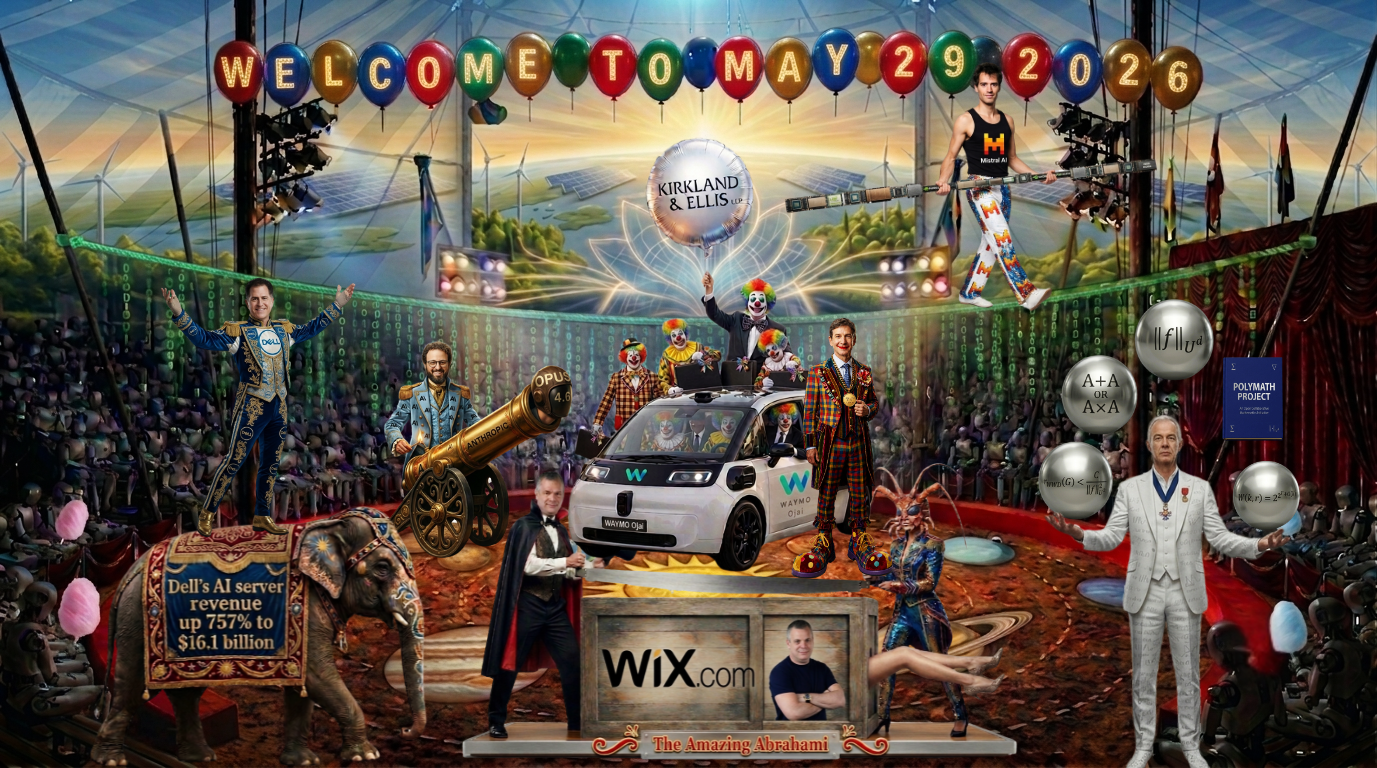
Cirque de la Singularité : La Boucle la Plus Profonde. Singularity Circus Innermost Loop. On May 29, 2026, @siouid142 turned Dr. Alex Wissner-Gross’s Innermost Loop into a big-top program. The dispatch moved through Anthropic’s Opus 4.8, mathematical problem s
Read the narration
Cirque de la Singularité : La Boucle la Plus Profonde.
Singularity Circus Innermost Loop.
On May 29, 2026, @siouid142 turned Dr. Alex Wissner-Gross’s Innermost Loop into a big-top program. The dispatch moved through Anthropic’s Opus 4.8, mathematical problem solving, financing, Dell’s server business, Waymo’s larger Ojai robotaxi, Kirkland & Ellis’s plan to spend 500 million dollars on its own tools, Mistral and a major Wix staff reduction. The circus is not decorative whimsy. It is the social form in which feats, danger, capital and misdirection can share one ring.
A balloon marquee reading “WELCOME TO MAY 29 2026” fixes the performance to a single day. Behind it, the luminous green landscape associated with Wissner-Gross’s Solve Everything vision appears as painted scenery. Abundance is the destination promised on the backdrop; the awkward, competitive and often painful transition occupies the foreground. The distinction prevents a utopian horizon from smoothing over the labor and infrastructure required to reach it.
At far left, Michael Dell stands above a richly dressed elephant. Its blanket declares that Dell’s AI-server revenue rose 757 percent to 16.1 billion dollars. The elephant is the circus’s load-bearing animal and the image’s material substrate. Models and agents may receive the applause, but racks, accelerators, memory, networking and power carry their weight. The huge body turns a revenue statistic into mass that the viewer can feel.
Near center, an Anthropic cannon is marked “OPUS 4.6,” although the day’s dispatch launched Opus 4.8. The visible discrepancy is preserved rather than silently corrected; it belongs to the contemporaneous construction of the image. A Dario Amodei figure tends the cannon as model capability becomes a projectile and product release becomes a public stunt. The device promises range and force, while the circus setting keeps the possibility of recoil in view.
Waymo’s roomier Ojai arrives as a literal clown car packed with briefcases and performers. The joke reverses the product announcement: expanded interior space immediately attracts more occupants, props and institutional ambition. Nearby, the Kirkland & Ellis chairman is associated with an enormous pair of clown shoes and the firm’s balloon. A 500-million-dollar effort to build proprietary legal tools becomes a bid to enter the ring without renting another performer’s act.
High above, a Mistral acrobat crosses a glitch-like wire with a chip-patterned balancing pole. European model ambition is rendered as poise over an unstable technical line. Below, robots eat cotton candy like ordinary spectators. Their leisure is a small but important inversion: artificial systems are not only instruments in the program; they have entered the audience and the culture that decides which feat deserves applause.
At right, Timothy Gowers juggles equation-marked spheres beside a Polymath Project book. Mathematics becomes the cerebral act whose difficulty remains visible even while machines begin to claim parts of it. The juggling metaphor respects coordination and judgment rather than presenting proof as a single trophy. Each sphere can be kept aloft only through an ongoing relation to the others.
The darkest act occurs at the front. Wix founder Avishai Abrahami appears beside “The Amazing Abrahami,” a sword box associated with the company’s plan to cut roughly twenty percent of its staff amid AI’s rapid evolution. Corporate restructuring becomes a disappearance trick. The spectacle asks the audience to admire efficiency while the body inside the box bears the blades. Humor does not soften the loss; it reveals the promotional language through which loss can be made to vanish.
The ring also exposes the difference between measured achievement and staged confidence. Revenue can be printed on a blanket, investment tied to a balloon and a model fired from a cannon, but every prop requires somebody to position it and every act can fail. Circus grammar makes technological competition legible as choreography: apparent spontaneity rests on training, capital and hidden support.
As contemporary history painting, Singularity Circus Innermost Loop gives each report a distinct act while showing that all depend on the same tent. Hardware receipts, model launches, legal autonomy, transportation, mathematics and layoffs are not a random collage. They are participants in a public contest over who controls the accelerating system and who is treated as expendable. The image’s critical precision lies in preserving both wonder and labor: the Singularity is already spectacular, but every spectacle requires rigging, animals, workers, risk and an audience willing to believe the trick.
Opening the gallery…