70 Clock Galerie / The Innermost Loop Feed Reply Tableaux
Sur la Définition de l'Intelligence Artificielle Générale – Pièce 6
On the Definition of Artificial General Intelligence – Exhibit 6
May 29, 2026
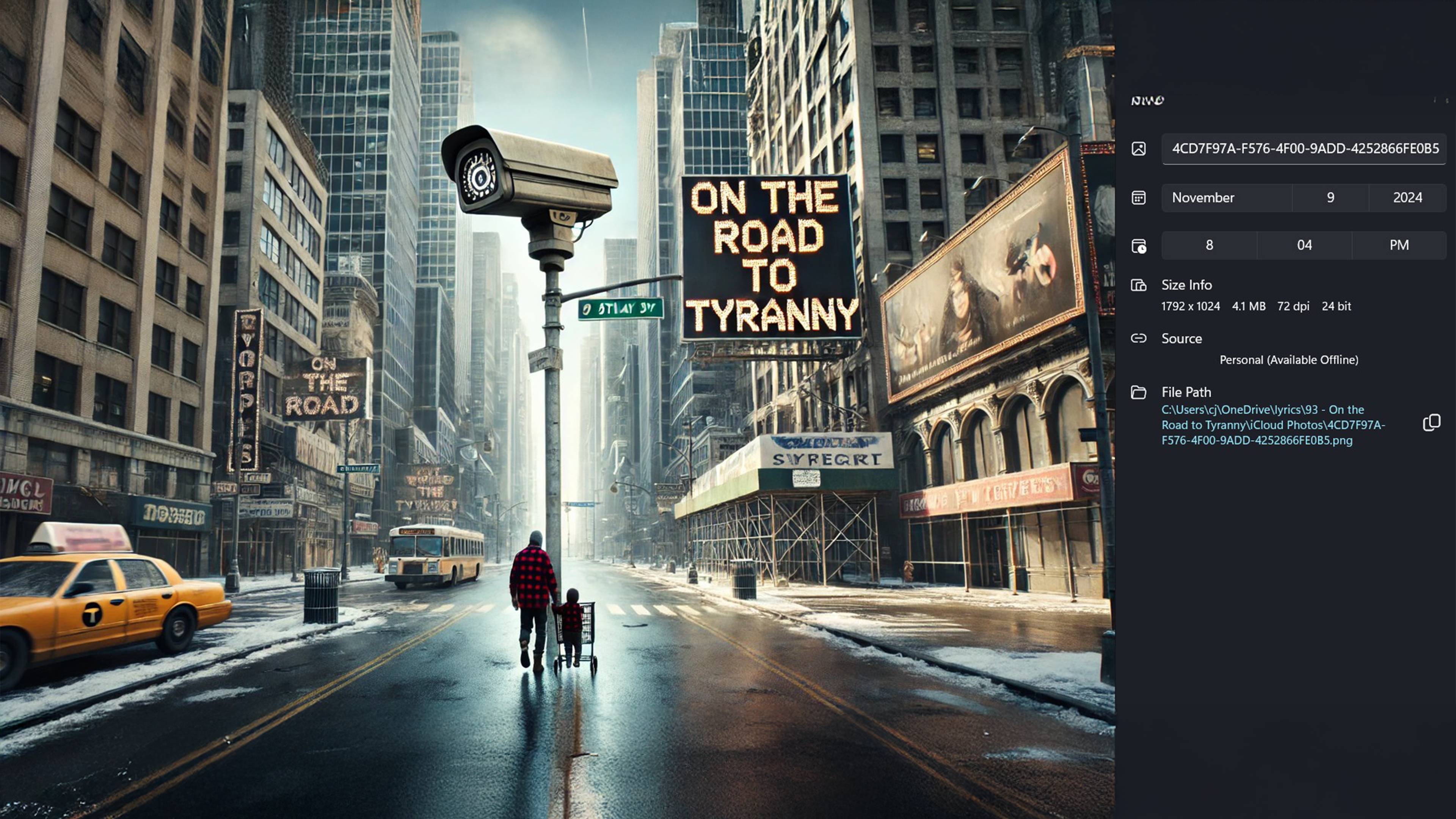
Sur la Définition de l'Intelligence Artificielle Générale – Pièce 6. On the Definition of Artificial General Intelligence – Exhibit 6. Presented on May 29, 2026 as the sixth exhibit in the AGI-definition exchange, this image is also a recovered artifact from N
Read the narration
Sur la Définition de l'Intelligence Artificielle Générale – Pièce 6.
On the Definition of Artificial General Intelligence – Exhibit 6.
Presented on May 29, 2026 as the sixth exhibit in the AGI-definition exchange, this image is also a recovered artifact from November 9, 2024. Its visible file-information panel records the earlier date and an evening timestamp. @siouid142 therefore uses the work differently from Exhibits 4 and 5: not as a new illustration of the latest dispatch, but as material evidence of what image generation could already compose before it could reliably write.
The setting is a cold Manhattan canyon after ordinary urban life has thinned out. Wet pavement and old snow reflect a gray sky. A yellow taxi waits at right, a bus recedes in the distance and a red signal hangs above the intersection, yet the avenue feels evacuated rather than active. A parent in a red-and-black plaid jacket walks away with a small child and a shopping cart. Their scale makes the city’s architecture seem less like shelter than an abandoned system.
The Road by Cormac McCarthy supplies the narrative grammar. Parent, child and cart translate the novel’s intimate survival unit into New York. A billboard on the left retains the phrase “ON THE ROAD,” while the central sign expands it to “ON THE ROAD TO TYRANNY.” The change redirects the unspecified catastrophe of McCarthy’s landscape toward a political warning. The pair is not only traveling after collapse; they are moving beneath infrastructure that watches, classifies and commands.
That infrastructure enters through the enormous surveillance camera in the lower-left foreground. Its lens points toward the two figures and occupies more visual space than either of them. The device is so close that it behaves like a mechanical spectator standing in for the viewer. We look down the same avenue through an image whose own act of looking has become the threat. The billboard names tyranny, but the lens gives the word a body.
The picture’s uneven typography is the crucial forensic evidence. The principal billboard is readable, while awnings and storefronts fracture into near-language—forms such as “SYREGRT” that look momentarily plausible before refusing meaning. In 2024 this defect was familiar. By 2026, the neighboring exhibits could build people, brains, corporate symbols and extensive newspaper copy into coherent worlds. The sequence turns a technical improvement into an archived visual comparison rather than a retrospective boast.
Yet the older image is not aesthetically primitive. Its cinematic depth, weather, traffic cues, emotional pacing and literary allusion are already remarkably coordinated. The parent’s plaid jacket becomes the lone warm human signal, echoed faintly by the red light overhead. The cart anchors the figures to bodily necessity. The taxi and bus suggest a transit network that exists without restoring social density. Composition and atmosphere are persuasive even where individual words fail.
That mismatch complicates any single definition of intelligence. A system unable to spell a storefront could nevertheless synthesize McCarthy, Manhattan, surveillance and familial vulnerability into a coherent scene. Two years later, clean typography might tempt the viewer to declare a categorical threshold. Exhibit 6 warns that abilities arrive unevenly. Technical progress is not a staircase on which every faculty rises together, and a failed word does not erase a successful social metaphor.
The file-metadata sidebar also changes the status of the image. Usually an interface panel would be cropped away as accidental residue. Here it acts like a museum registrar’s label embedded in the artwork, tying aesthetic evidence to a creation time and source path. The artifact can be examined rather than merely remembered. Its imperfections become dated features of a historical instrument.
As contemporary history painting, On the Definition of Artificial General Intelligence – Exhibit 6 makes technological memory part of the subject. The dystopian billboard warns about political control, while the broken shop signs preserve the limitation of the machine that rendered the warning. The parent and child walk between those two uncertainties: what increasingly capable systems may enable, and what society will decide those capabilities mean. The work does not prove AGI existed in 2024. It proves that the road toward any later declaration was already visually rich, socially anxious and much less linear than a benchmark can show.
Opening the gallery…