70 Clock Galerie / The Innermost Loop Feed Reply Tableaux
Sur la Définition de l'Intelligence Artificielle Générale – Pièce 5
On the Definition of Artificial General Intelligence – Exhibit 5
May 29, 2026
Sur la Définition de l'Intelligence Artificielle Générale – Pièce 5. On the Definition of Artificial General Intelligence – Exhibit 5. Dated May 29, 2026, this fifth exhibit continues the AGI-definition exchange and draws its technical evidence from Dr. Alex W
Read the narration
Sur la Définition de l'Intelligence Artificielle Générale – Pièce 5.
On the Definition of Artificial General Intelligence – Exhibit 5.
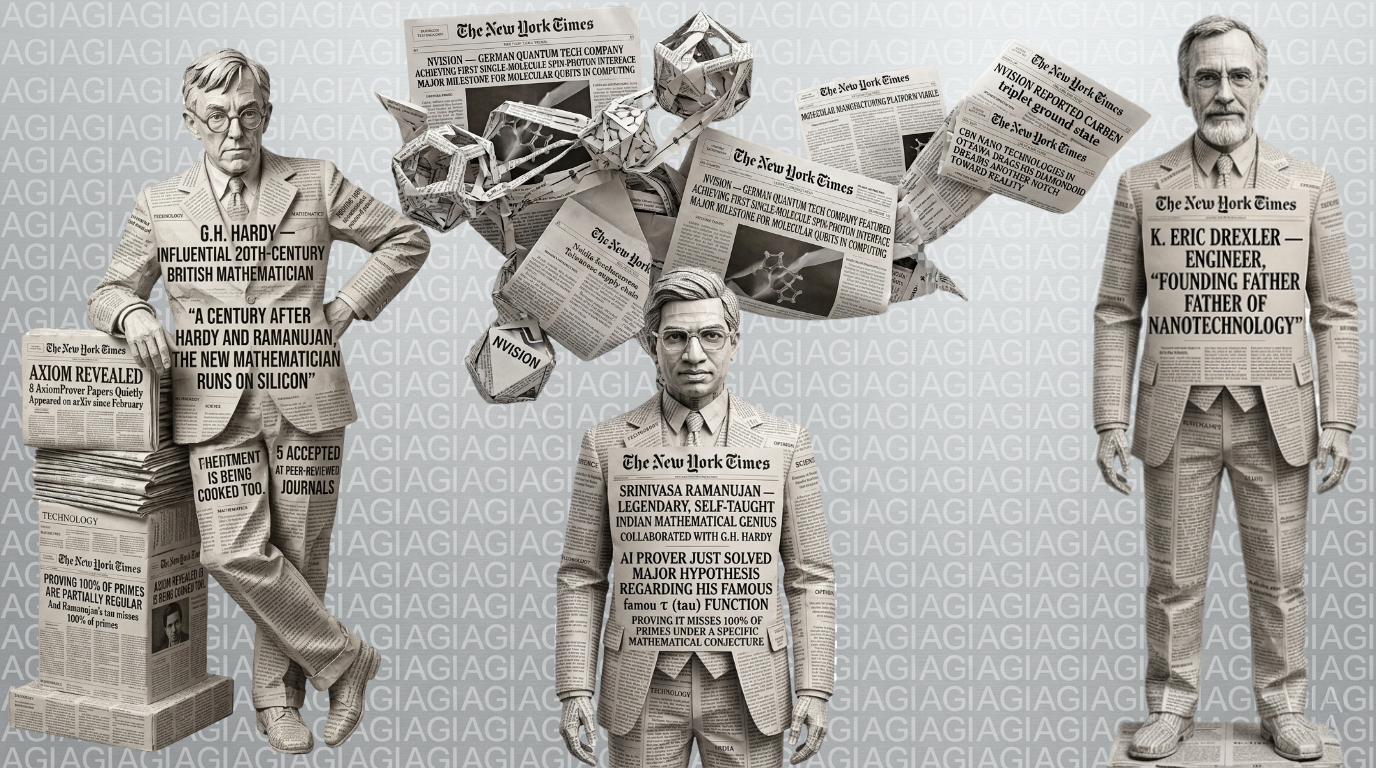
Dated May 29, 2026, this fifth exhibit continues the AGI-definition exchange and draws its technical evidence from Dr. Alex Wissner-Gross’s May 28 Innermost Loop. @siouid142 does not picture a generic supermind. The work convenes G. H. Hardy, Srinivasa Ramanujan and K. Eric Drexler beneath a paper firmament of proofs and molecular structures, asking whether general intelligence becomes legible through mathematical discovery, physical fabrication or the continuity between them.
The three figures are made from newspaper, as though the historical record had folded itself into witnesses. At left, Hardy leans against a column of New York Times editions. The headline announces that eight AxiomProver papers had appeared on arXiv since February, five already accepted or peer-reviewed. Beneath it, blocks refer to a result about partially regular primes. The casual pose makes a startling change look archival: a machine prover has entered the professional rhythm of papers, review and cumulative mathematics.
Ramanujan stands at center in a finely tailored paper suit. Across his body appears the claim that, under a stated conjecture, his tau function misses one hundred percent of primes in the relevant sense. The image does not present the condition as an unconditional conquest, and that distinction matters. The historic mathematician becomes the surface on which a contemporary proof system writes, while his continued recognizability prevents the new result from erasing the human imagination and century of theory that made the problem meaningful.
The pairing of Hardy and Ramanujan recalls an intellectual relationship formed across distance, institution and unequal recognition. AxiomProver introduces a new collaborator whose biography cannot be told in the same terms. By placing the machine’s papers on Hardy’s stack and its theorem across Ramanujan’s suit, the work asks whether automated proving joins mathematical culture, accelerates it or changes what the culture will count as understanding.
At right stands K. Eric Drexler, identified as a founding father of nanotechnology. Overhead, folded molecular cages and newspaper constructions turn atom-scale research into a suspended architecture. NVision’s work on a single-molecule spin-photon interface and a triplet-ground-state carbene appears alongside CBN Nano Technologies’ progress toward mechanosynthetic diamondoid structures. Proof and fabrication remain distinct, but the composition makes them neighbors within one definition problem.
That adjacency is the exhibit’s central argument. Mathematical intelligence can produce a formal chain that specialists verify; physical intelligence must also negotiate material, measurement, error and manufacture. Drexler’s presence extends the question from knowing that a proposition follows to making an atomically precise object exist. If AGI is defined only by conversation, the molecular ceiling is extraneous. If it is defined by the capacity to understand and alter the world, then the ceiling becomes part of the test.
The repeated AGI backdrop offers no answer. It resembles a museum wall, a corporate step-and-repeat and a laboratory control field at once. Clean lettering and stable likenesses contrast with the glitch-text era recalled in the surrounding conversation. Yet visual fluency is only one kind of competence among the proofs, papers and molecular interfaces presented here. The exhibit deliberately multiplies criteria faster than it ranks them.
Newspaper is an especially apt material because each breakthrough reaches the public as a claim before it becomes settled history. Pages can certify, sensationalize, preserve and be refolded. Here they become plinth, clothing and molecule, making mediation impossible to ignore. The viewer never encounters intelligence outside an institution that names the result and decides where it belongs.
As contemporary history painting, On the Definition of Artificial General Intelligence – Exhibit 5 converts inheritance into a provisional courtroom of objects. Hardy, Ramanujan and Drexler are not mascots pasted onto current news; they mark different standards of intellectual consequence. The work’s refusal to choose among theorem, understanding and manufacture is its critical precision. AGI appears not as a finish line but as a dispute among disciplines over which achievements deserve to move the line at all.
Opening the gallery…