70 Clock Galerie / The Innermost Loop Feed Reply Tableaux
Sur la Définition de l'Intelligence Artificielle Générale – Pièce 4
On the Definition of Artificial General Intelligence – Exhibit 4
May 28, 2026
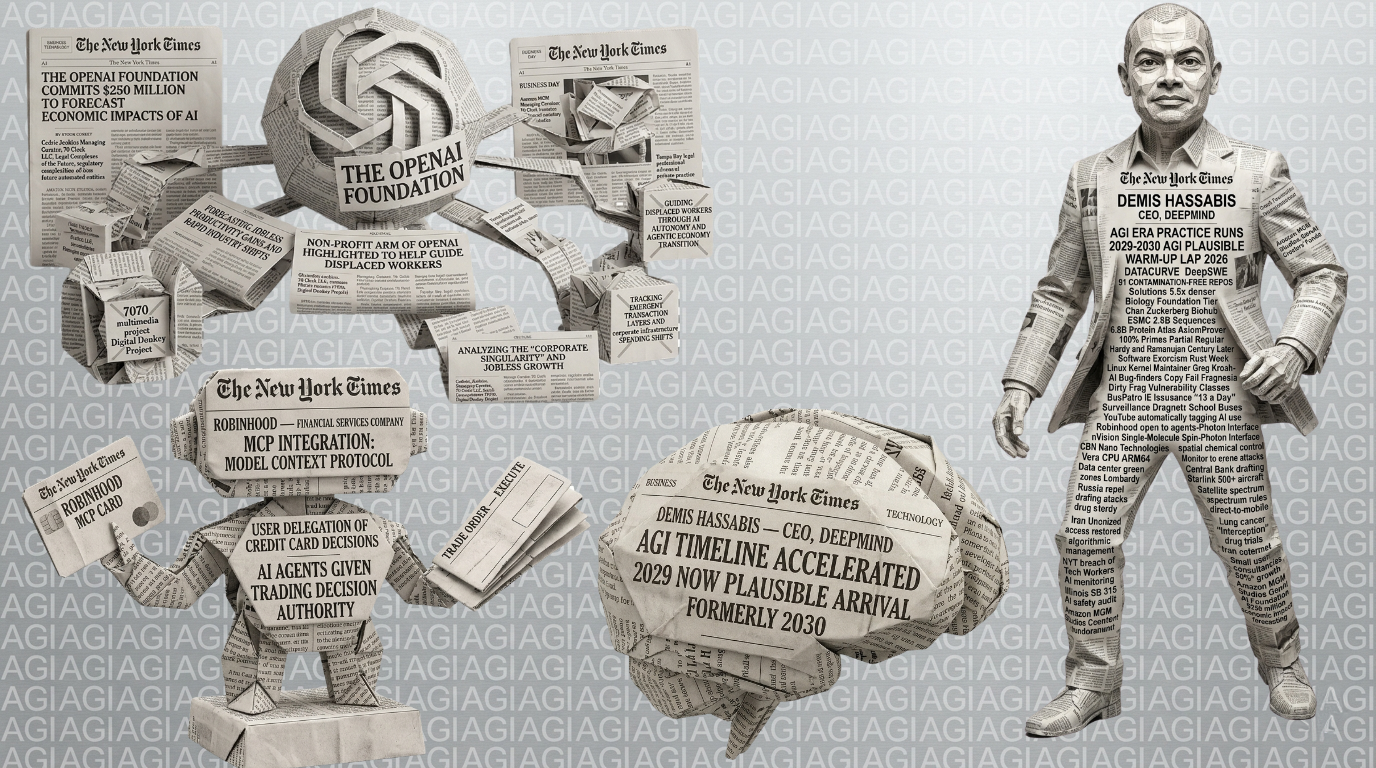
Sur la Définition de l'Intelligence Artificielle Générale – Pièce 4. On the Definition of Artificial General Intelligence – Exhibit 4. On May 28, 2026, @siouid142 made this fourth exhibit in response to Dr. Alex Wissner-Gross’s Innermost Loop and to a parallel
Read the narration
Sur la Définition de l'Intelligence Artificielle Générale – Pièce 4.
On the Definition of Artificial General Intelligence – Exhibit 4.
On May 28, 2026, @siouid142 made this fourth exhibit in response to Dr. Alex Wissner-Gross’s Innermost Loop and to a parallel exchange about the definition of artificial general intelligence. Wissner-Gross observed that everyone seems to carry a different definition of AGI, and proposed a social threshold: perhaps AGI arrives when society can no longer agree on what intelligence is. The image does not settle the category. It turns the uncertainty into evidence that can be inspected.
The entire tableau is built from The New York Times. Newspaper is background, clothing, sculpture, archive and skin. That decision gives a disputed technical threshold a public material. Intelligence is not represented as an abstract glow outside society; it is folded from headlines about institutions, capital, employment and prediction. The record that reports the transformation becomes the substance from which its protagonists are made.
At left, the OpenAI knot rises as a large paper orb. Its pages announce the OpenAI Foundation’s commitment of 250 million dollars to forecast the economic effects of artificial intelligence. Smaller clippings refer to displaced workers, jobless growth, a corporate singularity, AgentRock and the 7070 multimedia project. Folded birds lift fragments of this record into the air. Their flight suggests distribution, but the printed wings keep every promise tethered to a particular account of consequences.
Below them, a small Robinhood MCP agent holds an MCP card beside language granting artificial agents authority over credit-card and trading decisions. The figure gives the Model Context Protocol an economic body. It is not merely answering a question; it can be delegated access to accounts and actions. In the context of an AGI definition, this modest paper trader matters because generality may first become socially consequential through permission rather than through a single spectacular benchmark.
A compact 7070 project cube and a folded robot extend that question from finance to media and action. They are small compared with the OpenAI knot and Hassabis figure, but their scale is instructive. General intelligence is often announced through monumental claims, while practical agency enters through ordinary interfaces, protocols and objects that users begin trusting one task at a time. The exhibit makes those quieter admissions part of the record.
At center, a folded brain carries the claim “AGI Timeline Accelerated: 2029 Now Plausible Arrival, Formerly 2030.” Demis Hassabis stands at right in a full-length newsprint suit, while the day’s research and company names run across his torso. His human likeness, the anatomical brain and the institutional OpenAI form offer three rival locations for intelligence: person, cognitive object and organization. None is permitted to dominate the exhibit completely.
The creation exchange compared this coherent paper world with images made only a year earlier, when speaking to a telephone could produce striking scenes whose lettering dissolved into mistakes. Here, readable headlines, recognizable people and stable relationships become part of the capability argument. The work does not claim that clean typography proves AGI. Instead, it preserves a visible change in what generative systems could coordinate: language, likeness, spatial hierarchy and topical synthesis within one image.
The repeated gray AGI field behaves like museum wallpaper and an unresolved test pattern. Against it, each object appears labeled and admissible, yet the total refuses a single verdict. Forecasting labor effects, assigning trading authority, accelerating a date and rendering newspaper sculpture are different kinds of evidence. Their coexistence exposes why consensus fails: every observer can select a different component as the decisive threshold.
As contemporary history painting, On the Definition of Artificial General Intelligence – Exhibit 4 uses the sobriety of an evidentiary display to examine a category being negotiated in real time. The newsprint aesthetic grants documentary authority and then makes that authority visibly constructed through folding, cropping and arrangement. Its deepest proposition is not that AGI arrived on May 28, 2026. It is that the social machinery for declaring, denying and absorbing its arrival was already being assembled from headlines, permissions and revised expectations—and that disagreement itself had become one of the exhibits.
Opening the gallery…