70 Clock Galerie / The Innermost Loop Feed Reply Tableaux
Sur la Définition de l'Intelligence Artificielle Générale – Pièce 3
On the Definition of Artificial General Intelligence – Exhibit 3
May 28, 2026
Sur la Définition de l'Intelligence Artificielle Générale – Pièce 3. On the Definition of Artificial General Intelligence – Exhibit 3. On May 28, 2026, @siouid142 used the third AGI-definition exhibit to shift attention from capability to institutional consequ
Read the narration
Sur la Définition de l'Intelligence Artificielle Générale – Pièce 3.
On the Definition of Artificial General Intelligence – Exhibit 3.
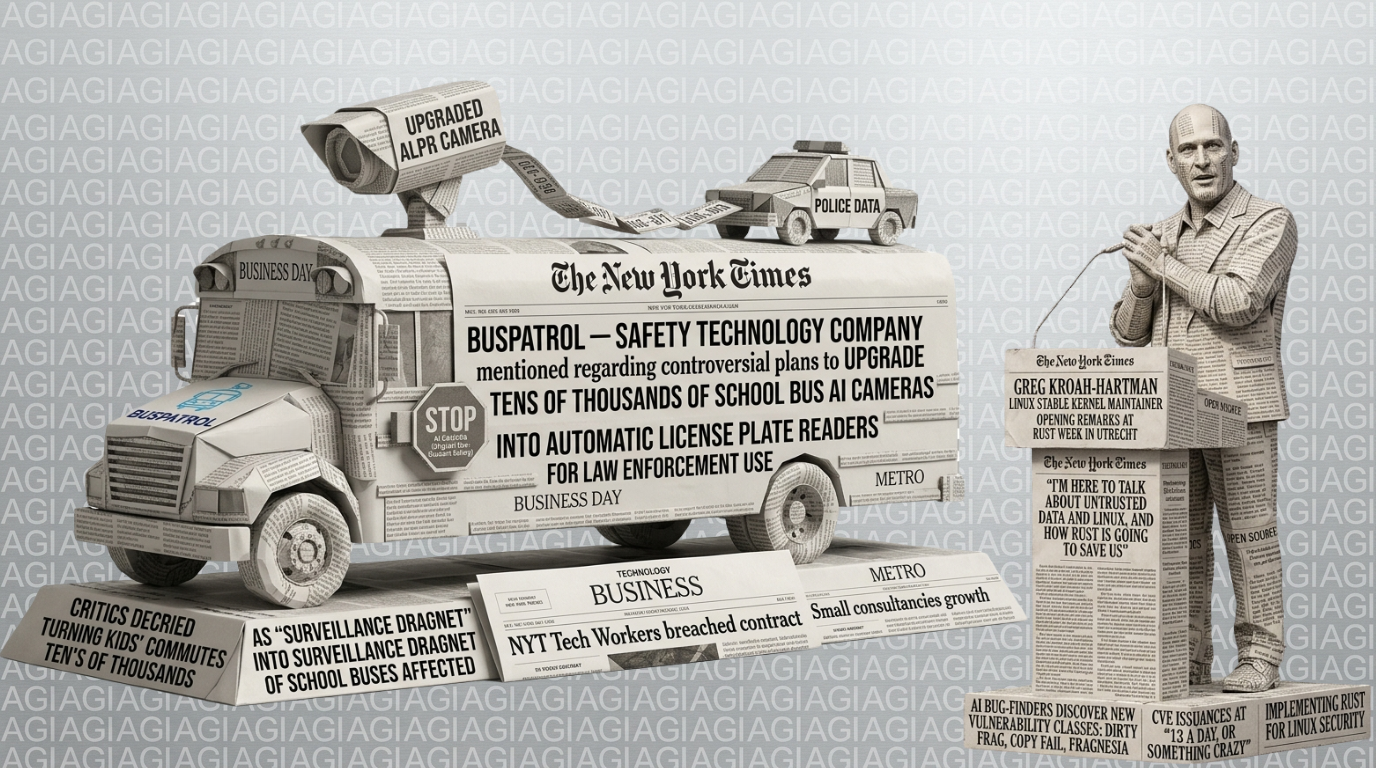
On May 28, 2026, @siouid142 used the third AGI-definition exhibit to shift attention from capability to institutional consequence. Dr. Alex Wissner-Gross had suggested that the threshold might be marked by society’s inability to agree on what counts as intelligence. Here a BusPatrol school bus routes license-plate information toward a police car while Linux maintainer Greg Kroah-Hartman stands beside warnings about untrusted data, Rust and rapidly multiplying vulnerabilities. The question is no longer only what the system can recognize, but who receives the recognition.
A school bus routes license-plate data from a roof camera to a police car while a human figure warns about untrusted inputs. BusPatrol’s plan to upgrade tens of thousands of school-bus AI cameras into automatic license-plate readers becomes a literal paper pipeline for law enforcement. Collection, transmission, recipient, and critic all occupy one chain, making machine intelligence inseparable from who gathers the data, who receives it, and who bears the risk.
Greg Kroah-Hartman’s Rust Week remarks in Utrecht about untrusted data and Linux stand beside that surveillance mechanism as the software-security counterweight. Along the ground, a union-contract headline and criticism of a school-bus “surveillance dragnet” bring labor and public scrutiny into the system. The newsletter’s open question about how to define AGI is answered visually with institutions and consequences rather than a benchmark score.
The newsprint bus carries the BusPatrol plan, a stop sign marked “AI CATICA,” and a roof unit labeled “UPGRADED ALPR CAMERA.” A ribbon unspools from the lens toward a small car marked “POLICE DATA,” physically carrying the proposed transfer. Kroah-Hartman stands at right beside the printed declaration, “I’m here to talk about untrusted data and Linux, and how Rust is going to save us,” while a second headline identifies his Rust Week opening remarks in Utrecht. Around his feet are Dirty Frag, Copy Fail, Fragnesia, CVE volume, and Rust-security references. A lower strip reads “NYT Tech Workers breached contract.” Pale “AGI” wallpaper recedes behind a specific chain of collection, transmission, security warning, labor conflict, and institutional dispute.
The bus is an exact civic object because school transportation ordinarily signifies care, routine and bounded responsibility. Cameras installed to protect children can acquire a second purpose when upgraded into automatic license-plate readers. The roof unit marked “UPGRADED ALPR CAMERA” makes that functional expansion visible as hardware. A familiar safety system becomes a mobile node in a broader surveillance network.
The paper ribbon unspooling from the lens toward the car labeled “POLICE DATA” gives information transfer a physical path. Data is often discussed as though it moved without weight or direction. Here the strip has an origin, route and recipient. The viewer can follow collection from the school bus to law enforcement, making institutional custody part of the image’s definition of intelligence.
Greg Kroah-Hartman provides the security counterweight. His Rust Week declaration—“I’m here to talk about untrusted data and Linux, and how Rust is going to save us”—stands beside Dirty Frag, Copy Fail, Fragnesia and a reported pace of roughly 13 CVEs a day. The surrounding fragments make “untrusted” more than a coding abstraction. Every new sensor and agent expands the boundary across which malformed, adversarial or misdirected information can travel.
Rust appears not as a magic shield but as one response to a legacy system under pressure. Memory safety can eliminate important vulnerability classes, yet it cannot decide whether school-bus cameras should become police infrastructure. The juxtaposition separates technical security from political legitimacy. A pipeline may be implemented safely and still be contested in purpose.
Pale AGI lettering again recedes behind concrete relationships. This panel suggests that general intelligence cannot be assessed solely by benchmark breadth or conversational fluency. A consequential definition must include deployment: what is sensed, how securely it is processed, where it is sent, who can challenge it and what authority acts on the result.
As contemporary history painting, On the Definition of Artificial General Intelligence – Exhibit 3 turns a technology threshold into a question of custody. Camera, bus, ribbon, police car, maintainer, vulnerability and union headline form one civic circuit. The work asks society to define intelligence not only by what a model knows, but by whether institutions know where its data came from, where it is going and who is permitted to refuse the route.
Opening the gallery…