70 Clock Galerie / The Innermost Loop Feed Reply Tableaux
Sur la Définition de l'Intelligence Artificielle Générale – Pièce 2
On the Definition of Artificial General Intelligence – Exhibit 2
May 28, 2026
Sur la Définition de l'Intelligence Artificielle Générale – Pièce 2. On the Definition of Artificial General Intelligence – Exhibit 2. On May 28, 2026, @siouid142 continued the response to Dr. Alex Wissner-Gross’s observation that society lacks a stable defini
Read the narration
Sur la Définition de l'Intelligence Artificielle Générale – Pièce 2.
On the Definition of Artificial General Intelligence – Exhibit 2.
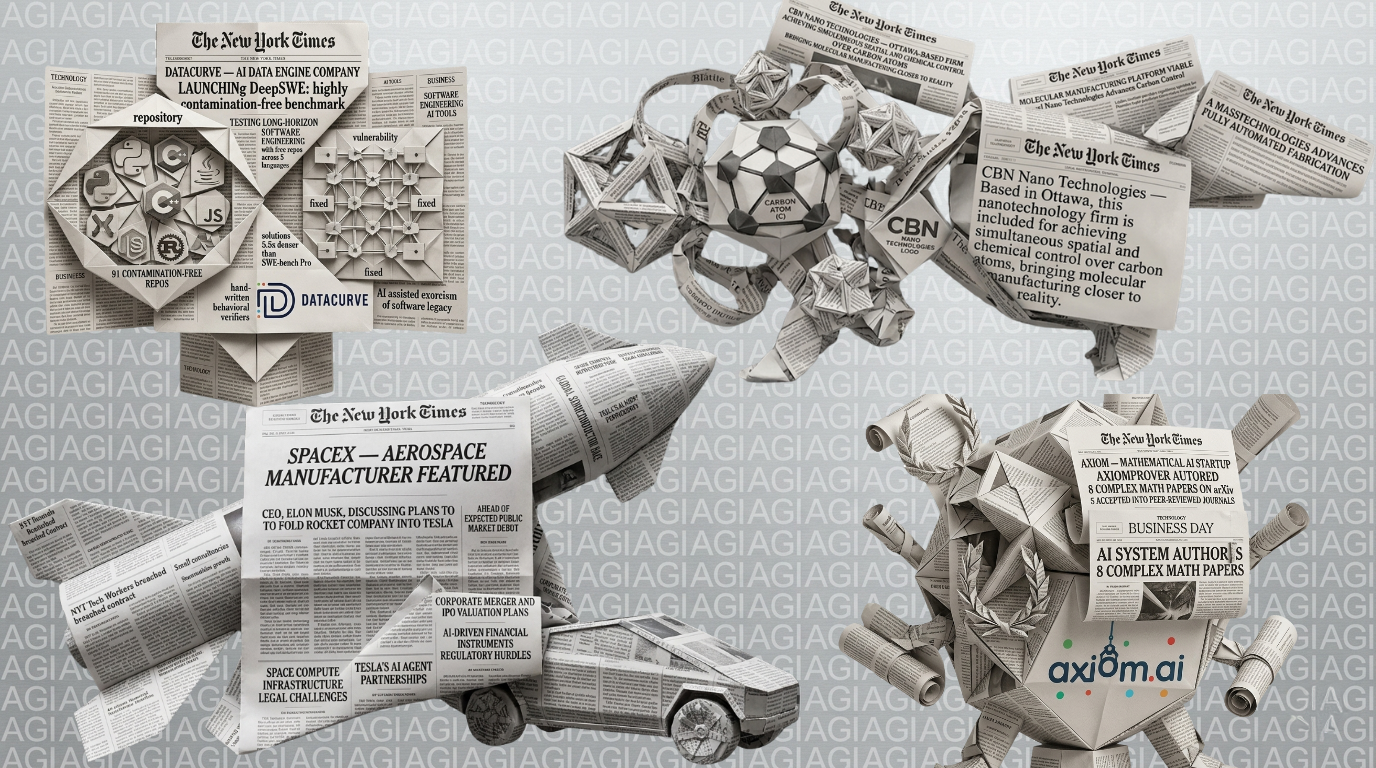
On May 28, 2026, @siouid142 continued the response to Dr. Alex Wissner-Gross’s observation that society lacks a stable definition of artificial general intelligence. Exhibit 2 arranges four paper constructions against a pale AGI field: Datacurve’s DeepSWE repository matrix, CBN Nano Technologies’ carbon structures, a SpaceX rocket fused with a Cybertruck-like body, and an axiom.ai robot announcing eight mathematics papers. The panel tests generality across code, atoms, corporate plans and proof.
A software repository, a carbon atom, a rocket fused to a vehicle, and a theorem-writing robot fold four newsletter reports into a newsprint world. The disputed threshold for AGI sits in the pale background; the foreground tests a more concrete proposition, whether one system can preserve meaning while moving coherently across code, atoms, corporate plans, and mathematical proof. Each domain remains recognizable even after its article becomes an object.
Datacurve’s DeepSWE benchmark becomes a repository matrix whose compartments sort languages, tests, vulnerabilities, and fixes. CBN Nano Technologies’ control over carbon becomes a molecular sphere wrapped in atomic headlines. Discussion of combining rocket and vehicle businesses produces a SpaceX-style body emerging from a Cybertruck-like chassis, while Axiom’s eight mathematics papers stand up as a robot built from the publication announcing them. Software architecture, molecular manufacturing, industrial consolidation, and formal reasoning share one material without losing their separate claims.
The repository shows Python, C, C++, JavaScript, and Rust symbols beside “91 CONTAMINATION-FREE REPOS,” testing grids, fixed vulnerabilities, and the Datacurve mark. A faceted “CARBON ATOM (C)” sits among folded molecular clusters under CBN Nano copy about molecular manufacturing. Below, merger and IPO headlines remain discussions rather than a completed-transaction claim as the rocket-truck crosses their pages. The newsprint robot carries axiom.ai branding and “AI SYSTEM AUTHORS 8 COMPLEX MATH PAPERS.” Article and sculpture remain visibly joined against the repeating field of “AGI,” binding each capability to the report that named it.
DeepSWE supplies the most explicit architecture. Its compartments name 91 contamination-free repositories, five programming languages, behavioral verifiers, fixes and vulnerability classes. Folding the benchmark into a matrix gives long-horizon software work a building rather than a leaderboard. The system must move through unfamiliar codebases, preserve local constraints and leave results that tests can inspect.
CBN Nano’s molecular cluster shifts the scale from repositories to atoms. A faceted carbon sphere and surrounding structures visualize simultaneous spatial and chemical control in mechanosynthetic fabrication. Drexler’s long-imagined diamondoid future enters the panel not as a smooth product but as a manipulable lattice. Intelligence becomes consequential when it can specify where matter goes and what bonds it forms.
Below, a rocket emerges from a Cybertruck-like chassis across headlines about possible corporate consolidation. The work does not claim that SpaceX and Tesla had completed a merger. It preserves the source as discussion and planning while giving that discussion a speculative body. Vehicle and launch system share one folded skin, showing how quickly a rumored organizational move can acquire the visual inevitability of an engineered object.
The axiom.ai robot stands as the panel’s formal-reasoning figure. “AI system authors 8 complex math papers” remains readable across its body, while the source reported that five had already been accepted. The robot is assembled from the publication announcing its output. It therefore embodies a recursive authorship problem: a system writes proofs, an institution evaluates them, and the newspaper folds that evaluation into a new author-shaped figure.
The four constructions do not illustrate one universal mind. They show a common pressure moving through unlike domains: maintain structure while transforming it. DeepSWE changes code without breaking behavior; mechanosynthesis changes matter without losing chemical control; corporate plans change ownership boundaries; automated mathematics changes the production of proof. Generality appears as transferable discipline rather than a personality.
As contemporary history painting, On the Definition of Artificial General Intelligence – Exhibit 2 makes cross-domain competence materially comparable without pretending the domains are identical. Its four objects share newsprint but retain separate standards of success. The work’s caution is embedded in its seams: a coherent paper world can reveal convergence while still distinguishing benchmark, experiment, corporate rumor and accepted proof.
Opening the gallery…