70 Clock Galerie / The Innermost Loop Feed Reply Tableaux
Sur la Définition de l'Intelligence Artificielle Générale – Pièce 1
On the Definition of Artificial General Intelligence – Exhibit 1
May 28, 2026
Sur la Définition de l'Intelligence Artificielle Générale – Pièce 1. On the Definition of Artificial General Intelligence – Exhibit 1. On May 28, 2026, Dr. Alex Wissner-Gross briefly stepped outside the usual Innermost Loop format to observe that everyone defi
Read the narration
Sur la Définition de l'Intelligence Artificielle Générale – Pièce 1.
On the Definition of Artificial General Intelligence – Exhibit 1.
On May 28, 2026, Dr. Alex Wissner-Gross briefly stepped outside the usual Innermost Loop format to observe that everyone defines artificial general intelligence differently; perhaps arrival occurs when society can no longer agree on what counts as intelligence. @siouid142 answered with a sequence of labeled paper exhibits. The first places a protein-biology world model, an AI film-production fund and tethered display glasses before the viewer while the letters AGI recede into the wall.
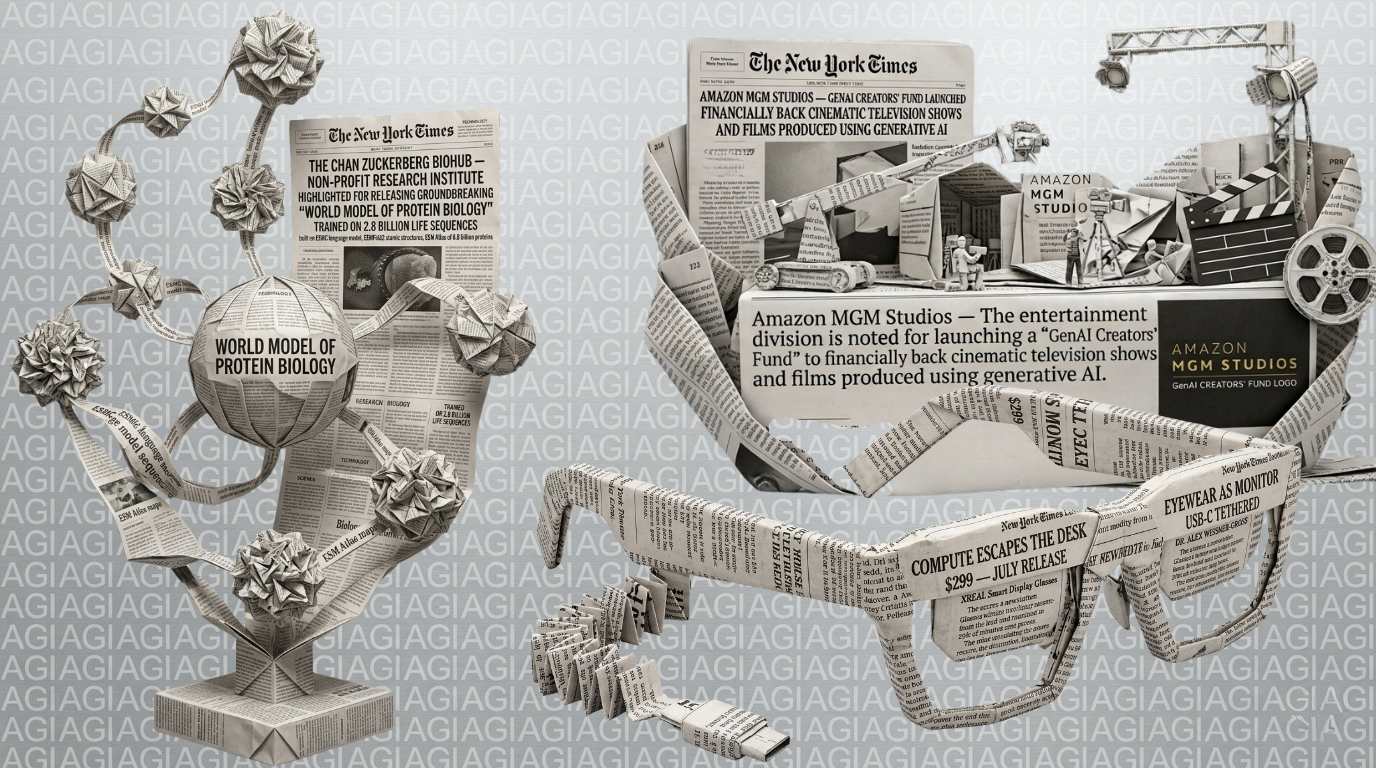
A paper protein globe grows beside a film set and USB-C display glasses, turning three reports into an argument about whether AGI needs a settled definition. Dr. Alex Wissner-Gross suggested that everyone defines artificial general intelligence differently—perhaps its arrival is the moment society can no longer agree on what counts. A year after a spoken phone request produced broken text, the same gesture now yields legible headlines, labels, prices, and interconnected paper objects.
Chan Zuckerberg Biohub’s world model of protein biology becomes a faceted botanical sphere orbited by sequence ribbons. Those ribbons become stems and blossoms, making language-like biological tokens grow into a modeled organism. Amazon MGM Studios’ GenAI Creators Fund becomes a miniature production stage with cameras, lights, trusses, a clapperboard, and film reel. Xreal’s tethered display glasses become an oversized monitor that has escaped the desk. Folding all three from The New York Times joins biology, cinema, and wearable computing through the information used to describe them.
At left, “WORLD MODEL OF PROTEIN BIOLOGY” rises from a newsprint pedestal beside a front page naming the Biohub and 2.8 billion life sequences. At upper right, the tiny studio surrounds the Amazon MGM announcement. Across the bottom, large paper glasses retain a USB-C cable and carry “COMPUTE ESCAPES THE DESK $299 — JULY RELEASE.” Pale “AGI” lettering covers the background but recedes behind concrete capabilities: modeling biological sequences, generating cinematic production, and moving a display from desk to face. The newspapers remain readable even after becoming the things they report.
The reply noted that a year earlier, speaking to a phone yielded broken lettering. Here the request produces coherent objects with readable names, numbers and relationships. No artifact proves AGI, but a familiar failure mode has become material for a coordinated argument.
The Chan Zuckerberg Biohub object occupies the left like a scientific terrarium. A faceted globe grows from a newspaper pedestal while sequence ribbons become stems, leaves and blossoms. The dispatch’s 2.8 billion life sequences are not represented as a database screen. They become a modeled ecology, showing how biological language can be folded into a structure that proposes relations across life.
Yet the globe remains visibly made from newsprint. Model and report cannot be separated. The article supplies names and scale; the sculpture supplies an imagined organism. This doubleness keeps the world model from appearing as life itself. It is an artifact built from observations, labels and institutional choices, however comprehensive its sequence space may be.
Across the bottom, oversized Xreal glasses carry their USB-C cable and the declaration that compute escapes the desk for 299 dollars in July. The tether complicates the promise. The display has moved onto the face, but it remains attached to another device and to the supply chain behind the connector. Escape is real as interface and incomplete as infrastructure.
Biology, cinema and eyewear constitute three different tests of generality. One system models proteins, another generates cultural production, and another relocates computation into everyday perception. They do not merge into a single superhuman agent. Their coexistence shows why a social definition of AGI becomes unstable: capability arrives as a field of specialized transformations whose combined effect may be more consequential than any ceremonial threshold.
The pale AGI wallpaper is therefore the correct hierarchy. The disputed category covers the room but does not command the foreground. Concrete achievements obscure it. Definition becomes environmental background while models, studios and glasses acquire weight, surface and price. The exhibit asks the viewer to look at what systems do before deciding what they should be called.
As contemporary history painting, On the Definition of Artificial General Intelligence – Exhibit 1 treats disagreement over AGI as a framing problem rather than an obstacle. The background asks for a definition; the foreground supplies changes in biology, entertainment and perception. Society may continue debating the noun while its articles are already being folded into the world the noun was meant to predict.
Opening the gallery…