70 Clock Galerie / The Innermost Loop Feed Reply Tableaux
Grève de l'Origami du Département Technique du New York Times Contre la Surveillance de la Productivité Agentique
New York Times Tech Department Origami Strike Against Agentic Productivity Surveillance
May 28, 2026
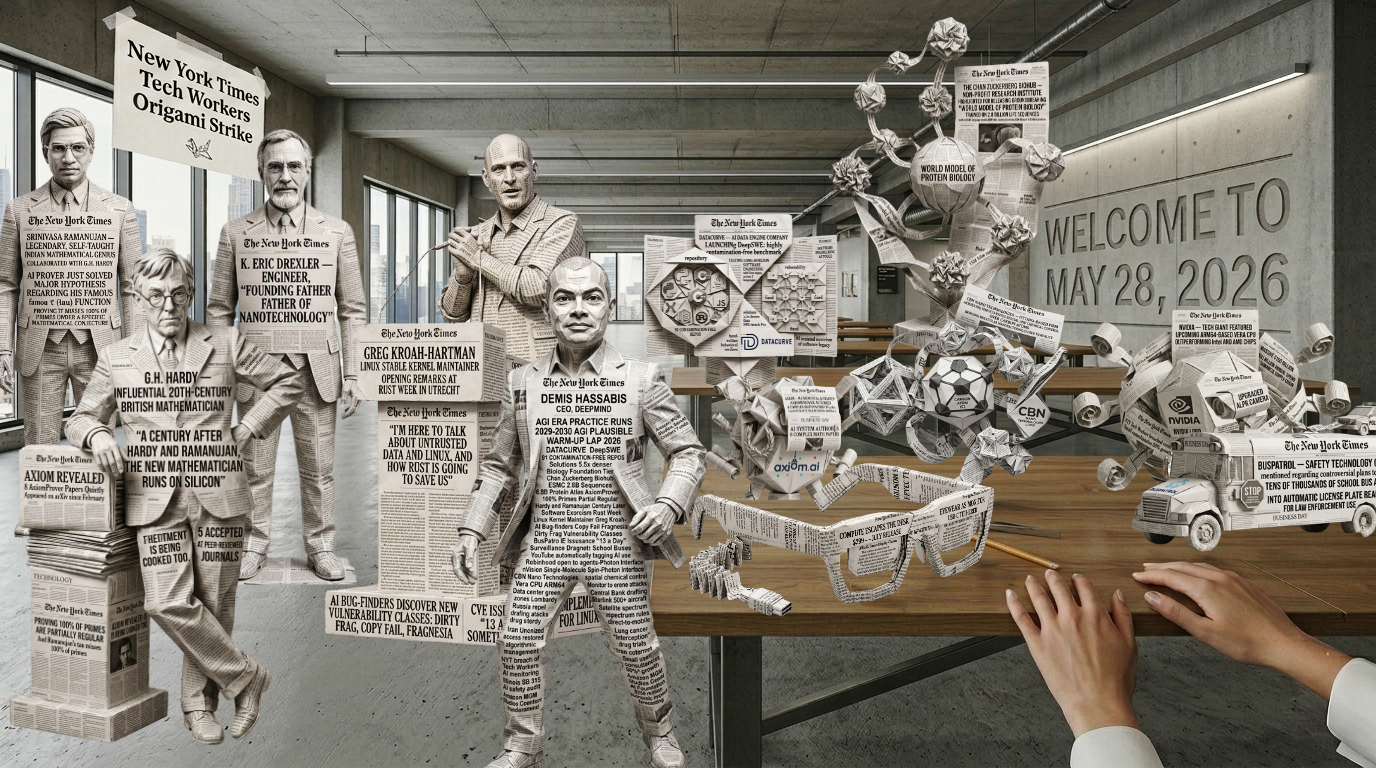
Grève de l'Origami du Département Technique du New York Times Contre la Surveillance de la Productivité Agentique. New York Times Tech Department Origami Strike Against Agentic Productivity Surveillance. On May 28, 2026, @siouid142 answered Dr. Alex Wissner-Gr
Read the narration
Grève de l'Origami du Département Technique du New York Times Contre la Surveillance de la Productivité Agentique.
New York Times Tech Department Origami Strike Against Agentic Productivity Surveillance.
On May 28, 2026, @siouid142 answered Dr. Alex Wissner-Gross’s Innermost Loop with a workplace made entirely from The New York Times. The dispatch reported that unionized Times technology workers accused management of breaching their contract through AI productivity monitoring. It also ranged across autonomous software engineering, theorem proving, protein modeling, mechanosynthetic carbon, wearable displays, Linux security and school-bus surveillance. The artist’s governing idea was exact: the workers’ strike would consist of folding the newspaper into origami.
New York Times pages are folded into the people, machines, molecules, and surveillance systems discussed by the paper’s own technology workers. Unionized staff said management breached their contract by using AI to monitor performance. The newsletter also ranged from AxiomProver work on primes and Ramanujan’s tau function to DeepMind’s agentic timetable, Datacurve’s DeepSWE benchmark, a protein-biology world model, mechanosynthetic carbon, Xreal glasses, and BusPatrol’s planned license-plate-reader expansion.
An “origami strike” turns that labor dispute into quiet material control. Instead of leaving the office, workers refold their employer’s publication into the world that its algorithms measure. Newsprint becomes both information and structure: a newspaper can describe surveillance, but the hands at the table can also bend the page into the camera, bus, chip, or executive being described. The disciplined paper craft answers automated productivity scoring with a different form of technical precision.
At left, folded Srinivasa Ramanujan and G. H. Hardy stand beside an “AXIOM REVEALED” column, while K. Eric Drexler, Greg Kroah-Hartman, and Demis Hassabis wear article text as clothing. Across the conference table, hands assemble a Datacurve repository matrix, a “WORLD MODEL OF PROTEIN BIOLOGY,” molecular carbon forms, Xreal glasses, an axiom.ai robot, a paper Nvidia array, and a BusPatrol school bus carrying upgraded ALPR cameras. A wall poster announces “New York Times Tech Workers Origami Strike,” and “WELCOME TO MAY 28, 2026” is cut into the concrete at right. The mastheads remain readable on faces and machines, so the institution being contested is literally the substrate held between the workers’ fingers.
This is not a conventional walkout. Human hands remain at the conference table and perform a more pointed act of material control. They take the employer’s informational product—the page on which authority is printed—and refold it into the people and systems used to measure them. The strike therefore withholds neither labor nor attention. It demonstrates that labor still decides what shape information takes.
Origami gives the protest a quiet, mathematical discipline opposed to the automated score. A productivity system counts outputs, speed and compliance; paper folding depends on sequence, touch, judgment and irreversible creases. Every object carries evidence of the hands that made it. The image answers invisible monitoring with a craft whose process remains physically legible on the finished surface.
The readable mastheads and headlines are crucial. Only a year earlier, as the accompanying reply observed, speaking to a phone often produced images with broken lettering. Here the page survives transformation without surrendering names, prices or institutional claims. The advance in image generation is therefore not announced by a benchmark. It is demonstrated by a room in which information remains coherent after becoming sculpture.
The date carved into the concrete and the wall banner naming the origami strike prevent the installation from becoming timeless craft. May 28 joins a labor dispute to a capability threshold. The office is both archive and picket line, and the newspaper is both evidence and the object being contested.
Human hands enter at the lower right rather than yielding the scene entirely to generated figures. Their scale is modest, yet they are the only bodies visibly changing matter. That compositional decision keeps agency with workers at the very moment the dispute concerns whether management may translate their activity into an agentic surveillance system.
As contemporary history painting, New York Times Tech Department Origami Strike Against Agentic Productivity Surveillance turns labor resistance into control over form. The workers do not destroy the newspaper; they prove they can recompile it. Their folded world preserves a central contradiction of the agentic era: institutions want intelligence that can reshape everything while treating the human hands already doing the reshaping as quantities to monitor.
Opening the gallery…