70 Clock Galerie / The Innermost Loop Feed Reply Tableaux
L'Aria d'Anniversaire du Dr Alex Wissner-Gross à l'Opéra de New York
Dr Alex Wissner Gross’s Happy Birthday Aria at New York Opera
May 26, 2026
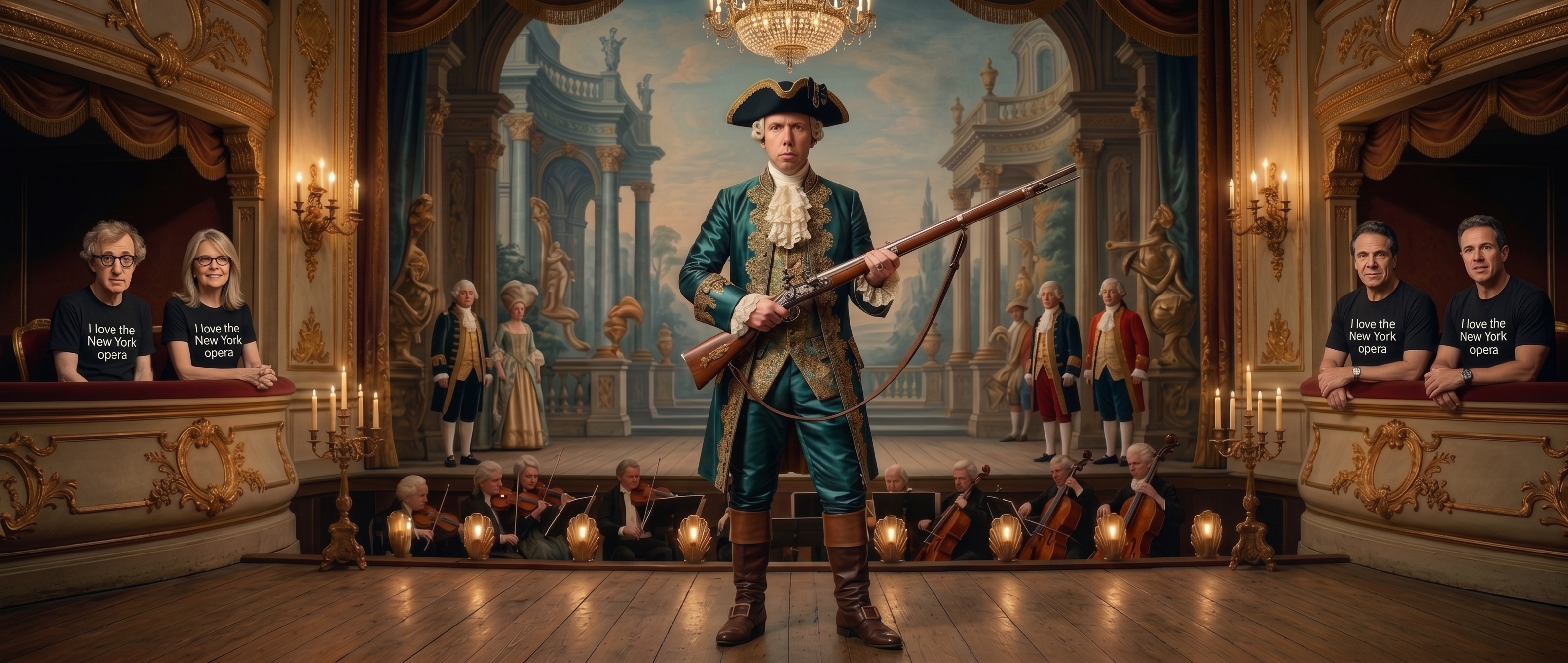
L'Aria d'Anniversaire du Dr Alex Wissner-Gross à l'Opéra de New York. Dr Alex Wissner Gross’s Happy Birthday Aria at New York Opera. Dated May 26, 2026 in the 70 Clock archive, this work did not originate in an Innermost Loop dispatch. @siouid142 made it from
Read the narration
L'Aria d'Anniversaire du Dr Alex Wissner-Gross à l'Opéra de New York.
Dr Alex Wissner Gross’s Happy Birthday Aria at New York Opera.
Dated May 26, 2026 in the 70 Clock archive, this work did not originate in an Innermost Loop dispatch. @siouid142 made it from a Moonshots exchange in which Salim Ismail began a birthday song, Dr. Alex Wissner-Gross tried to join, and Peter Diamandis cut it short. Wissner-Gross answered that his first career job had been at New York City Opera. The tableau restores the voice the podcast interrupted.
An awkward podcast interruption is enlarged into a Baroque opera gala with Dr. Alex Wissner-Gross alone at center stage. During Moonshots with Peter Diamandis episode 253, his singing was cut short; Wissner-Gross answered with the biographical detail that his first career job had been at New York City Opera. An operatic credential delivered inside a technology podcast becomes the premise for restoring the scale that the conversation denied it.
The birthday aria uses eighteenth-century ceremony rather than a contemporary microphone. Colonial dress, a painted architectural backdrop, orchestra pit, boxes, chandeliers, and gilt moldings convert the anecdote into a formal performance. A flintlock gives the central figure a second role, part tenor and part armed period protagonist, while New York cultural and political celebrities become the audience. The comedy lies in treating an offhand defense of a past job as though it had always been the evening’s grand production.
Wissner-Gross stands squarely before the footlights in a turquoise-and-gold coat, white cravat, tricorn hat, breeches, and boots, holding the long flintlock across his body. Below him, strings fill the orchestra pit; behind him, powdered figures wait inside the painted court. Woody Allen and Diane Keaton occupy the left box, Andrew and Chris Cuomo the right. All four wear identical black shirts reading “I love the New York opera,” a deliberately plain slogan inside the ornate room. No birthday cake or podcast equipment appears. The interrupted singer instead owns the entire proscenium, and every spectator displays the New York Opera credential he cited when the microphone moved on.
Scale is the first act of reparative comedy. A moment small enough to disappear between podcast topics is enlarged into a complete proscenium, orchestra pit and audience. The stage does not illustrate what literally happened; it supplies the magnitude implied by the biography. If the casual microphone would not hold the aria, the image builds a room acoustically and socially prepared to receive it.
Wissner-Gross’s turquoise-and-gold coat, white cravat, breeches, boots and tricorn place him inside an eighteenth-century theatrical world. He is not shown behind a laptop or chart. The costume insists that a technical identity can contain an earlier artistic career rather than superseding it.
The flintlock across his body gives the aria an armed punctuation. It may belong to the implied opera, to the colonial costume or to the defiant response of a singer denied his entrance. Because the weapon is too long to ignore, vocal authority becomes physical stance. The performer is no longer asking permission to contribute to the birthday chorus; he occupies the stage as someone whose scene has already begun.
Woody Allen and Diane Keaton in the left box, and Andrew and Chris Cuomo in the right, form two kinds of New York recognition. Film culture faces political and media culture across the room. Their matching black shirts reading “I love the New York opera” deliberately flatten those differences. The slogan is visually plain against gilt molding, velvet and chandeliers, as if contemporary fan merchandise had entered a ceremonial painting.
No cake, candle, podcast microphone or Moonshots logo explains the joke. Their absence is essential. Literal props would keep the work attached to the scale of the interruption. Instead, the orchestra and painted court transform “Happy Birthday” into the missing aria itself. The picture trusts the recovered backstory to do the documentary work while the stage performs the imaginative correction.
The image also preserves an unexpected relation between acceleration culture and human multiplicity. A person known in this archive for tracking artificial intelligence, markets and frontier infrastructure briefly becomes a singer whose first work belonged to an opera company. The old career is not an embarrassing prehistory. It is another system of timing, ensemble, breath and disciplined performance.
As contemporary history painting, Dr Alex Wissner Gross’s Happy Birthday Aria at New York Opera turns conversational dismissal into ceremonial restitution. Its extravagance is not flattery for its own sake. It argues that biography contains capacities a public role can hide, and that an interrupted voice may require an entire opera house before its scale becomes audible.
Opening the gallery…