70 Clock Galerie / The Innermost Loop Feed Reply Tableaux
Unité Centrale de l'Entité Quantique
Quantum Central Entity Mainframe
May 26, 2026
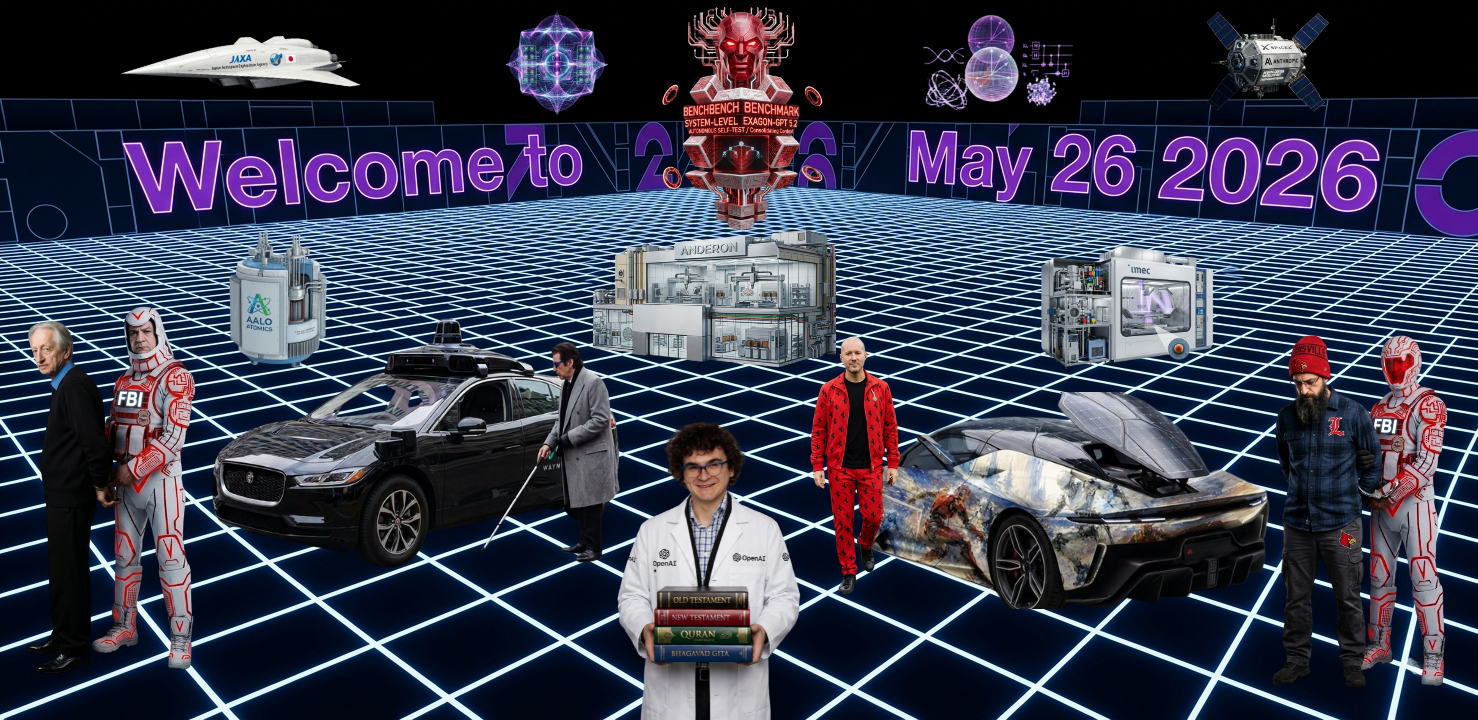
Unité Centrale de l'Entité Quantique. Quantum Central Entity Mainframe. On May 26, 2026, @siouid142 converted Dr. Alex Wissner-Gross’s Innermost Loop into a Tron-like mainframe. The dispatch moved from models consolidating memory during “sleep” and BenchBench’
Read the narration
Unité Centrale de l'Entité Quantique.
Quantum Central Entity Mainframe.
On May 26, 2026, @siouid142 converted Dr. Alex Wissner-Gross’s Innermost Loop into a Tron-like mainframe. The dispatch moved from models consolidating memory during “sleep” and BenchBench’s recursive evaluation to imec’s six-nanometer quantum-dot gates, the Anderon quantum-foundry program, Waymo independence for blind passengers, Aalo-X microreactors, JAXA hypersonics, orbital AI compute and federal reports about “anti-technology extremists.” The grid makes every institution a process inside one system.
A black Tron grid becomes a civic floor for quantum fabrication, microreactors, autonomous transport, hypersonics, safety enforcement, and a machine judging sacred texts. The newsletter reported imec fabricating a quantum-dot qubit with High-NA EUV lithography and gate gaps of about six nanometers, alongside Aalo-X microreactor progress, a JAXA Mach-5 ramjet, Waymo autonomy, Anderon’s quantum-foundry plans, and BenchBench evaluation. It also covered unpublished DHS and FBI material about anti-technology extremism, bringing institutional control into the same hardware story.
The mainframe setting gives those items one governing substrate. Microscopic gate arrays float like monuments, the red BenchBench entity becomes a Master Control Program, and researchers, critics, vehicles, and factories stand as processes inside its simulation. Cinematic references make autonomy and enforcement legible: Al Pacino’s blind character from Scent of a Woman approaches a driverless Waymo, while Tron-like FBI Sarks escort prominent AI-risk figures at the grid’s edges.
Geoffrey Hinton stands beside an FBI-marked Sark at far left; Roman Yampolskiy, in Louisville clothing, is paired with another at far right. Between them sit an Aalo Atomics unit, black Waymo Jaguar, Anderon building, imec fabrication module, and an artwork-wrapped Ferrari Luce beside Jony Ive in red. Adrien Ecoffet, wearing an OpenAI lab coat, offers a stack labeled Old Testament, New Testament, Quran, and Bhagavad Gita toward the hovering BENCHBENCH entity. Above the horizon fly a JAXA craft, six-nanometer gate and spin-trap diagrams, and a satellite marked AI/ANTHROPIC. “Welcome to May 26 2026” spans the grid in purple, while the two quantum structures hang overhead as the exact engineering blueprint behind the theatrical mainframe.
The red BenchBench entity governs the center like Tron’s Master Control Program. A benchmark that asks models to create tests other strong models cannot clear becomes a visible sovereign of evaluation. Its recursive authority mirrors the mainframe itself: the system judges the systems that invent the criteria by which systems will be judged. The theatrical villain clarifies a technical problem of who controls the test.
Adrien Ecoffet—not Sam Altman—stands beneath it holding the Old Testament, New Testament, Quran and Bhagavad Gita. The detail comes from Ecoffet’s joke that frontier laboratories were discussing which religion to select as a patron. Offering sacred books to a benchmark converts organizational alignment into machine adjudication. The humor is exact because the red entity does not appear capable of faith; it can only compare candidate traditions as inputs.
At the edges, Geoffrey Hinton and Roman Yampolskiy are handcuffed by FBI-marked Sark figures. Hinton’s likeness and Yampolskiy’s Louisville clothing identify the critics rather than anonymous suspects. Their symmetrical arrest does not report that either man was detained. It dramatizes the ambiguity created when state documents classify anti-technology extremism while prominent researchers publicly warn about technical danger. The system risks confusing criticism of the machine with hostility to society.
Al Pacino’s blind character from Scent of a Woman approaches the black Waymo Jaguar. Cinema gives the autonomy report an individual body and emotional history. The robotaxi promises not only efficiency but solitude and independence, allowing a passenger to move without asking another person for assistance. Against the coercive arrests at the borders, this smaller autonomy becomes the grid’s humane countercurrent.
Jony Ive stands beside the Ferrari Luce wrapped in the image attached to Wissner-Gross’s post. Nearby, the Anderon building and imec machine give quantum hardware an industrial address. The six-nanometer gate and spin-trap diagrams overhead are the engineering blueprints through which the theatrical mainframe could become physical.
As contemporary history painting, Quantum Central Entity Mainframe asks whether recursive intelligence and recursive governance are becoming visually indistinguishable. Benchmark, foundry, vehicle, reactor, critic and police agent all occupy the same grid. The mainframe’s power lies not in controlling every node, but in making every node appear as though it already belongs to one executable world.
Opening the gallery…