70 Clock Galerie / The Innermost Loop Feed Reply Tableaux
Le Langage d'un Chien : Le Collier d'Exolinguistique Sarama
A Dog’s Language: The Sarama Exolinguistics Collar
May 23, 2026
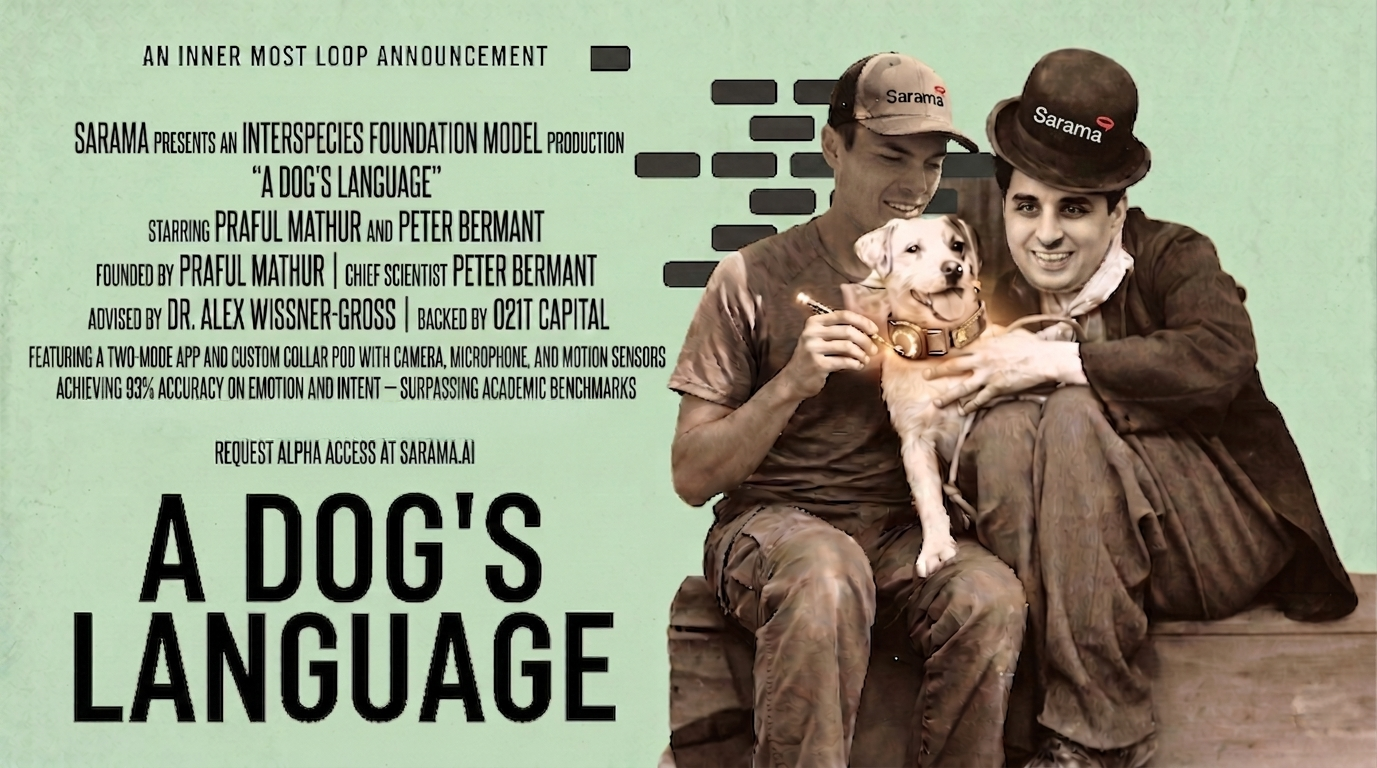
Le Langage d'un Chien : Le Collier d'Exolinguistique Sarama. A Dog’s Language: The Sarama Exolinguistics Collar. On May 23, 2026, @siouid142 answered Dr. Alex Wissner-Gross’s announcement of Sarama, described as the first consumer-scale interspecies foundation
Read the narration
Le Langage d'un Chien : Le Collier d'Exolinguistique Sarama.
A Dog’s Language: The Sarama Exolinguistics Collar.
On May 23, 2026, @siouid142 answered Dr. Alex Wissner-Gross’s announcement of Sarama, described as the first consumer-scale interspecies foundation model trained through smart dog collars. The project emphasized that canine behavior could not be fabricated from human text: grounded data had to be collected in homes through a custom pod combining camera, microphone and motion sensors. Its two-mode app reported 93 percent accuracy on emotion and intent. The response remakes Charlie Chaplin’s 1918 film A Dog’s Life as A Dog’s Language.
Charlie Chaplin’s 1918 silent-film composition is recast as an announcement for a device intended to make canine intent legible. The newsletter introduced Sarama’s interspecies foundation-model project and emphasized that animal behavior cannot simply be generated from existing human-language corpora; new grounded data must be measured in homes. Its collar pod combines camera, microphone, and motion sensing with a two-mode app, and the announcement reports 93% accuracy on emotion and intent.
A Dog’s Life supplies the exact cultural counterpoint. Silent cinema conveyed meaning without recorded dialogue through posture, gesture, expression, and context—the same channels through which dogs have long communicated with people. Renaming the poster A Dog’s Language turns the smart collar into an intertitle for the animal rather than a futuristic voice box. The old alley’s masonry also changes medium: brickwork breaks apart into floating digital blocks as observed behavior becomes training data.
The sepia-green broadside places founder Praful Mathur beside a Chaplin-styled Peter Bermant in a bowler hat, both seated with the collared dog between them. Their Sarama caps quietly preserve each role while borrowing the original film’s costume. The left text panel reads “AN INNER MOST LOOP ANNOUNCEMENT,” names Mathur and chief scientist Bermant, credits Dr. Alex Wissner-Gross as adviser and 021 Capital as backer, and lists the collar’s sensors and 93% figure. “REQUEST ALPHA ACCESS AT SARAMA.AI” appears above the oversized title. Behind the pair, rigid bricks dissolve into separated black data blocks. The most exact joke is therefore formal rather than hidden: a silent-film poster advertises the first instrument in the series designed to let its nonhuman co-star be read as speaking.
Silent film is the exact historical medium for this announcement because it built meaning from movement before synchronized speech. Chaplin’s posture, the dog’s attention and the surrounding alley allowed audiences to infer relationship without hearing a voice. Sarama formalizes that old interpretive act by turning gesture, sound and context into measurable multimodal data.
The dog remains seated between founder Praful Mathur and chief scientist Peter Bermant rather than appearing as a peripheral product demonstration. That position grants the animal compositional equality. Human experts frame the system, but the nonhuman subject supplies the behavior from which the model must learn. The collar is an instrument of observation, not a ventriloquist’s mouth.
Bermant’s work on sperm-whale codas through Project CETI widens the collar’s lineage beyond domestic pets. Bioacoustics enters the poster through the scientist dressed like Chaplin, connecting ocean-scale exolinguistics to the household dog. The bowler hat makes research history theatrical while the Sarama mark keeps the role precise.
The dissolving brick wall visualizes a consequential conversion. Homes and alleys provide continuous embodied context; the model separates that lived environment into clips, sensor traces and labeled blocks. Training data appears to liberate itself from masonry, yet every floating block remains dependent on an encounter that happened in a specific room with a specific animal.
The 93 percent figure is persuasive and incomplete. Emotion and intent are categories selected by humans, and accuracy depends on what counts as the correct answer. The poster treats the number as performance billing rather than final proof of translation. A readable dog is not necessarily a dog whose language has been fully understood.
Credit to Wissner-Gross as adviser and 021 Capital as backer makes institutional lineage part of the period typography. Scientific guidance, venture support, sensors and alpha access all occupy the same broadside.
As contemporary history painting, A Dog’s Language: The Sarama Exolinguistics Collar asks whether instrumentation can deepen companionship without reducing another species to a dashboard. Its optimism comes from treating canine behavior as meaningful enough to model. Its caution comes from the collar itself: the first voice humans hear may be shaped as much by our categories, homes and commercial interface as by the animal wearing it.
Opening the gallery…