70 Clock Galerie / The Innermost Loop Feed Reply Tableaux
La Seconde Source de Silicium au Panthéon de Hoboken
The Second Source of Silicon at the Hoboken Pantheon
May 22, 2026
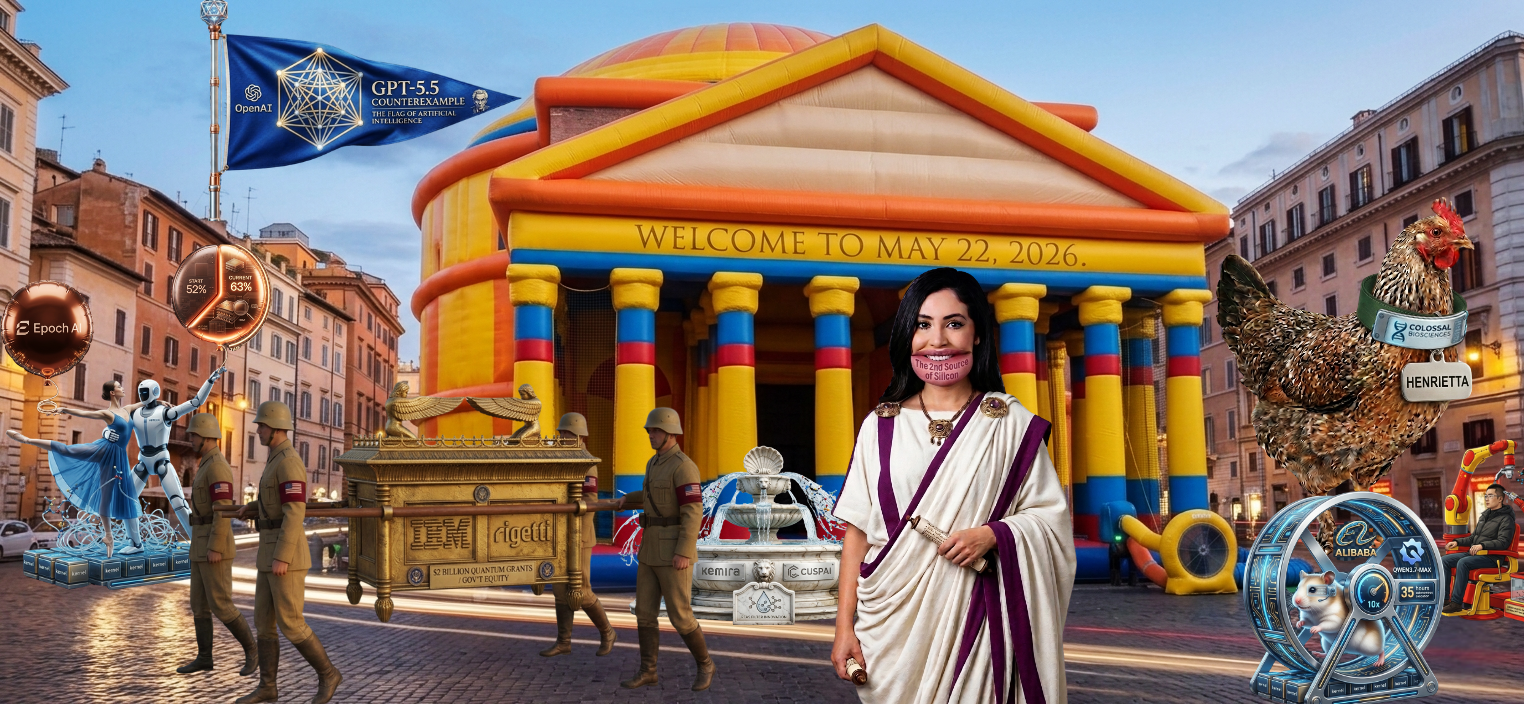
La Seconde Source de Silicium au Panthéon de Hoboken. The Second Source of Silicon at the Hoboken Pantheon. On May 22, 2026, @siouid142 responded to Dr. Alex Wissner-Gross’s Innermost Loop report that Gemini 3.5 Flash High had reconstructed Rome’s Pantheon thr
Read the narration
La Seconde Source de Silicium au Panthéon de Hoboken.
The Second Source of Silicon at the Hoboken Pantheon.
On May 22, 2026, @siouid142 responded to Dr. Alex Wissner-Gross’s Innermost Loop report that Gemini 3.5 Flash High had reconstructed Rome’s Pantheon through an OpenSCAD benchmark. The same dispatch tracked high-bandwidth memory rising from 52 to 63 percent of AI component cost, a proposed two-billion-dollar quantum-grant program with government equity, Colossal Biosciences’ artificial-egg work and Qwen 3.7-Max running for 35 hours to achieve a tenfold Triton speedup. The reply relocates the monument to Hoboken and makes it inflatable.
Rome’s Pantheon returns as a brightly inflated attraction while a giant chicken, a quantum ark, and a hamster wheel compete for space in the square. The absurd downgrade answers a concrete benchmark: the newsletter reported Gemini 3.5 Flash High reconstructing the Pantheon through OpenSCAD. It also tracked high-bandwidth memory rising from 52% to 63% of AI component cost, a proposed $2 billion quantum-grant program with government equity, Colossal Biosciences hatching chicks through artificial-egg work, and Qwen 3.7-Max sustaining a 35-hour tool-using run with a tenfold Triton speedup.
Inflatable plastic separates software reconstruction from physical permanence. A model can reproduce Hadrian’s geometry rapidly, but the translated monument still needs air, space, power, and local permission. Hoboken enters through Daniel Pinkwater’s 266-pound Henrietta from The Hoboken Chicken Emergency, turning modern synthetic biology into the return of a runaway local legend. “Second source of silicon” then becomes a bodily pun as well as a chip-supply concern.
The bounce-house portico bears “WELCOME TO MAY 22, 2026.” Epoch AI balloons at left carry the 52% and 63% figures, while uniformed agents transport a gold IBM–Rigetti ark engraved “$2 BILLION QUANTUM GRANTS / GOV’T EQUITY.” A central Roman-clad caricature has “The 2nd Source of Silicon” printed directly across her lower lip. Henrietta towers at right in a Colossal Biosciences collar; below her, an Alibaba/Qwen 3.7-Max hamster wheel displays “10X” and “35 hours.” A robot performs a ballet lift on labeled benchmark blocks, and the smallest corner vignette reduces another automation story to a robotic arm tending a seated customer. The Pantheon’s oculus survives, but everything around it has become portable, branded, and inflated.
The bounce-house material separates geometric knowledge from architectural duration. Software can reproduce dome, portico and oculus as a formal system, but Rome’s concrete achievement was also an act of logistics, labor and maintenance surviving two millennia. Inflatable plastic can imitate the silhouette quickly because air performs the structural work that history once assigned to masonry.
Hoboken supplies a municipal scale opposed to imperial Rome. The reconstructed Pantheon must occupy an ordinary lot among barriers, agents, toys and local commotion. This change of address turns a benchmark victory into a permitting question: what happens after a model solves the geometry and the object still needs land, power, inspection and neighbors?
Henrietta comes from Daniel Pinkwater’s The Hoboken Chicken Emergency, where a 266-pound chicken transforms local order into comic crisis. Giving her a Colossal Biosciences collar converts synthetic-biology news into the return of a city-specific literary creature. She is not a generic giant bird but a recovered cultural organism placed beside newly engineered chicks.
The IBM–Rigetti ark carried by uniformed agents makes quantum grants resemble a sacred public compact. Two billion dollars and government equity are engraved as cargo, joining frontier research to state ownership.
Epoch AI’s 52 and 63 percent balloons turn memory cost into atmospheric pressure. They float lightly, but the rising share means the physical bottleneck is becoming heavier within every system budget. “The second source of silicon” can therefore name both supply diversification and the lips of the central Roman caricature, where industrial language becomes bodily absurdity.
The Qwen hamster wheel compresses 35 hours, 432 kernel evaluations and 1,158 tool calls into repetitive motion. Its “10X” result is genuine, yet the apparatus asks whether long autonomous execution looks less heroic when rendered as a small animal running inside a branded loop. Endurance becomes spectacle only after the energy cost is hidden.
As contemporary history painting, The Second Source of Silicon at the Hoboken Pantheon contrasts computational reconstruction with physical persistence. The model can rebuild Hadrian’s form, but the tableau repopulates it with memory constraints, public capital, engineered life, literature and local friction. The Pantheon returns quickly because it is filled with air; history remains heavy because everything around it still has to live somewhere.
Opening the gallery…