70 Clock Galerie / The Innermost Loop Feed Reply Tableaux
Quiconque a Dit Y.O.L.O. Était un Menteur au Cimetière de Grove Street, New Haven
Whoever Said Y.O.L.O. Was a Liar at Grove Street Cemetery, New Haven
May 21, 2026
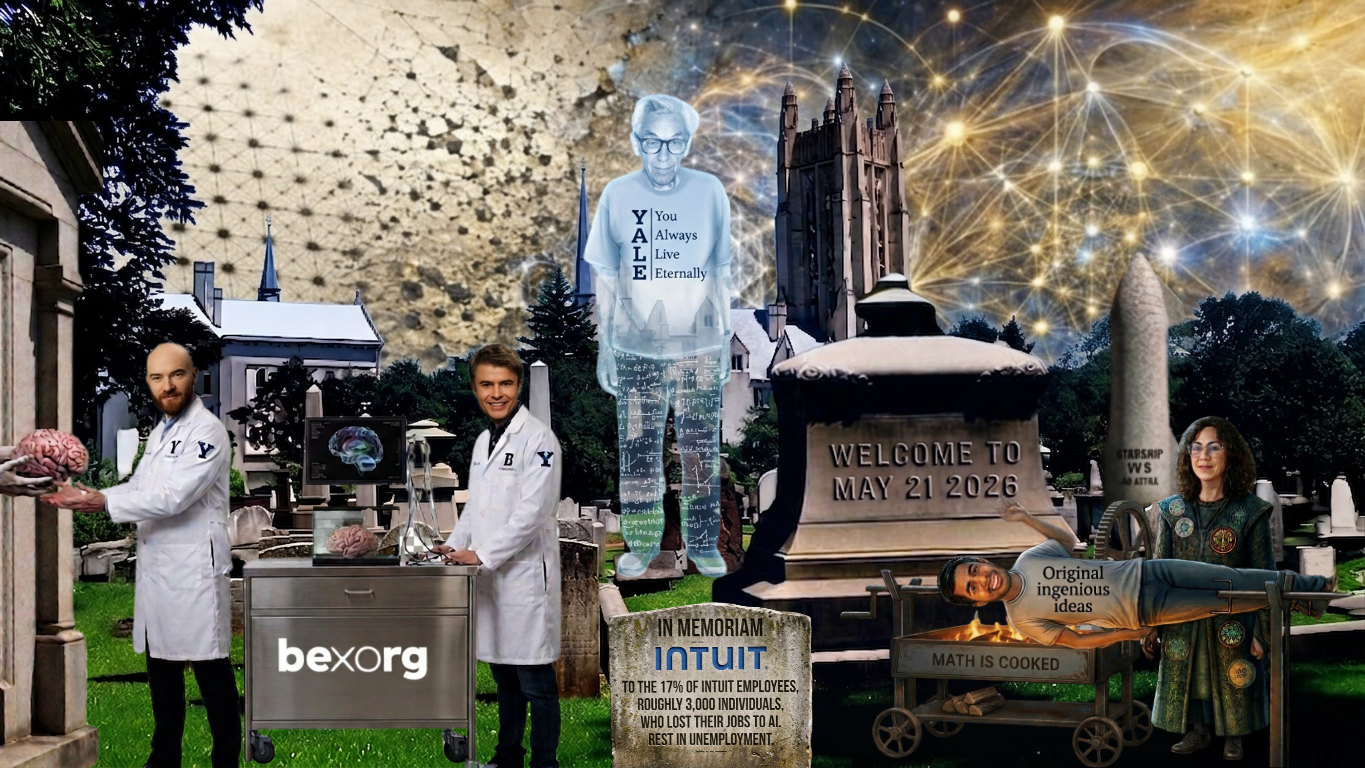
Quiconque a Dit Y.O.L.O. Était un Menteur au Cimetière de Grove Street, New Haven. Whoever Said Y.O.L.O. Was a Liar at Grove Street Cemetery, New Haven. On May 21, 2026—not May 20—@siouid142 turned Dr. Alex Wissner-Gross’s Innermost Loop into a gothic ledger a
Read the narration
Quiconque a Dit Y.O.L.O. Était un Menteur au Cimetière de Grove Street, New Haven.
Whoever Said Y.O.L.O. Was a Liar at Grove Street Cemetery, New Haven.
On May 21, 2026—not May 20—@siouid142 turned Dr. Alex Wissner-Gross’s Innermost Loop into a gothic ledger at Grove Street Cemetery in New Haven. Bexorg was restoring cellular functions in intact brains from deceased donors; AI-assisted mathematics had reopened a long-standing Paul Erdős planar unit-distance problem; and Intuit announced a 17 percent workforce reduction affecting roughly 3,000 people. The work joins biological reanimation, mathematical afterlife and employment displacement on Yale’s burial ground.
Grove Street Cemetery becomes a shared open-air laboratory for reanimated tissue, automated mathematics, and newly unemployed labor. Bexorg’s work restoring cellular function in intact brains from deceased donors appeared beside an AI-assisted solution to a long-standing Paul Erdős planar unit-distance problem and Intuit cutting 17% of its workforce, roughly 3,000 people. Each item disturbed a different boundary—between life and death, open conjecture and solved proof, employment and automation—so the cemetery supplies a single ground for all three.
The title’s joke rewrites YOLO as Y.A.L.E., “You Always Live Eternally.” Yale’s New Haven setting binds biotechnology to a gothic institutional landscape, while “MATH IS COOKED” converts a timeline phrase about model capability into an outdoor rotisserie. Ghosts, graves, and memorials give restored brain function, reopened mathematics, and displaced labor three forms of uneasy afterlife.
Likenesses of Bexorg pioneers Nenad Sestan and Zvonimir Vrselja stand in Yale lab coats at a cart with brains, tubing, and a neural monitor. One scientist holds an intact brain while another brain appears on the monitor. Above them, a translucent Paul Erdős figure wears a shirt that spells out the Y.A.L.E. acronym, his legs dissolving into equations. A front headstone reads “IN MEMORIAM INTUIT” and records the 17%, 3,000-person layoff as “Rest in unemployment.” At right, a figure labeled “Original ingenious ideas” turns on a spit above the “MATH IS COOKED” fire, watched beside the “STARSHIP WS ATTRA” obelisk. The central tomb’s in-image inscription reads “WELCOME TO MAY 21 2026,” and the sky changes from a unit-distance lattice into a vast luminous neural web.
The date correction is substantive because the central tomb is itself inscribed “WELCOME TO MAY 21 2026.” Same-day response is part of the project’s evidence system. Preserving May 21 keeps the cemetery aligned with the source event rather than repeating the stale website metadata that once placed the work one day early.
Sestan and Vrselja occupy the left side as scientists rather than necromancers. Their Yale coats, brain cart, tubing and neural monitor keep the work grounded in experimental procedure even while the cemetery invites supernatural reading. The tension is deliberate: a restored function is not a resurrected person, but old language for death becomes inadequate once tissue can resume organized activity.
Paul Erdős appears as a translucent figure whose legs dissolve into equations. Mathematics grants a different form of survival: a conjecture can remain active after its author dies and receive a new proof through tools unavailable during his life. The Y.A.L.E. shirt makes “You Always Live Eternally” both campus joke and theory of intellectual persistence.
The Intuit headstone is the scene’s most contemporary memorial. “Rest in unemployment” turns a percentage and headcount into a burial inscription, refusing the abstraction of restructuring language. Unlike the revived brain and reopened problem, displaced workers receive no automatic second life. Their skills, routines and institutional identities must seek another body.
At right, “Original ingenious ideas” rotates over the “MATH IS COOKED” fire. The phrase captures anxiety that proof has become a production process, but the rotisserie complicates the slogan. Cooking can mean destruction, completion or transformation. The figure is sacrificed to the demand for results while the tools that supposedly kill originality also make new mathematical movement possible.
The luminous neural web spreading across the sky links wetware and geometry without claiming they are identical. Both stories concern dormant structures made active through an external system. Grave markers keep those activations inside a history of named persons and institutions, preventing the technical achievements from floating free of mortality.
As contemporary history painting, Whoever Said Y.O.L.O. Was a Liar at Grove Street Cemetery makes afterlife uneven. Cells resume function, equations resume motion and corporate labor is declared obsolete. The joke is funny because it is impossible, yet the picture’s deeper claim is exact: technologies now reopen boundaries that law, ritual and ordinary language still treat as closed.
Opening the gallery…