70 Clock Galerie / The Innermost Loop Feed Reply Tableaux
Ornn Rejoint les Goombas des Matières Premières à l'Intercontinental Exchange
Ornn Joins the Commodities Goombas at the Intercontinental Exchange
May 19, 2026
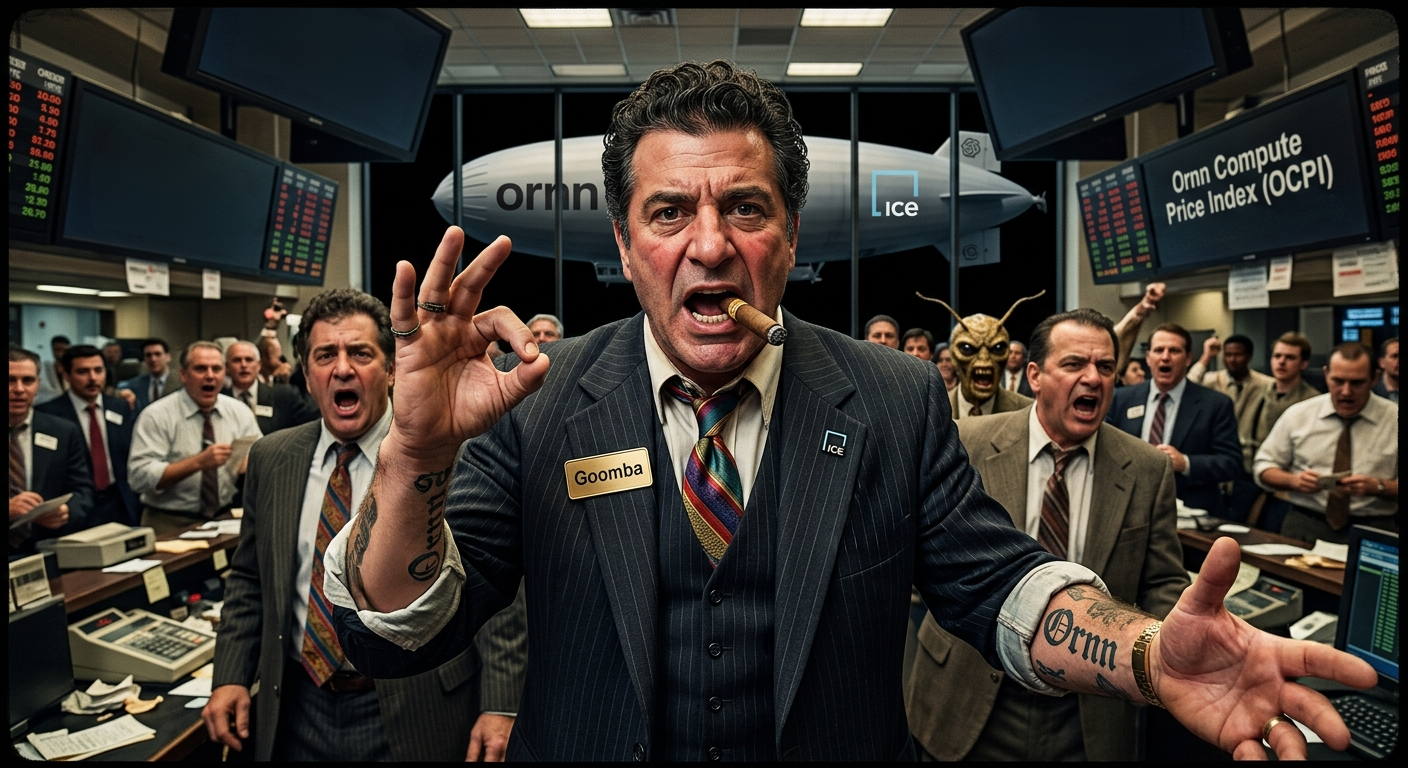
Ornn Rejoint les Goombas des Matières Premières à l'Intercontinental Exchange. Ornn Joins the Commodities Goombas at the Intercontinental Exchange. On May 19, 2026, @siouid142 made a second response to the Ornn–Intercontinental Exchange announcement by moving
Read the narration
Ornn Rejoint les Goombas des Matières Premières à l'Intercontinental Exchange.
Ornn Joins the Commodities Goombas at the Intercontinental Exchange.
On May 19, 2026, @siouid142 made a second response to the Ornn–Intercontinental Exchange announcement by moving beneath the immaculate dirigible and onto the human trading floor. The same contracts that promised standardized exposure to H100, H200, B200, RTX 5090 and other GPU types now enter the culture of commodity brokers. Wissner-Gross’s phrase “commodities goombas” supplied the governing caricature: compute arrives at the exchange surrounded by cigars, paper tickets, tattoos, hand signals and bodies trained to price scarcity by shouting.
An old commodities pit receives GPU pricing with cigars, tattoos, hand signals, and a literal goomba among the suits. The Ornn–ICE announcement moved compute into the lineage of regulated markets. Intercontinental Exchange founder Jeff Sprecher had bought a struggling power exchange in 1997 and built electronic clearing around markets once governed by opaque, noisy trading. GPU capacity entered that history as a standardized exposure, but brokers, market makers, and clearing desks still carried the habits of oil, gas, cotton, and open outcry.
“Commodities goombas” turns pit culture into caricature: loud voices, rolled sleeves, paper tickets, and bodies competing for attention. The slang marks the cultural translation required when compute leaves software pricing and becomes something an old commodities desk can quote, hedge, and shout across a room. A small monstrous goomba hidden behind the central broker makes the insult visible without turning the whole setting into a game world.
The foreground trader wears a “Goomba” name badge and ICE lapel pin, with “Ornn” tattooed across one forearm and its circular mark on the other. His pinched-finger signal and cigar echo the shouting brokers behind him. Screens on both walls carry price ladders, while the clearest monitor identifies the “Ornn Compute Price Index (OCPI).” Through the rear windows, the Ornn airship from the previous work passes with separate Ornn and ICE marks, linking the clean corporate announcement to the human frenzy below. The Easter egg is the creature standing almost unnoticed among the suits: the new asset may be electronically cleared, but its marketplace is still populated by the old pit’s theatrical archetypes.
The central broker’s body acts as the contract’s first human interface. His Ornn tattoo cannot be removed like a badge, while the ICE pin identifies the institution that authorizes the market. One mark suggests tribal commitment and the other formal jurisdiction. Between them, a new financial product acquires both subculture and law.
His pinched-finger gesture is a pre-digital compression system. Before a screen could distribute every price, floor traders used codified movements to communicate through noise. Placing compute futures inside that choreography reminds the viewer that markets have always required bandwidth, protocols and error correction. The pit is an old communications network wearing sleeves.
Jeff Sprecher’s history deepens the joke. Buying a struggling power exchange for one thousand dollars in 1997 and building electronic clearing around opaque energy markets established the institutional ancestor of this scene. The software future of GPU trading grows from a project that once confronted the same disorder now preserved theatrically in the pit.
The OCPI screens promise transparency, but the faces around them remain competitive and exaggerated. A standardized index can make price exposure legible without making motives calm. The work refuses the fantasy that electronic clearing removes appetite, bravado or asymmetry. It relocates those forces around a more precise number.
The literal goomba hiding among the suits is the picture’s smallest and sharpest Easter egg. It converts slang into a creature while exposing how every profession produces its own caricature. The broker and the monster differ less than expected: both are compact, aggressive inhabitants of a system whose rules outsiders must learn quickly.
Through the windows, the clean Ornn airship repeats the previous work at miniature scale. Corporate announcement and market culture now occupy one visual chain. From outside, the product appears as smooth institutional machinery; from inside, it is negotiated by people leaning, signaling and competing for position. Neither view is complete alone.
As contemporary history painting, Ornn Joins the Commodities Goombas at the Intercontinental Exchange makes financial plumbing social again. Compute may be the newest commodity, but its entry does not begin from cultural zero. The image shows a frontier technology being adopted by an old market species—measured on screens, cleared electronically and still carried through the room by gesture, reputation and nerve.
Opening the gallery…