70 Clock Galerie / The Innermost Loop Feed Reply Tableaux
Surf sur BugCrowd vers un Bruit Bon Marché
BugCrowd Surfing to Cheap Noise
May 18, 2026
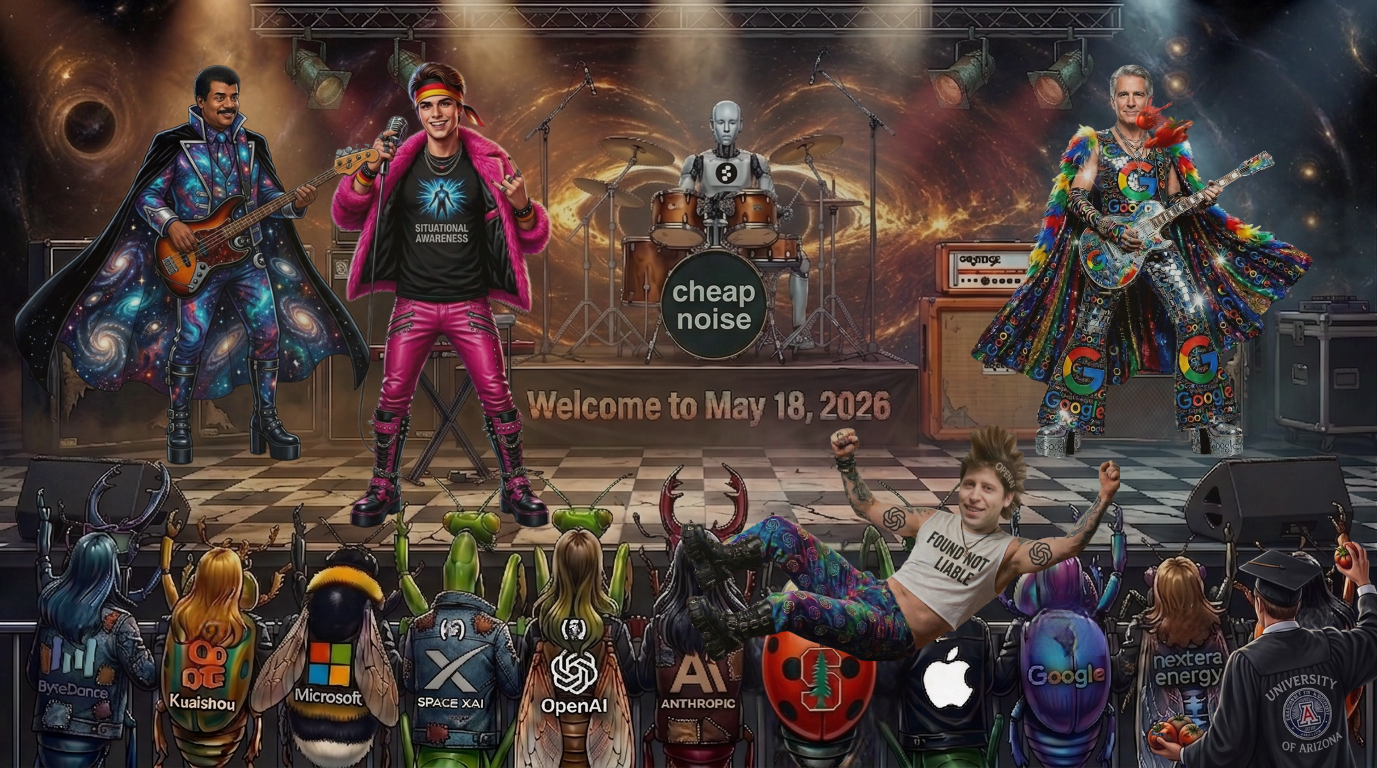
Surf sur BugCrowd vers un Bruit Bon Marché. BugCrowd Surfing to Cheap Noise. On May 18, 2026, @siouid142 turned Dr. Alex Wissner-Gross’s Innermost Loop line “cheap intelligence also means cheap noise” into a rock concert whose audience is Bugcrowd. The dispatc
Read the narration
Surf sur BugCrowd vers un Bruit Bon Marché.
BugCrowd Surfing to Cheap Noise.
On May 18, 2026, @siouid142 turned Dr. Alex Wissner-Gross’s Innermost Loop line “cheap intelligence also means cheap noise” into a rock concert whose audience is Bugcrowd. The dispatch reported AI-generated vulnerability submissions quadrupling in three weeks and Linus Torvalds calling duplicate security traffic almost unmanageable. It also joined Sam Altman’s courtroom victory, Leopold Aschenbrenner’s infrastructure holdings, Eric Schmidt’s hostile commencement reception and Neil deGrasse Tyson’s revised posture toward unexplained phenomena. The tableau makes them share one stage.
A robot rock band performs “Cheap Noise” above a Bugcrowd made literal as a branded insect audience. Cheap intelligence also means cheap noise: Bugcrowd had seen AI-generated vulnerability submissions quadruple in three weeks, while Linus Torvalds described duplicate security traffic as unmanageable. The same account recorded Sam Altman’s “found not liable” courtroom outcome, Leopold Aschenbrenner’s disclosed infrastructure holdings, Eric Schmidt’s hostile commencement reception, and Neil deGrasse Tyson revising the baseline of his public UAP skepticism.
Altman’s legal outcome becomes the slogan on a crowd-surfer’s shirt, and security overload becomes music with too many automated performers. The volume is generated cheaply, but the humans and institutions below still have to carry it. Arena staging lets verdict, capital, science, and software failure share one unstable frequency; every participant becomes either a performer or a shell in the swarm.
Tyson plays bass in a galaxy cape at far left. A German-flag headband and “SITUATIONAL AWARENESS” shirt identify Aschenbrenner at the microphone; Schmidt plays guitar in a garment covered with Google marks while a University of Arizona graduate raises tomatoes at the barrier. The robot’s bass drum reads “cheap noise,” backed by the day’s gravitational anomaly. Below, beetles and cicadas wear ByteDance, Kuaishou, Microsoft, SpaceXAI, OpenAI, Anthropic, Apple, Google, NextEra Energy, and university insignia. Altman crosses that branded swarm in a “FOUND NOT LIABLE” crop top, with OpenAI symbols on his shaved scalp, arms, and trousers. “Welcome to May 18, 2026” is set into the stage itself, fixing the concert to the exact news cycle it remixes.
The governing pun is not merely that Bugcrowd has become a crowd of bugs. Each insect carries a corporate or institutional shell, so the swarm visualizes how automated reports arrive through real platforms, customers and laboratories. Every beetle is individually legible while the mass becomes impossible to govern.
Altman’s crowdsurf converts a legal result into a theory of platform power. His “FOUND NOT LIABLE” shirt records the verdict, yet his elevated position depends on the same synthetic torrent that threatens to overwhelm the people beneath him. He does not silence the noise; he uses it as a supporting medium. Exoneration becomes buoyancy.
The robot drummer supplies the correct producer for the phrase “Cheap Noise.” A machine can maintain tempo without fatigue and generate an endless beat at negligible marginal cost. The drum kit therefore turns a security problem into cultural production: volume is no longer evidence of importance, originality or even distinct authorship. It is simply a rhythm the network can afford to repeat.
Aschenbrenner, Schmidt and Tyson give the band three different relationships to authority. The German flag and Situational Awareness costume turn geopolitical forecasting into lead-singer theater. Schmidt’s Google-covered guitar makes legacy technical power absorb public disapproval as performance, while Tyson’s galaxy cape lets scientific skepticism enter a venue built from anomalous signals.
The tomatoes thrown by the University of Arizona graduate are deliberately low-tech. Against models, platforms and infrastructure holdings, the fruit preserves the ancient audience right to register dissatisfaction with the body. It is comic protest, but also a reminder that cheap digital speech does not eliminate the physical risk of appearing before a crowd.
The stage inscription fixes May 18 because the work depends on collision rather than timeless symbolism. Courtroom, fund disclosure, commencement, UAP reconsideration and vulnerability spam were adjacent for one news cycle. The image gives that temporary adjacency an acoustic form before the items separate into different historical categories.
As contemporary history painting, BugCrowd Surfing to Cheap Noise asks what happens when intelligence becomes inexpensive faster than judgment does. The concert is energetic because abundance is real, and exhausting because selection remains scarce. Its central spectacle is not a triumphant executive or a rebellious audience. It is a culture learning to stand beneath a machine-made flood while its most powerful figures discover how to surf it.
Opening the gallery…