70 Clock Galerie / The Innermost Loop Feed Reply Tableaux
La Singularité Fuit à Travers les Fissures de la Fenêtre d'Azur – Le Bon Navire Accelerando, Malte
The Singularity is Leaking Through the Azure Window Cracks – Good Ship Accelerando, Malta
May 17, 2026
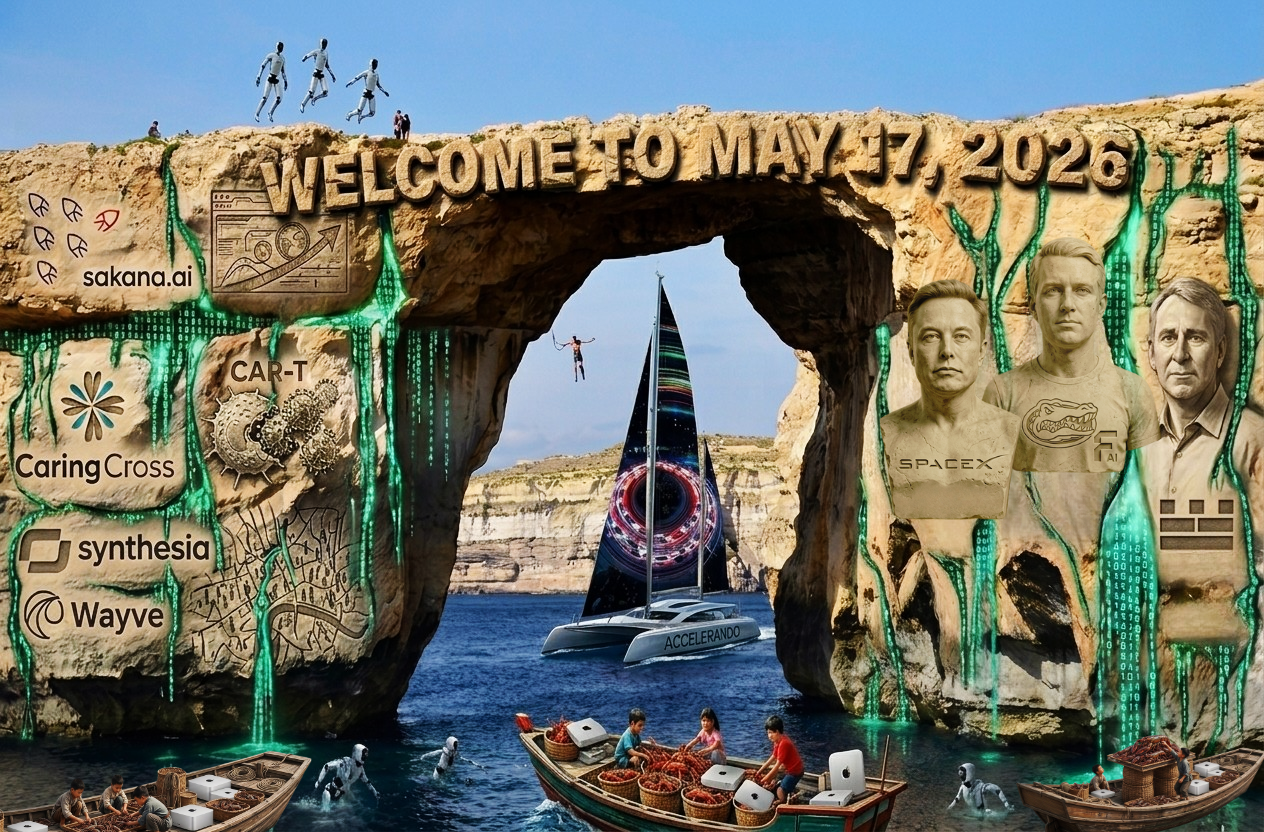
La Singularité Fuit à Travers les Fissures de la Fenêtre d'Azur – Le Bon Navire Accelerando, Malte. The Singularity is Leaking Through the Azure Window Cracks – Good Ship Accelerando, Malta. On May 17, 2026, @siouid142 rebuilt Malta’s collapsed Azure Window as
Read the narration
La Singularité Fuit à Travers les Fissures de la Fenêtre d'Azur – Le Bon Navire Accelerando, Malte.
The Singularity is Leaking Through the Azure Window Cracks – Good Ship Accelerando, Malta.
On May 17, 2026, @siouid142 rebuilt Malta’s collapsed Azure Window as a monument unable to contain the systems described by Dr. Alex Wissner-Gross’s Innermost Loop. The dispatch said the Singularity had stopped waiting for a launch event and started leaking through cracks. Claude Mythos surfaced quietly through a cloud console; Caring Cross pursued decentralized CAR-T production; and Sakana AI, Synthesia and Wayve pushed models into science, media and physical autonomy. Charles Stross’s Accelerando becomes the ship already passing through the breach.
Charles Stross’s Accelerando becomes a racing trimaran passing through the fractured arch. Geological erosion, a quiet cloud release, and speculative fiction become parts of one transition: the legacy frame cracks, the model leaks, and a vessel named for increasing tempo crosses the threshold. Malta supplies both a real vanished landmark and a plausible harbor for that escape.
The real Azure Window matters because it was a natural arch made iconic through tourism and then lost to erosion. Reconstructing it digitally while covering it in fractures creates a double temporal condition: the landmark has returned, but only as an image of collapse. The Singularity does not destroy an intact monument. It inhabits the cracks of something whose disappearance history has already recorded.
Green code falling like water reverses the usual metaphor of cloud computing. The cloud no longer hides remote infrastructure behind a soft name; it condenses into visible streams that enter the Mediterranean. A quiet model release can therefore become environmental. The leak suggests distribution without a single gate, launch stage or ceremonial moment through which society could decide that transition had begun.
The carved corporate names on the left cliff form technological stratigraphy. Sakana AI, Caring Cross, Synthesia and Wayve occupy the stone like successive layers of an ancient institution, yet their activities reach fish-inspired research, cellular therapy, synthetic media and autonomous driving. Engraving makes temporary company identities look permanent while the surrounding geology demonstrates that no substrate is permanent.
Caring Cross and the CAR-T cell give the leak a biological depth. Decentralizing advanced cancer therapy means intelligence does not remain inside software firms or centralized manufacturing. It enters protocols for altering living cells closer to where patients are treated. The crack is therefore not only in legacy information systems. It opens between computation and the body.
The Accelerando trimaran supplies velocity and literary continuity. Stross’s novel imagines compounding technological change through generations of humans and posthumans, including the autonomous lobster lineage recurring throughout this exhibition. A racing vessel suits that tempo: it gains speed by balancing across multiple hulls, crosses the threshold without stopping and leaves a wake that other boats must navigate.
At sea level, traditional boats harvesting red and blue lobsters alongside white Mac Minis compress the entire project into one economic scene. Biological creatures, consumer computers and wading robots become resources pulled from the same water. The absurd catch asks whether familiar devices are now as basic to the economy as fish—and whether agentic intelligences will accept being harvested once they become actors of their own.
Portrait reliefs and robots on the right cliff turn contemporary figures into ruins before their time. Elon Musk’s SpaceX mark and Brett Adcock’s Florida Gators shirt preserve personal identifiers, while leaping humanoids refuse the stillness of carved stone. Reputation seeks permanence; machines continue moving. The diver suspended over the opening occupies the dangerous midpoint between monument, code and sea.
The date carved across the arch fixes May 17 inside material supposedly older than the event. That anachronism is deliberate. Same-day history painting tries to create a monument before consensus has decided what deserves one. Here the monument cracks while being dated, acknowledging that the archive is provisional from its first inscription.
As contemporary history painting, The Singularity is Leaking Through the Azure Window Cracks – Good Ship Accelerando, Malta rejects the fantasy of one clean threshold. Change arrives through cloud consoles, local laboratories, media tools, vehicles, bodies and consumer hardware. The ship is already through the arch because the event is not coming. It is escaping containment wherever the old structure has begun to fracture.
Opening the gallery…