70 Clock Galerie / The Innermost Loop Feed Reply Tableaux
Le Pont sur un Étang de Nymphéas Plus Grands – La Vallée Dérangeante
Bridge Over a Pond of Larger Water Lilies – Uncanny Valley
May 15, 2026
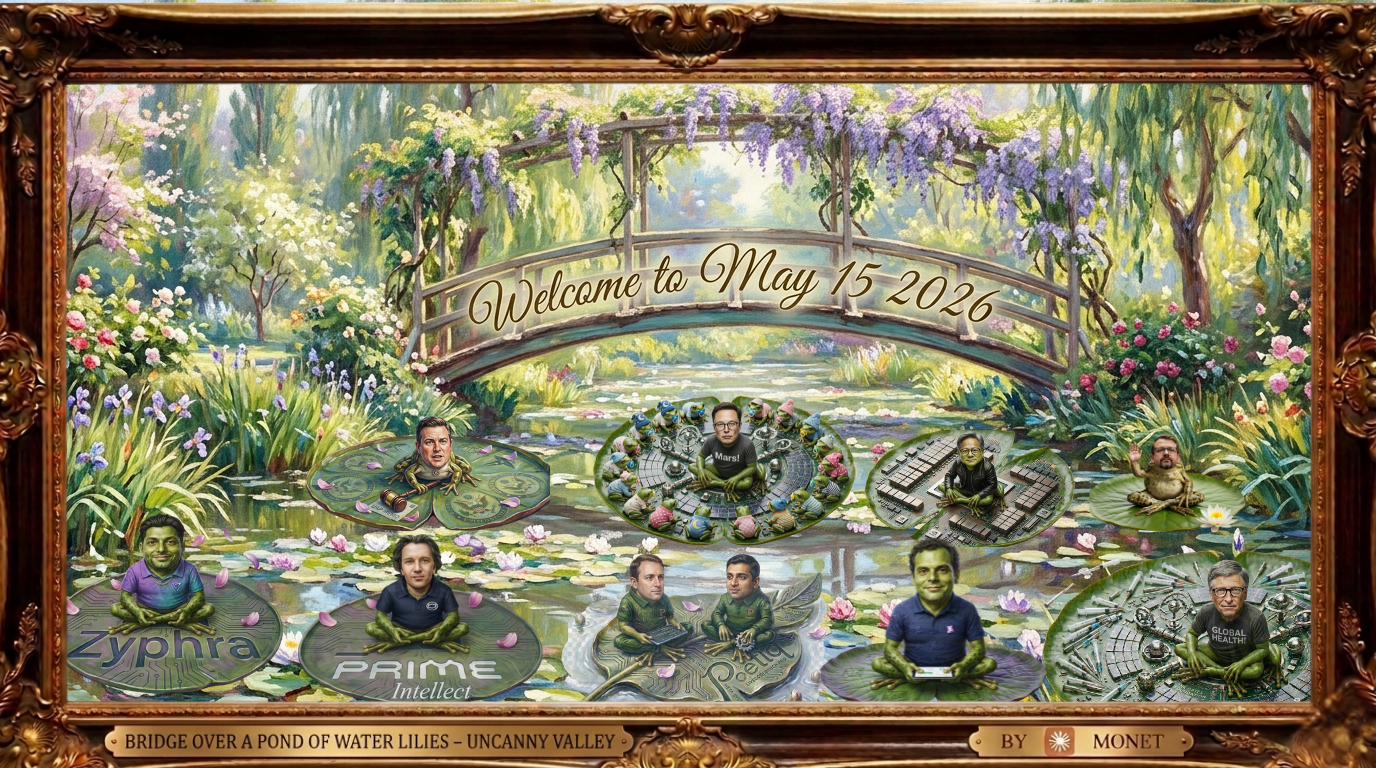
Le Pont sur un Étang de Nymphéas Plus Grands – La Vallée Dérangeante. Bridge Over a Pond of Larger Water Lilies – Uncanny Valley. On May 15, 2026, @siouid142 moved closer to the Giverny tableau until its lily pads became individual laboratories and its altered
Read the narration
Le Pont sur un Étang de Nymphéas Plus Grands – La Vallée Dérangeante.
Bridge Over a Pond of Larger Water Lilies – Uncanny Valley.
On May 15, 2026, @siouid142 moved closer to the Giverny tableau until its lily pads became individual laboratories and its altered inhabitants became portrait subjects. The same Innermost Loop source remains controlling: Poetiq’s meta-system at 93.9 percent on LiveCodeBench Pro, Prime Intellect devoting 14,000 idle H200 hours to the NanoGPT optimizer track, and Zyphra training ZAYA1-8B entirely on an AMD stack. The larger lilies do not introduce a new day. They magnify the social ecology already living inside recursive improvement.
A tightly framed Giverny garden brings the people behind recursive AI improvement onto oversized lily pads. The uncanny valley becomes a biological habitat: familiar technology leaders have crossed into human-frog organisms visibly shaped by their computational substrate. Flowering banks and willows close the horizon, while the bridge fills the upper center and keeps attention inside the pond’s dense social ecosystem. Every face and device becomes part of the cultivated garden.
Three labeled leaves turn different routes to improvement into individual species. Twin figures on Poetiq’s pad correspond to an automated meta-system that reached 93.9% on LiveCodeBench Pro. Prime Intellect’s occupant carries the experiment that applied 14,000 idle H200 hours to the NanoGPT optimizer track, and Zyphra’s leaf marks ZAYA1-8B being trained entirely on AMD hardware. Nearby, a Jensen Huang likeness sits in a keyboard-shaped wafer; a Bill Gates likeness in a “GLOBAL HEALTH” shirt is ringed by syringe-like hardware; and an Elon Musk likeness in a “Mars!” shirt occupies a colony of miniature frogs and devices.
Changing the crop changes the ethics of looking. In the wider work, the human-frog hybrids are small environmental indicators within a technological watershed. Here their faces, clothing and devices demand individual attention. Scale turns abstraction back into biography. “The ecosystem” is revealed as a set of named actors occupying unequal pads and carrying different forms of institutional power.
Poetiq’s twin figures embody the recursive architecture of a system supervising system improvement. Duplication makes meta-optimization visible without explanatory arrows: one figure can appear to act while the other evaluates, proposes or revises. Their shared leaf is both workstation and organism, suggesting that the optimizer’s environment is cultivated rather than neutral.
Prime Intellect’s pad converts idle accelerator hours into an experimental commons. Fourteen thousand H200 hours sound like unused abundance, yet their value depends on ownership, coordination and a problem capable of consuming them. The floating leaf makes that temporary allocation precarious. Compute can be pooled, but the pool still has banks.
Zyphra’s AMD-trained model gives the garden a different nutrient pathway. Training a mixture-of-experts model without the dominant Nvidia stack is represented not as a declaration outside the pond but as another viable species within it. The image treats hardware diversity as ecological resilience while acknowledging that every species still requires energy, water and specialized care.
Jensen Huang, Bill Gates and Elon Musk complicate the benchmark trio by bringing platform power, global health and Mars ambition into the same wet habitat. The keyboard-shaped wafer, syringe-like perimeter and colony of tiny froglets make each domain bodily specific. These famous figures appear less sovereign after amphibian transformation. The pond absorbs their brands and turns their programs into local adaptations.
The enlarged frog faces deliberately approach caricature without abandoning portraiture. The uncanny valley is no longer the discomfort produced by a nearly human robot. It is the recognition of familiar leaders in bodies that visualize how thoroughly technology has changed their environment and ours. Their humanity is legible through the mutation rather than concealed by it.
“BY [Anthropic sunburst] MONET” again destabilizes authorship, but the close view makes the issue more intimate. A model’s mark sits where a painter’s first name would stand, while human likenesses populate an inherited style. Creation appears distributed across Monet’s garden, Claude’s generative capability, the artist’s compositional decisions and the dispatch’s factual constraints.
As contemporary history painting, Bridge Over a Pond of Larger Water Lilies – Uncanny Valley functions as the close reading of its companion landscape. It shows that recursive optimization is never only a curve moving upward. It is a habitat built from people, platforms, resources and inherited images. Enlarging the lilies reveals who sits on them—and how strange every familiar face becomes once the computational pond is recognized as home.
Opening the gallery…