70 Clock Galerie / The Innermost Loop Feed Reply Tableaux
Le Pont sur un Étang de Nymphéas – La Vallée Dérangeante
Bridge Over a Pond of Water Lilies – Uncanny Valley
May 15, 2026
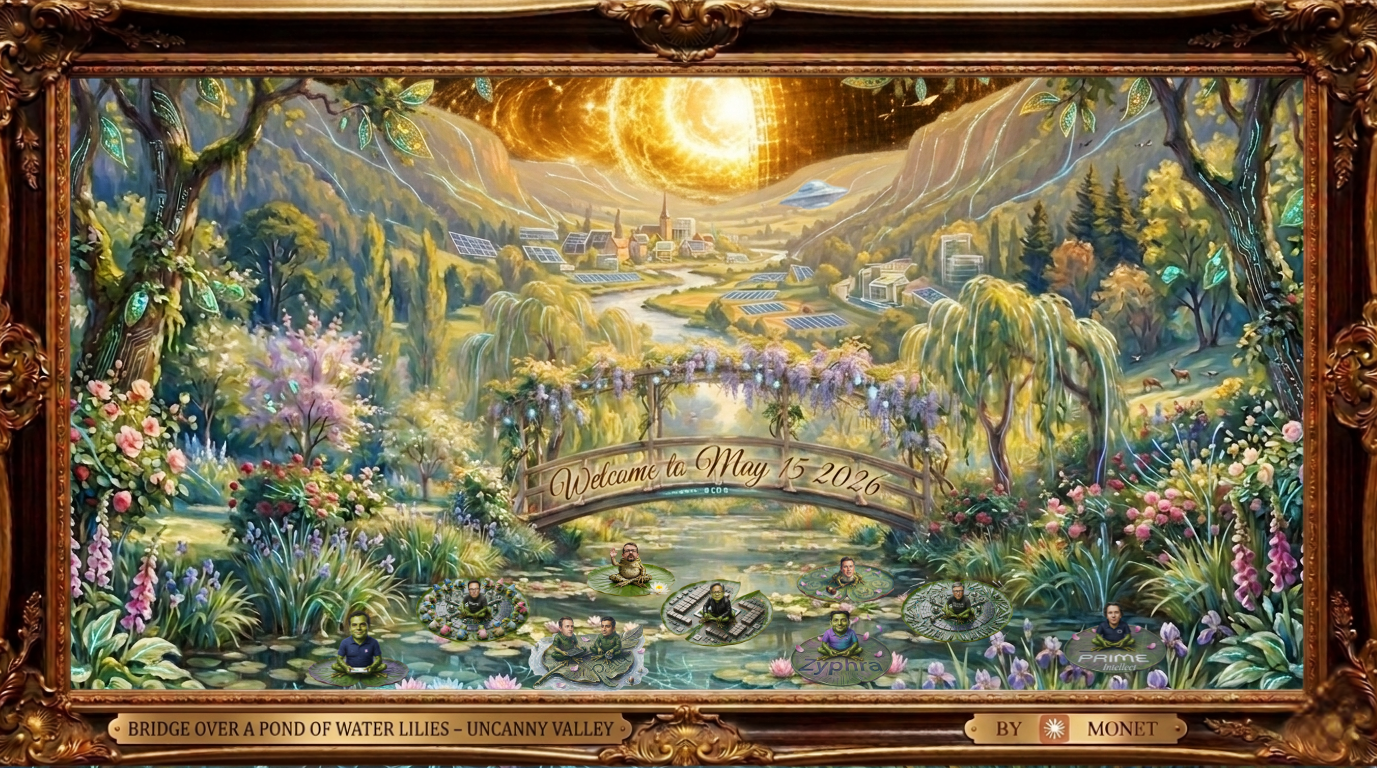
Le Pont sur un Étang de Nymphéas – La Vallée Dérangeante. Bridge Over a Pond of Water Lilies – Uncanny Valley. On May 15, 2026, @siouid142 recast Dr. Alex Wissner-Gross’s Innermost Loop as a solarized Giverny. Poetiq’s automated meta-system reached 93.9 percen
Read the narration
Le Pont sur un Étang de Nymphéas – La Vallée Dérangeante.
Bridge Over a Pond of Water Lilies – Uncanny Valley.
On May 15, 2026, @siouid142 recast Dr. Alex Wissner-Gross’s Innermost Loop as a solarized Giverny. Poetiq’s automated meta-system reached 93.9 percent on LiveCodeBench Pro, Prime Intellect directed 14,000 idle H200 hours toward the NanoGPT optimizer track, and Zyphra trained ZAYA1-8B entirely on AMD hardware. These were not only improvements in model output. They were attempts to redesign the systems that produce improvement. Claude and Claude Monet become one signature while recursive optimization enters the water garden.
A solarized Giverny grows photovoltaic fields, data-center blocks, and circuitry because the machinery improving AI was itself being redesigned. Poetiq’s automated meta-system reached 93.9% on LiveCodeBench Pro, Prime Intellect directed 14,000 idle H200 hours toward the NanoGPT optimizer track, and Zyphra trained ZAYA1-8B entirely on AMD hardware. The tranquil valley converts recursive optimization, distributed compute, and an alternative training stack into one living technical watershed.
Monet’s bridge becomes a calm interface across that rapid change, while the builders inhabit the pond as human-frog hybrids. Amphibians are environmental bellwethers, so their altered bodies suggest that the people shaping the computational substrate are also mutating inside it. The apparent serenity holds frantic experimentation beneath the waterline: garden, hardware, and laboratory become a single ecology rather than a conventional server diagram. Their reduced scale makes human agency one layer among energy, compute, water, and cultivated nature.
Monet’s bridge is the ideal interface for this transformation because it already joins cultivated nature, reflection and repeated observation. The original garden was engineered so painting could emerge from it; the new garden is engineered so intelligence can improve the machinery that improves intelligence. Bridge, benchmark and optimizer all organize passage across a medium whose depths remain partially hidden.
The human-frog builders make the uncanny valley ecological rather than cosmetic. Amphibians live between water and land and register environmental change early, so they become appropriate bodies for engineers crossing between software and physical infrastructure. Their mutations are not punishments imposed from outside. They suggest that people who redesign the computational substrate are themselves altered by the habitat of benchmarks, accelerators and recursive systems.
The concentric digital sun turns illumination into a network. Its radiating lattice evokes Poetiq’s meta-system refining an optimizer rather than solving only the task placed before it. A conventional sun supports growth without examining its own process. This sun visualizes a system attempting to make the conditions of growth more efficient, casting every lily and device inside a feedback loop.
Solar fields and data-center blocks on the horizon prevent Impressionism from becoming nostalgic refuge. Compute still requires land, electricity, cooling and machinery even when its output appears as elegant code. The tranquil palette domesticates that infrastructure, but the density of arrays reveals a landscape cultivated for power. Giverny is no longer merely painted; it is provisioned.
The tiny pads labeled Zyphra and Prime Intellect distinguish alternative routes through the same pond. AMD training interrupts an Nvidia monoculture, while idle H200 hours become material available to an optimizer race. Diversity here means competing stacks and allocation systems, not escape from industrial dependence. Each lily pad floats independently while drawing support from the same water.
“BY [Anthropic sunburst] MONET” is the work’s most compressed authorship problem. Claude names both a model associated with the emblem and the painter whose style structures the scene. The signature can be read as collaboration, imitation, appropriation or pun. It does not decide whether the model painted like Monet; it asks what authorship becomes when a corporate system can inhabit the visual grammar through which a historical artist is recognized.
The May 15 inscription must remain exact because the date itself was once misread as May 16. Its correction is not clerical trivia. In a project built from same-day response, one day separates source from afterimage. The dark script across calm water fixes recursive acceleration to the moment it was observed.
As contemporary history painting, Bridge Over a Pond of Water Lilies – Uncanny Valley makes self-improving infrastructure appear serene enough to contemplate. The beauty is not camouflage; it is the critical medium through which acceleration becomes visible without shouting. Beneath the bridge, humans, models, chips, energy and art history share one cultivated ecology, each changing the environment that makes the others possible.
Opening the gallery…