70 Clock Galerie / The Innermost Loop Feed Reply Tableaux
L'Astronaute de Pharmacie
Drugstore Astronaut
May 14, 2026
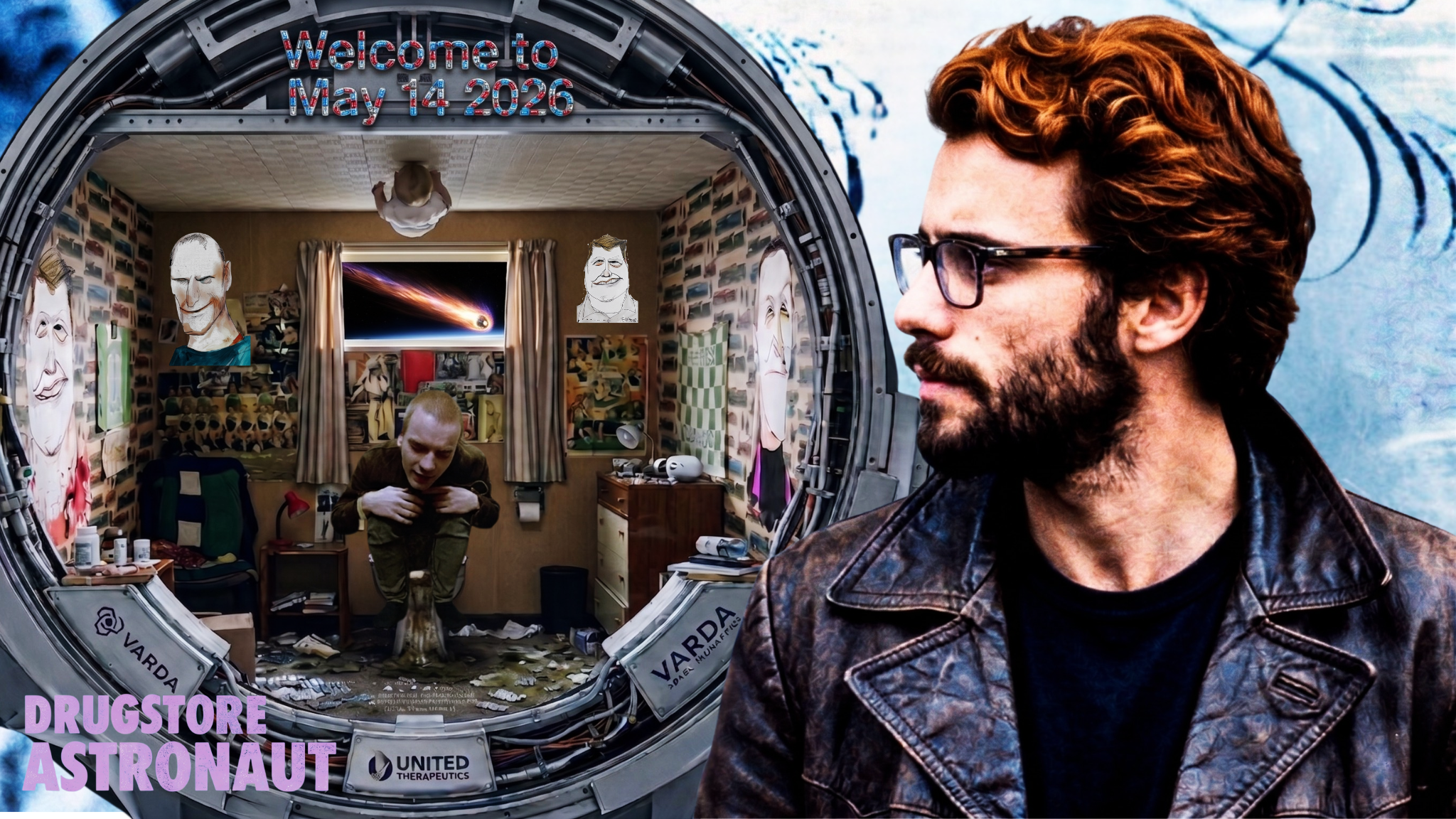
L'Astronaute de Pharmacie. Drugstore Astronaut. On May 14, 2026, @siouid142 turned Dr. Alex Wissner-Gross’s Innermost Loop into a pharmaceutical space capsule viewed through a circular hatch. Varda Space Industries and United Therapeutics supplied the orbital-
Read the narration
L'Astronaute de Pharmacie.
Drugstore Astronaut.
On May 14, 2026, @siouid142 turned Dr. Alex Wissner-Gross’s Innermost Loop into a pharmaceutical space capsule viewed through a circular hatch. Varda Space Industries and United Therapeutics supplied the orbital-biomedical threshold: manufacturing medicine beyond Earth meets a company organized around replacing failing organs. The cultural route runs through Drugstore Cowboy and Trainspotting, films in which drugs belong to compromised bodies, improvised interiors and difficult desire rather than the polished cleanliness of a laboratory brochure. Space medicine enters through grit.
A cramped, cluttered room appears through the circular hatch of a spacecraft. The title supplies the drugstore cue; inside are small packages, bottles, caricature portraits, furniture, and a bent human figure. The right half is occupied by an enormous, polished profile in a leather jacket. Varda and United Therapeutics are fixed to the threshold, giving the collision a specific orbital-biomedical vocabulary without turning the interior into a sleek laboratory.
Inside, the bent figure faces scattered boxes beneath caricature portraits pasted to the wall. A desk, a cabinet, and a checkerboard curtain compress the room even further, while a fiery object crosses the black view beyond the window. Varda appears on both lower hatch panels; the United Therapeutics emblem occupies the center plate; and “Welcome to May 14 2026” is bolted above in red, white, and blue. Near the ceiling, a small upside-down figure sharpens the scale reversal. The portal does not open onto a pristine future; it frames a branded, untidy room.
The hatch organizes the entire argument. A spacecraft portal usually separates the disciplined technological interior from dangerous space outside. Here, the clean branded ring frames an untidy room full of packages, bottles, furniture and bodies. The boundary does not protect purity; it reveals that advanced manufacturing still serves human organisms whose needs are domestic, chaotic and intimate.
Varda and United Therapeutics appearing on the threshold make partnership architectural. Their marks are not labels floating in the room but bolts on the opening through which the viewer must look. Orbital manufacturing and regenerative medicine jointly determine what counts as inside. The portal becomes a supply-chain interface connecting launch, production, reentry, clinical use and the patient’s ordinary life.
The title’s pulp lettering changes how that supply chain is remembered. Drugstore Astronaut sounds like a cheap serial hero, someone who moves between pharmacy counter and vacuum without institutional grandeur. The phrase compresses an enormous infrastructure thesis into a recognizable archetype. If pharmaceuticals can be manufactured in orbit and returned routinely, the astronaut becomes less explorer than specialist courier in an expanded drugstore.
The leather-jacketed profile at right dominates the view like a movie protagonist, but his scale destabilizes the scene. He is too large for the crowded room and too composed for its disorder. Founder mythology often works this way: one recognizable figure becomes the face of systems built by many laboratories, launch providers, regulators and patients. The hatch grants him a close-up while the actual work remains scattered behind him.
The bent figure and upside-down body restore vulnerability. Gravity, posture, dependence and disorientation persist inside the branded future. Medicine exists because bodies fail, and the image refuses to hide failure behind stainless steel. Even the checkerboard curtain resembles a domestic attempt to partition private life inside a capsule that has become public infrastructure.
The fiery object beyond the window connects the clutter to orbital logistics. Reentry is not an abstract arrow on a business diagram; it is heat, risk and timing visible from the room where the payload’s human meaning accumulates. The future medicine must survive launch and return before it can reach the bottles and packages with which patients actually live.
The small figure near the ceiling also turns microgravity into a social condition. Up and down no longer organize bodies consistently, yet branding and commerce remain firmly attached to the hatch. Physical orientation becomes fluid while institutional orientation stays fixed. The capsule can invert a person without inverting the ownership structure around the medicine.
As contemporary history painting, Drugstore Astronaut rejects the antiseptic fantasy of orbital biotechnology. Its circular frame promises mastery, then delivers compounding in both senses: medicines being made and systems accumulating mess. The work celebrates an extraordinary manufacturing horizon while insisting that its destination is not a pristine future. It is the crowded room of the body, where every technological triumph must finally become an ordinary dose.
Opening the gallery…