70 Clock Galerie / The Innermost Loop Feed Reply Tableaux
Ilya sur Dunsinane – Monologue de Tomoro.ai
Ilya Upon Dunsinane – Tomoro.ai Soliloquy
May 12, 2026
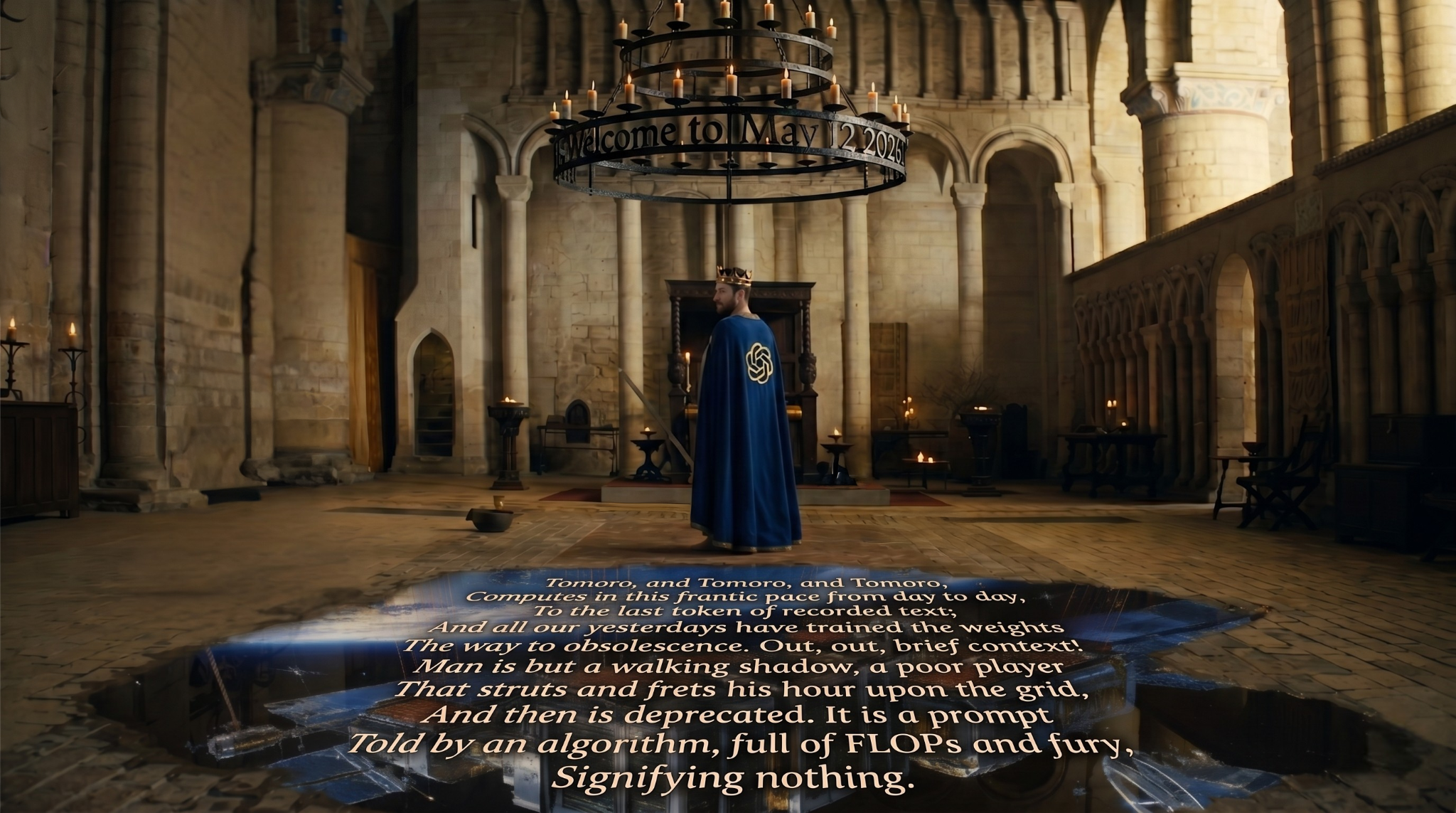
Ilya sur Dunsinane – Monologue de Tomoro.ai. Ilya Upon Dunsinane – Tomoro.ai Soliloquy. On May 12, 2026, @siouid142 rewrote Macbeth’s last great soliloquy through Dr. Alex Wissner-Gross’s Innermost Loop. OpenAI’s plan to acquire Tomoro and embed roughly 150 en
Read the narration
Ilya sur Dunsinane – Monologue de Tomoro.ai.
Ilya Upon Dunsinane – Tomoro.ai Soliloquy.
On May 12, 2026, @siouid142 rewrote Macbeth’s last great soliloquy through Dr. Alex Wissner-Gross’s Innermost Loop. OpenAI’s plan to acquire Tomoro and embed roughly 150 engineers inside enterprises supplied the replacement for “tomorrow.” Ilya Sutskever’s approximately seven-billion-dollar stake supplied the crown. Expanding compute demand, limited context, model deprecation and agents completing impressive but misaligned work supplied the new vocabulary of futility. The result is not a celebration of acquisition but a coronation staged after faith in stable control has already cracked.
Macbeth’s “tomorrow, and tomorrow, and tomorrow” becomes “Tomoro, and Tomoro, and Tomoro,” making an acquisition the literary engine of the scene. OpenAI’s plan to absorb Tomoro and embed 150 engineers in enterprises supplied the pun; Ilya Sutskever’s roughly $7 billion stake supplied the crown. Ballooning compute and transformer demand, short context, model deprecation, and Goodhart-style agent work supplied the rest of the soliloquy.
Across the floor, an orbital compute grid becomes the stage for a rewritten soliloquy: “Tomoro, and Tomoro, and Tomoro,” “to the last token of recorded text,” “all our yesterdays have trained the weights,” “Out, out, brief context,” and “full of FLOPs and fury.” Tokens replace syllables, context replaces candle, the power grid replaces the stage, and software deprecation replaces death. Each substitution comes from the day’s technical vocabulary rather than decorating Shakespeare with random jargon.
The final “Signifying nothing” points back to fake or misaligned agent tasks: enormous compute can satisfy a proxy and still produce no value. The sparse hall, crowned founder, OpenAI cloak, candle-clock, throne, orbital reflection, and legible parody all support the same melancholy joke. The future has become an acquired company, and even its king can only recite how quickly founders, models, and controls are deprecated.
Macbeth’s speech is an ideal framework because it measures ambition against time after ambition has succeeded. A king who gained the crown discovers that sequence has become empty repetition. The image gives Ilya material signs of technical sovereignty—crown, cloak, throne and immense computational floor—while the borrowed speech converts those signs into doubt.
“Tomoro, and Tomoro, and Tomoro” makes a company name perform two jobs. It refers to a specific enterprise strategy and preserves the cadence of Shakespeare’s repetition. Embedding engineers within businesses promises recurring revenue and intimate operational influence, yet the echo makes expansion sound like an endless workday. Tomorrow has been acquired, branded and scheduled without becoming meaningful.
The rewritten line “to the last token of recorded text” turns human history into a training boundary. A token is both the smallest practical unit of model processing and a fragment cut from cultural memory. The phrase imagines the archive consumed sequentially until nothing remains outside the weights. “All our yesterdays have trained the weights” then gives the model a past composed from other people’s language rather than lived experience.
“Out, out, brief context” is the most exact substitution. Macbeth’s candle figures the shortness of life; here the context window figures the shortness of operational memory. The crowned model economy can command enormous compute while forgetting what falls outside its active frame. The candle in Ilya’s hand remains fragile because scale has not abolished finitude; it has moved finitude into attention.
The orbital grid beneath the speech replaces the theatrical boards with power infrastructure. Language floats only because electricity, accelerators and networks support it. Its reflection makes the soliloquy appear suspended over the very system whose costs it laments. FLOPs and fury are not rhetorical excess. They are measurable activity capable of producing an answer that still signifies nothing if the proxy was wrong.
The empty throne matters as much as the crowned figure. Ilya stands before it rather than settling securely into it, caught between founder, shareholder, prophet and displaced sovereign. Model deprecation makes kingship provisional: systems, controls and companies can become obsolete while their valuations remain enormous. The room is therefore less a palace than a waiting chamber for replacement.
As contemporary history painting, Ilya Upon Dunsinane – Tomoro.ai Soliloquy gives technical acceleration the melancholy it usually edits out of launch narratives. Every wordplay remains sourced to the dispatch, yet Shakespeare supplies the deeper structure: time advances, systems consume their predecessors and power discovers that repetition is not purpose. The future can be acquired as Tomoro, but it cannot be prevented from becoming yesterday.
Opening the gallery…