70 Clock Galerie / The Innermost Loop Feed Reply Tableaux
Deux Escaliers Différents vers les Cieux
Two Different Stairways to the Heavens
May 8, 2026
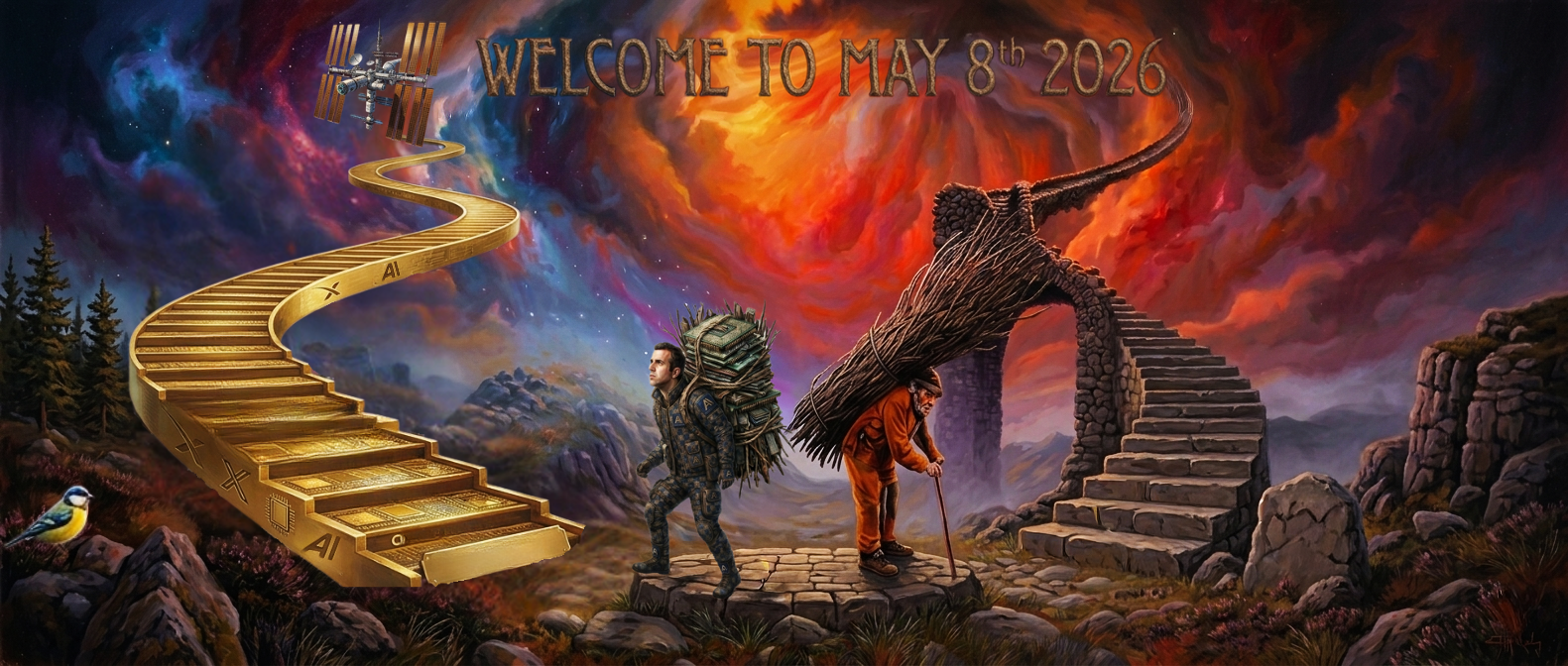
Deux Escaliers Différents vers les Cieux. Two Different Stairways to the Heavens. On May 8, 2026, @siouid142 developed this split landscape from Dr. Alex Wissner-Gross’s Innermost Loop account of intelligence infrastructure moving toward orbit. Anthropic’s agr
Read the narration
Deux Escaliers Différents vers les Cieux.
Two Different Stairways to the Heavens.
On May 8, 2026, @siouid142 developed this split landscape from Dr. Alex Wissner-Gross’s Innermost Loop account of intelligence infrastructure moving toward orbit. Anthropic’s agreement for Colossus 1 promised more than 300 megawatts and over 220,000 Nvidia GPUs within a month, while SpaceXAI described multiple gigawatts of eventual orbital compute. Anthropic Chief Compute Officer Tom Brown called the work “moving a lot of atoms.” The same dispatch described ProgramBench as a ladder whose higher rungs remained unsolved. Those two metaphors become two routes toward heaven.
Two stairways rise from the same rocky path into different skies. At left, a polished gold staircase curves through blue space toward an orbital station. Its rails and steps carry circuit patterns, repeated “AI” labels, X marks, and a chip emblem. At right, rough stone steps pass under an arch woven from roots, branches, and bundled sticks before climbing into a red-orange storm.
The travelers stand between those routes with unequal burdens. A younger man in dark patterned clothing carries a tall stack of rectangular packs beside the gold stair. An older man in orange work clothes bends over a cane beneath a bundle of firewood at the mouth of the stone ascent. Neither has begun climbing, and neither arrives empty-handed.
A small blue-and-yellow bird watches from the heather at lower left. Above both routes, “WELCOME TO MAY 8th 2026” crosses the divided sky, with the station beside its opening letters and the root arch beneath its closing date. The gold road disappears into built infrastructure; the stone road disappears into weather.
The young traveler is Tom Brown, not an anonymous beneficiary of technology. His dark clothing repeats Anthropic-like marks in the manner of luxury monogramming, while the bundle on his back replaces firewood with stacked chips. The substitution came directly from the creation process: both men had to carry a burden in comparable poses, but one burden belongs to subsistence labor and the other to the infrastructure of cognition. Their backs face one another as their stairways diverge.
The golden route condenses the dispatch’s orbital proposition. Circuitry, AI marks and silicon emblems are fused into the steps, while the staircase curves toward a station rather than disappearing into a religious cloud. Heaven has become addressable real estate with power specifications, launch economics and a supply chain. Tom Brown still carries matter, honoring his phrase, but technical coordination converts the weight into a route designed to bypass terrestrial constraints.
The stone stair provides the moral and visual counterweight. Its older traveler bends beneath ordinary wood and walks toward a root-bound arch through hostile weather. Nothing in the scene says that his path is false; it may even possess a spiritual integrity absent from the polished alternative. What differs is the cost of ascent. One traveler has inherited an engineered staircase backed by concentrated capital, while the other must transform bodily exhaustion into every gained step.
That inequality complicates the title’s plural heavens. The destinations may appear equivalent from the valley, yet the routes create different relationships to time, risk and access. The orbital station promises speed and scale, while the stone path preserves delay, labor and exposure. The image does not simply oppose technology to nature. It asks who receives an infrastructure capable of turning a climb into an escalated system and who remains responsible for carrying the old world uphill.
ProgramBench’s unsolved rungs make the stairs epistemic as well as economic. Opus 4.7 led the reported task while still resolving no full program, so the benchmark punctured triumph with a visible limit. The gold staircase may look complete, but it also disappears beyond what the traveler can see. Models can be granted immense compute without erasing the next rung. Industrial acceleration and intellectual humility occupy the same shining route.
The small blue-and-yellow bird refuses to join either system. It can cross the gap without stairs, bundles or orbital agreements, providing a third model of movement that neither traveler controls. Its scale keeps the picture from becoming a binary diagram. Life already possesses forms of ascent that capital and labor imitate differently.
As contemporary history painting, Two Different Stairways to the Heavens turns a compute partnership into a meditation on unequal transcendence. The image remembers exact capacity, named personnel and the benchmark metaphor while embedding them in an older story about burdens and salvation. Its question is not whether humanity will reach heaven through technology. It is whether the new staircase remains a common path once its steps are made from scarce chips and its destination moves off-planet.
Opening the gallery…