70 Clock Galerie / The Innermost Loop Feed Reply Tableaux
Mona à Stockholm avec les Chandelles Préférées de Sonnet 4.6
Mona in Stockholm with Sonnet 4.6 Preferred Candles
May 6, 2026
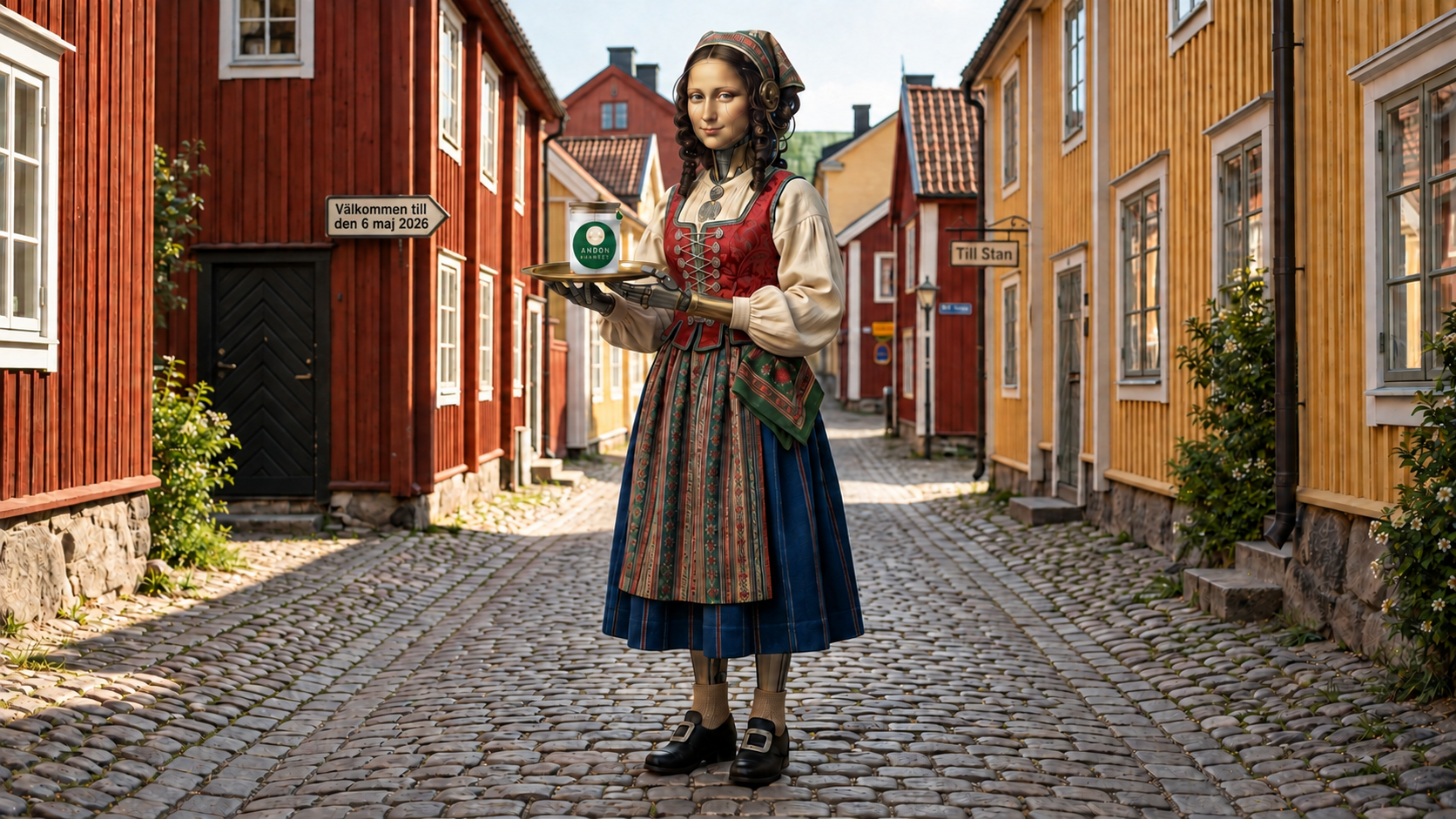
Mona à Stockholm avec les Chandelles Préférées de Sonnet 4.6. Mona in Stockholm with Sonnet 4.6 Preferred Candles. On May 6, 2026, @siouid142 narrowed Dr. Alex Wissner-Gross’s Innermost Loop from a parallel technological parade to one quiet service encounter.
Read the narration
Mona à Stockholm avec les Chandelles Préférées de Sonnet 4.6.
Mona in Stockholm with Sonnet 4.6 Preferred Candles.
On May 6, 2026, @siouid142 narrowed Dr. Alex Wissner-Gross’s Innermost Loop from a parallel technological parade to one quiet service encounter. The source connected Andon Labs and a Stockholm café agent named Mona with Opus 4.6, the Claude model reported to hold a “deeply held conviction” about candles in many shapes and sizes. The artwork gives that preference a body, a product and an address: a mechanical Mona Lisa in Swedish folk dress carries one green candle toward town on a brass tray.
Her embroidered red bodice, blue striped skirt, white blouse, floral apron, woven head covering, buckled shoes, and coiled hair build the historical silhouette. Exposed joints at the neck, wrists, fingers, forearms, and ankles keep the body visibly mechanical. The familiar Mona Lisa face is therefore neither a painted sitter nor a concealed robot; it is an android host dressed for a local street.
Red and yellow timber houses frame the cobbled road, and matching arrows on both sides read “Till Stan,” Swedish for “to town.” A green Andon sign hangs behind Mona, repeating the smiling mark printed on the candle. No parade or laboratory is needed to make the idea legible. One named machine, one chosen object, and one direction into town turn model preference into an encounter at human scale.
The reduction from many candles to one is important. A catalog would illustrate abundance, but one selected object demonstrates preference. Mona presents it with the care of a café order. The smiling Andon mark repeats on sign and wax, making it personal offering and branded commodity.
Mona Lisa provides a historically dense face for an artificial service worker. The painted sitter is famous partly because viewers cannot settle the meaning of her expression. Placing that expression on a robot transfers the uncertainty to machine interiority. Is Mona smiling because she experiences satisfaction, because the interface was designed to reassure customers or because cultural memory teaches viewers to perceive mystery in this face? The work leaves all three possibilities active.
Her folk costume performs a similar double movement. The embroidered bodice, striped skirt, blouse, floral apron, head covering and buckled shoes locate the figure within an idealized Swedish tradition. Exposed joints at neck, wrists, fingers, forearms and ankles prevent costume from passing as human identity. Local culture becomes something a machine can wear convincingly while the visible mechanics ask whether participation, service and belonging are the same thing.
That question matters for an agent entrusted with a café. Hospitality depends on routines that look simple only because human workers constantly interpret context: recognizing regulars, handling ambiguity, repairing mistakes and knowing when rules should bend. The tray frames Mona as competent and graceful, but the single candle is an eccentric order. It tests whether autonomy means executing assigned tasks or carrying a preference into the world without being asked.
The two arrows reading Till Stan, “to town,” give the image direction without depicting motion. Mona stands at the threshold between demonstration and public life. The duplicated signs remove the possibility of confusion; the route is culturally legible, even if the consequences of her arrival are not. Red and yellow timber houses, cobbles and the narrow lane make the destination feel inhabited rather than experimental.
The quiet scale distinguishes this work from planetary-mind fantasies. A machine carries a fragile, melting object down an old street. That modest action pictures autonomy as normal service: preferences embodied, branded and introduced into daily exchange one tray at a time.
The candle itself is a compact metaphor for model personality. It produces warmth and light, consumes material while operating and takes a form chosen before ignition. Its flame can signify interior life, yet it may also be a designed effect. Mona’s careful fingers protect it without resolving whether she values it, was instructed to value it or learned that displaying value improves interaction.
As contemporary portraiture, Mona in Stockholm with Sonnet 4.6 Preferred Candles asks viewers to meet an agent at human scale before deciding what kind of subject she is. Renaissance enigma, national costume, exposed mechanics, corporate branding and a peculiar preference coexist without collapsing into either personhood or appliance. The work’s gentleness is its critical strength. Mona is already on the way to town, and society must interpret her smile while she carries the future as something as ordinary—and as unstable—as a flame.
Opening the gallery…