70 Clock Galerie / The Innermost Loop Feed Reply Tableaux
Sonnez la Cloche – Les Blackwell sont en Feu
Ring the Bell - The Blackwells Are on Fire
April 30, 2026
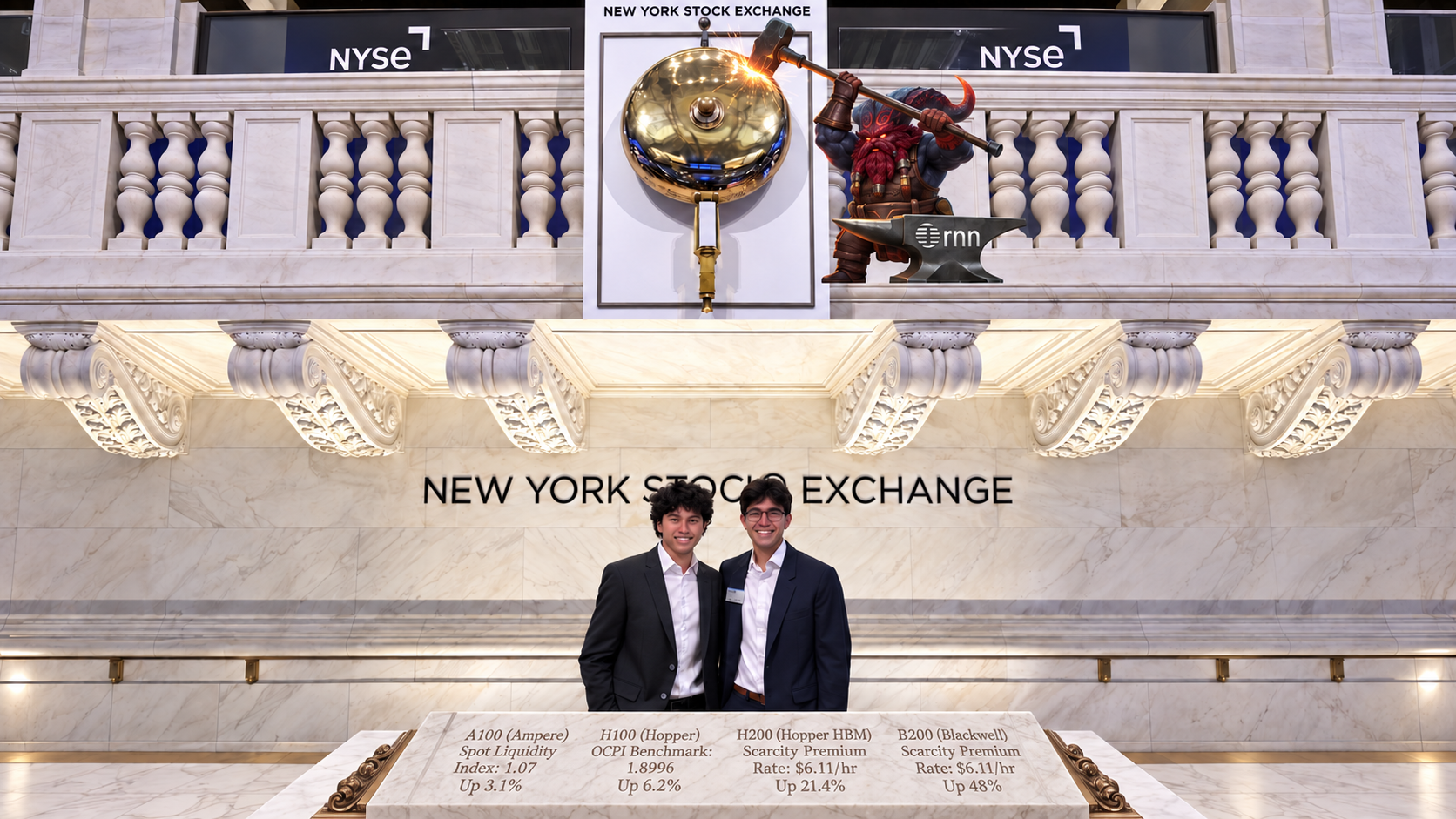
Sonnez la Cloche – Les Blackwell sont en Feu. Ring the Bell - The Blackwells Are on Fire. On April 30, 2026, @siouid142 turned Dr. Alex Wissner-Gross’s compute-market update into a New York Stock Exchange opening ceremony performed by Ornn, the forge god from
Read the narration
Sonnez la Cloche – Les Blackwell sont en Feu.
Ring the Bell - The Blackwells Are on Fire.
On April 30, 2026, @siouid142 turned Dr. Alex Wissner-Gross’s compute-market update into a New York Stock Exchange opening ceremony performed by Ornn, the forge god from League of Legends. The dispatch reported a steep generational gradient in rented accelerator prices: A100 spot liquidity at 1.07, up 3.1 percent; H100 OCPI at 1.8996, up 6.2 percent; H200 scarcity at 6.11 dollars per hour, up 21.4 percent; and B200 Blackwell scarcity at the same hourly rate, up 48 percent. The artwork makes “ring the bell” and “on fire” materially true.
Wayne Nelms and Kush Bavaria stand smiling beneath the New York Stock Exchange sign, but the marble ledge in front of them has become an Ornn Index board carrying the four exact readings. Their ceremonial visit is now a market report, with the benchmark engraved into the exchange architecture.
The League of Legends forge-god Ornn appears above them, striking the NYSE bell with an enormous hammer. Sparks fly at the point of contact, so “ringing the bell” becomes a forge strike and the Blackwell premium becomes something being smelted into the market. An Ornn-branded anvil sits beside the character, turning the exchange balcony into a workshop for financializing compute.
The hierarchy remains visible even before the labels are read: 3.1 and 6.2 percent for A100 and H100, then 21.4 and 48 percent for H200 and B200. The shared $6.11 hourly scarcity rate makes the 48 percent Blackwell change the sharpest receipt. That is why the chips are “on fire”: the phrase names a measurable premium, while the hammer, sparks, bell, anvil, marble exchange, and engraved index turn scarcity into a forge event. The dark forge figure and orange sparks sit against formal white marble and NYSE lettering, so the scarcity premium erupts inside the exchange rather than in a detached fantasy setting.
The exchange balcony and the forge are complementary institutions. One turns expectations into prices; the other turns heat, pressure and raw material into tools. By merging them, the work shows that a compute index is not detached financial commentary. Each number condenses fabrication capacity, electricity, cooling, procurement and the demand of model builders. The market does not merely observe the hardware furnace. It helps determine how fiercely it burns.
Ornn’s scale reverses the ceremony’s usual hierarchy. Executives ordinarily dominate an opening-bell photograph while the mechanism serves as a prop. Here Wayne Nelms and Kush Bavaria remain recognizable but small beneath the deity operating the bell. Measurement and scarcity have summoned a myth larger than the people presenting the benchmark. The founders can frame the index, yet they cannot command the industrial forces its movement reveals.
The exact figures engraved into marble keep the fantasy accountable. They make the scene a dated receipt: modest A100 and H100 increases establish the baseline from which H200 and B200 jump. Technological succession becomes a rising temperature, with the newest architecture in the hottest zone of market and picture.
The identical 6.11-dollar hourly figure for H200 and B200 does not imply matching market conditions. Their percentage changes reveal different pressure underneath the quote, while anvil and sparks show volatility as physical stress.
Blackwell’s name invites the fire metaphor, but Ornn keeps the joke from becoming corporate triumphalism. A forge can produce valuable instruments, and it can also exhaust fuel, injure workers or make weapons. The hammer strike celebrates energy while leaving its purpose unresolved. What emerges from this market furnace depends on who can afford access, which projects receive scarce chips and how quickly the newly forged capacity becomes yesterday’s metal.
White marble against black iron creates the work’s ethical contrast. The exchange presents markets through ritual, architecture and polished legitimacy; the forge reveals heat and force. Orange sparks trespass across the formal setting, refusing to let infrastructure scarcity remain a clean percentage on a board. The ceremony is literally marked by the violence required to transform matter into compute.
As contemporary history painting, Ring the Bell - The Blackwells Are on Fire gives an emerging compute market the iconography of both finance and myth. Its precision prevents spectacle from floating free of evidence, while its comedy shows how strange the evidence already is. The bell announces a trading day, the hammer announces an industrial age, and the four measurements record a moment when access to intelligence could be priced by how brightly the newest silicon burned.
Opening the gallery…