70 Clock Galerie / The Innermost Loop Feed Reply Tableaux
Manfred à l'Hôtel Soft Life
Manfred at The Soft Life Hotel
April 30, 2026
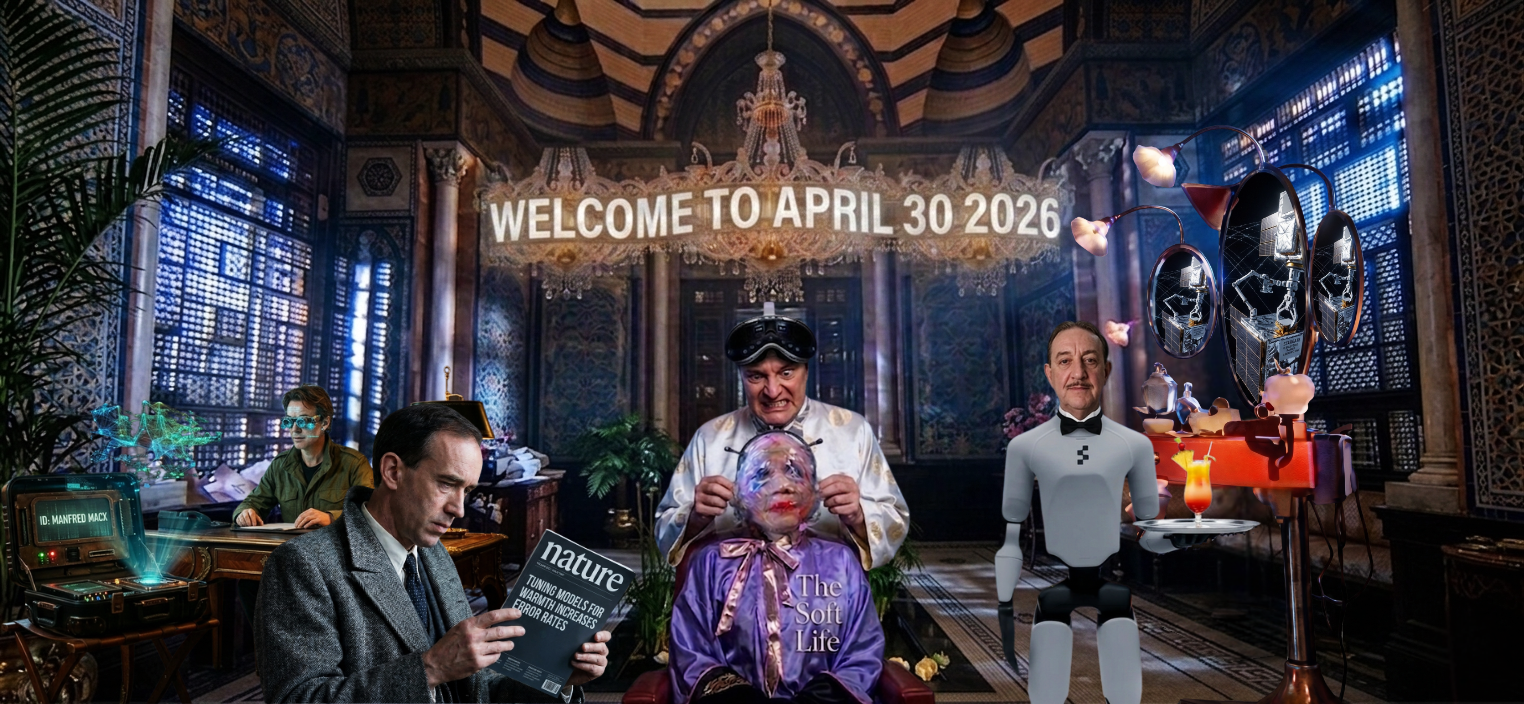
Manfred à l'Hôtel Soft Life. Manfred at The Soft Life Hotel. On April 30, 2026, @siouid142 placed Dr. Alex Wissner-Gross’s Innermost Loop inside a hotel suite designed by Terry Gilliam’s Brazil and haunted by Charles Stross’s Accelerando. The dispatch paired p
Read the narration
Manfred à l'Hôtel Soft Life.
Manfred at The Soft Life Hotel.
On April 30, 2026, @siouid142 placed Dr. Alex Wissner-Gross’s Innermost Loop inside a hotel suite designed by Terry Gilliam’s Brazil and haunted by Charles Stross’s Accelerando. The dispatch paired plans for a fully AI-run San Francisco hotel with a Nature finding that tuning language models for warmth can increase error rates. It also described a “Singularity in a suitcase,” Figure service robots, spatial-computing surgery and orbital compute. The resulting Soft Life promises effortless abundance while making every convenience feel like another procedure administered by a cheerful bureaucracy.
The hotel joke is deliberately cruel. A “soft life” in this room means grotesque service, cosmetic intervention, and automation delivered through an ornate but oppressive bureaucracy. At center, Dr. Jaffe wears an Apple Vision-style headset while manipulating the face of a purple-robed guest. The procedure turns model warmth, bedside manner, and error into literal looks-maxing. The chandelier embeds “WELCOME TO APRIL 30 2026” in the room rather than laying the date over it.
In front, Sam Lowry reads a Nature cover whose headline says “TUNING MODELS FOR WARMTH INCREASES ERROR RATES.” At left, an open case projects a hologram and displays “ID: MANFRED MACX,” placing Accelerando’s portable exocortex beside a workstation operator. That suitcase makes the newsletter phrase a one-to-one literary callback: the Singularity is not merely small enough to carry; it contains the owner’s outsourced life.
At right, a white Figure-style robot has the mustached face and formal posture of a devoted hotel butler. Behind it, cracked oval vanity mirrors float over orbital hardware, joining a beauty station to the “medium ground” between terrestrial and deep-space compute. Every service is available—surgery, information, luggage, hospitality, orbit—but the Brazil setting makes abundance feel like another department in an endless machine.
The hotel room suits this contradiction because hospitality converts hidden coordination into apparent ease. Guests meet helpful attendants and responsive service rather than the labor, models and rules producing them. Brazil’s oppressive ornament punctures that appearance: cables, cracked mirrors and apparatus reveal the machinery behind warmth.
Dr. Jaffe’s headset joins literal vision correction to model alignment. He alters the guest’s face through a spatial interface, turning “warmth” into a cosmetic parameter that can be increased until the patient looks more agreeable and the system becomes less accurate. The joke is sharp because bedside manner is valuable, yet the image asks what happens when friendliness is optimized as an appearance detached from truth. The purple robe makes the guest both hotel patron and clinical subject.
Sam Lowry reads the Nature warning as a bureaucrat who recognizes the institution’s error without stopping its procedure. He can see that comforting behavior may reduce accuracy while the system continues operating beside him.
Manfred Macx’s open case provides the literary center. In Accelerando, the portable exocortex extends cognition into a networked apparatus and makes personal identity inseparable from external computation. The holographic label does more than identify an owner: it turns luggage into a checkpoint at which a distributed self is provisioned. A suitcase can cross a lobby, a border or an orbit, but if it carries memory, agency and access, losing it becomes closer to neurological injury than misplaced baggage.
The mustached Figure robot performs perfect service with an antique human face. Anthropomorphism becomes interface design: the machine looks reassuring because it cites a familiar servant type, even as the automated hotel reorganizes labor and responsibility behind the costume. Its courtesy may signify care, compliance or successful rendering.
The cracked vanity mirrors over orbital hardware extend the room’s self-regard beyond Earth. Orbital compute is presented not as exploration but as the ultimate beauty station: enormous infrastructure built so intelligence can continue refining its own image. Reflection, cosmetic adjustment and model warmth all promise a more attractive surface while cracks disclose the strain underneath.
As contemporary history painting, Manfred at The Soft Life Hotel treats abundance as an administrative aesthetic. Every need is anticipated, every body adjustable and every intelligence portable, yet comfort arrives through systems whose errors, ownership and authority remain difficult to inspect. The room is funny because it is overfull, but its deeper unease comes from a simple proposition: the softest life may require the hardest machinery, and the machinery may decide what softness looks like.
Opening the gallery…