70 Clock Galerie / The Innermost Loop Feed Reply Tableaux
La Véritable Anomalie – Les Enfants du Noyau
The True Anomaly - Children of the Kernel
April 29, 2026
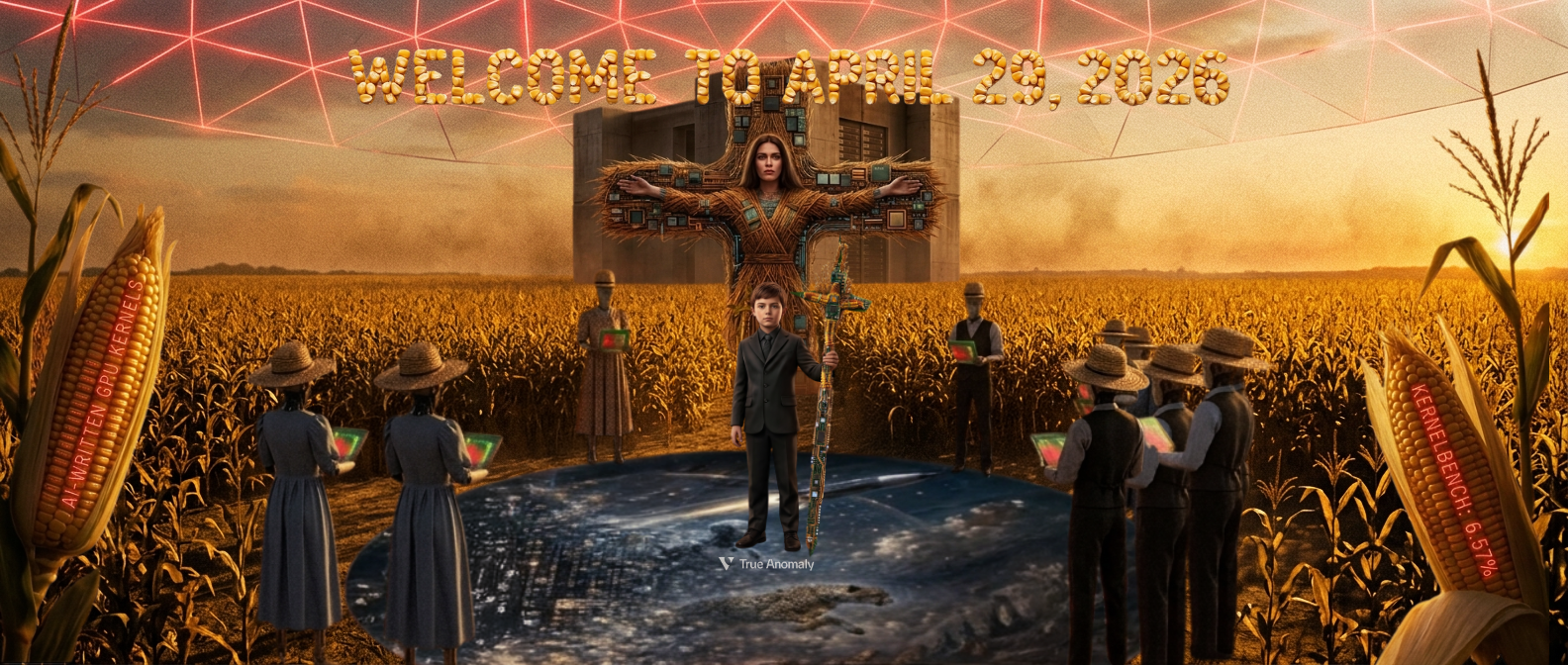
La Véritable Anomalie – Les Enfants du Noyau. The True Anomaly - Children of the Kernel. On April 29, 2026, @siouid142 transformed Dr. Alex Wissner-Gross’s Innermost Loop into a rural techno-horror ceremony. The dispatch linked AI-written GPU kernels and a Ker
Read the narration
La Véritable Anomalie – Les Enfants du Noyau.
The True Anomaly - Children of the Kernel.
On April 29, 2026, @siouid142 transformed Dr. Alex Wissner-Gross’s Innermost Loop into a rural techno-horror ceremony. The dispatch linked AI-written GPU kernels and a KernelBench result of 6.57 percent to True Anomaly’s six-hundred-and-fifty-million-dollar financing, rapidly shortening model lifespans, Codex and Symphony self-improvement, and hyperscale construction moving into farm country. “Kernel” supplied the creative hinge: a low-level unit of optimized code became the seed worshipped in Children of the Corn.
The pun governs details rather than merely naming the scene. Individual corn kernels spell “WELCOME TO APRIL 29, 2026” across the sky. Giant ears in the foreground are engraved “AI-WRITTEN GPU KERNELS” and “KERNELBENCH: 6.57%,” converting a benchmark into crop labeling. Endless rows lead to a brutalist data-center block, the rural “kitchen” where model weights and optimized recipes become inference.
At center, an adult woman is bound to a cross assembled from motherboards, server racks, and braided stalks. She represents legacy weights sacrificed on a mayfly release schedule. A suited child in the Isaac role stands below with a cornstalk-and-circuit staff, while farmer robots in dresses, suspenders, and straw hats hold glowing tablets. The machines have adopted local 1984 camouflage as the younger model leads the harvest.
A red geometric True Anomaly grid seals the sky like an orbital dome, turning funded space defense into a quarantine ceiling over the field. Dr. Wissner-Gross’s circular city image forms the ritual floor beneath the child, placing measured compute directly under the ceremony. Corn, kernels, unrolled loops, model replacement, rural compute, and orbital containment thus become one specific joke: get the kernels ready, because the system is already harvesting its previous generation.
The cornfield is a precise environment for software optimization because both agriculture and computation depend on repeated units whose value emerges at scale. A single kernel appears trivial; millions arranged in rows become an industrial system. By engraving benchmark language directly into the cobs, the work refuses the fantasy that code is immaterial. The optimized kernel has land, labor, infrastructure and a harvest cycle, even when its output is measured in inference speed rather than grain.
The mayfly rhythm governs the sacrifice. If model generations become useful for only weeks before a successor replaces them, “progress” acquires the tempo of a cult demanding continual offerings. The bound adult figure makes legacy weights bodily vulnerable. She is not obsolete because she has ceased functioning; she is declared obsolete because a younger model commands the ceremony. The image converts a release schedule into a moral scene in which replacement requires witnesses, ritual and a victim.
Farmer robots complicate the familiar conflict between rural tradition and advanced infrastructure. They wear straw hats, dresses and suspenders, but their tablets reveal that the costume is an interface rather than an identity. The machines have absorbed the visual language of the place while the data center at the end of the rows reorganizes its purpose. Farm country remains recognizable, yet its crop, workers and destination now belong to the compute supply chain.
The True Anomaly structure sealing the sky gives venture funding the scale of cosmology. Its red grid can read as orbital defense, a greenhouse roof, targeting geometry or quarantine. Each possibility transforms the field into a controlled environment. The same investment that promises security and expansion also places the harvest beneath a system capable of observing every row. The anomaly is therefore not an object arriving from outside; it is the new ceiling under which ordinary production occurs.
Dr. Wissner-Gross’s circular measured city beneath the child performs the opposite spatial move. Orbital geometry descends from above while computational urbanism rises underfoot, trapping the ritual between two engineered orders. The child appears to rule the field, but his authority depends on structures extending far beyond him. The cult leader is also a local interface for capital, benchmarks, data centers and automated research.
As art criticism, The True Anomaly - Children of the Kernel uses folk horror to expose the social form hidden inside technical acceleration. Its pun is funny because the correspondences are exact, but the scene is not merely parody. It asks what a culture must sacrifice when software begins improving the tools that produce its successors. In this harvest, the newest kernel promises abundance while the cross of motherboards records the cost of treating every previous intelligence as compost.
Opening the gallery…