70 Clock Galerie / The Innermost Loop Feed Reply Tableaux
Le Centre de Données Hyperscale O'Leary du Grand Lac Salé
The Great Salt Lake Hyperscale O’Leary Data Center
April 27, 2026
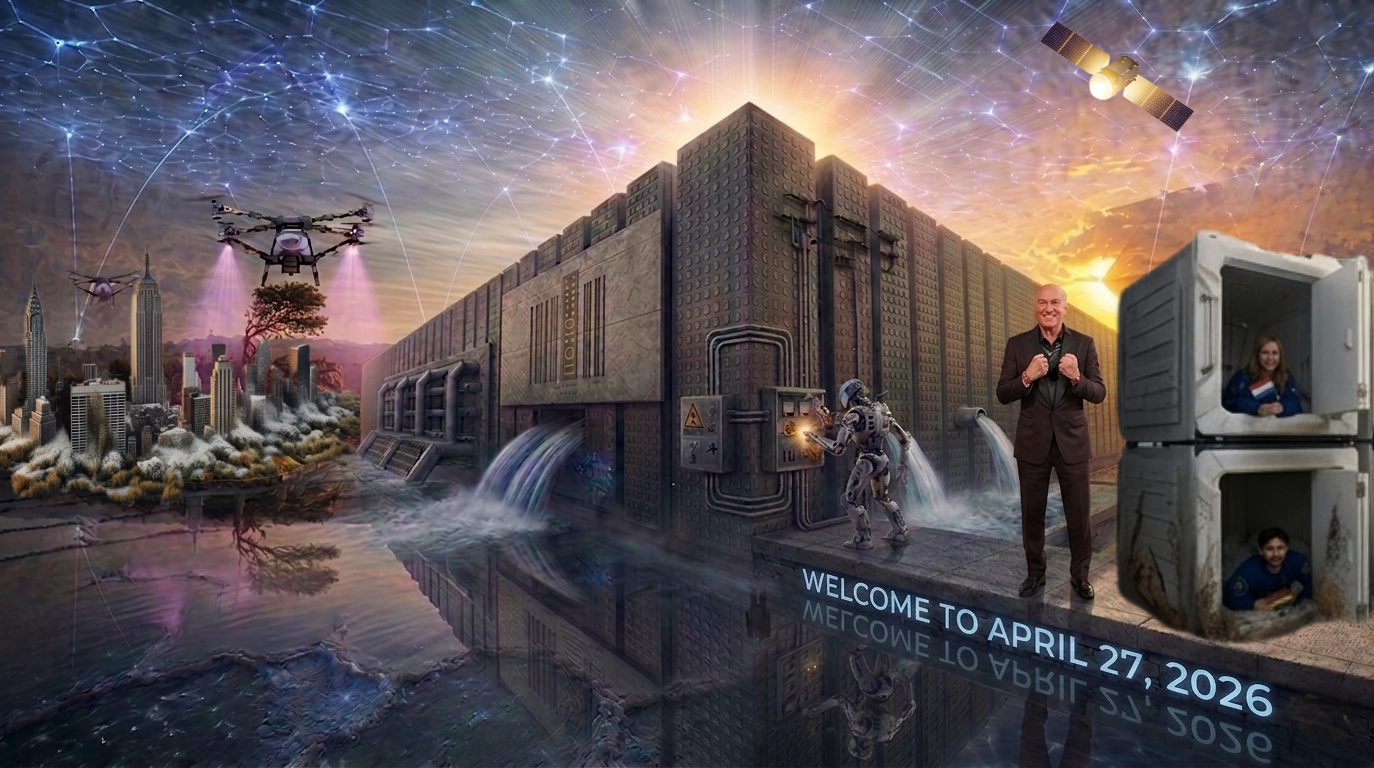
Le Centre de Données Hyperscale O'Leary du Grand Lac Salé. The Great Salt Lake Hyperscale O’Leary Data Center. On April 27, 2026, @siouid142 answered Dr. Alex Wissner-Gross’s Innermost Loop by giving Kevin O’Leary’s proposed Utah data center an impossible oper
Read the narration
Le Centre de Données Hyperscale O'Leary du Grand Lac Salé.
The Great Salt Lake Hyperscale O’Leary Data Center.
On April 27, 2026, @siouid142 answered Dr. Alex Wissner-Gross’s Innermost Loop by giving Kevin O’Leary’s proposed Utah data center an impossible operating environment. The dispatch placed the project beside fifteen stolen Ceres Air C31 chemical drones in New Jersey, a Supreme Court case about geofence warrants, State Grid’s fleet of five hundred electrical-safety humanoids and European Space Agency crews practicing polyphasic sleep for Mars simulations in Cologne. Rather than list those developments, the image makes every one of them a condition of the same hyperscale site.
The huge windowless data center anchors the fusion, its walls repeating like server cabinets and its cooling water pouring directly into the reflective lake. O’Leary stands in front with clenched fists, making the named project unmistakable. At left, a compressed Manhattan skyline rises from the wetland while multirotor drones sweep overhead; the geographic impossibility connects the New Jersey theft to the Utah infrastructure imagined as helping track it.
A luminous web covers the entire sky and bends down around the site. That cage translates geofence warrants into visible architecture: location data is no longer an invisible legal abstraction but a mesh enclosing the data center, city, drones, and lake. A satellite above the roof extends the same logic beyond the ground.
At the high-voltage panel, a humanoid works amid sparks, reproducing the State Grid safety task and its preferred failure mode—sacrificing a servo instead of a person. Two stacked white simulation pods at far right hold human occupants, moving the Cologne Mars exercise to Utah’s shore and setting fragile sleep-trained bodies beside nonstop machines. The clean lake reflection doubles every element, making the advertised hyperscale facility and its distributed attack surface appear as one continuous system.
The Great Salt Lake is more than a dramatic backdrop. Data centers are commonly represented as sealed, abstract containers for weightless computation. Here, cooling water visibly enters the lake and reflection makes the building answer to a vulnerable ecosystem. The smooth surface doubles the promised infrastructure while also doubling its dependencies: power, water, communications, surveillance and maintenance. What appears monumental above the water becomes an equally large question below it.
O’Leary’s stance gives the project a human promoter, but the clenched fists do not control the systems arranged around him. Drones cross jurisdictions; satellites extend observation; robots approach lethal voltages; sleeping bodies rehearse survival beyond Earth. The entrepreneur occupies the foreground while the operating field exceeds any one person’s grasp.
The luminous geofence is the work’s governing form. A warrant for location records is normally procedural and invisible, an instruction applied to data after movement has occurred. By stretching a glowing mesh over land, city, sky and water, the artwork turns legal search into environmental architecture. Everyone and everything inside the picture becomes potentially locatable. The net protects the facility against stolen equipment and simultaneously demonstrates how protection can enclose innocent movement.
That ambiguity reaches the C31 drones. Their chemical capability makes theft a concrete security problem, yet their migration from New Jersey into a compressed Manhattan wetland beside Utah shows how a networked incident ignores pictorial geography. The absurd collision is analytically accurate: the data center’s relevance is not local because the information used to detect, identify or govern remote machines passes through infrastructure that can be situated elsewhere. Distance becomes a property of the network rather than the map.
The two sleep pods offer the quietest counterweight to hyperscale. Their occupants train fragile human rhythms for an environment machines can inhabit continuously. Positioned beside a humanoid accepting electrical risk, they establish two models of adaptation: redesign the human schedule or substitute a mechanical body. Neither is presented as pure liberation. The pods resemble server racks, while the robot is exposed to sparks, so people become more machine-like as machines inherit danger.
As contemporary history painting, The Great Salt Lake Hyperscale O’Leary Data Center makes infrastructure legible through collision. Its spectacular building is not the conclusion but the container in which capital, ecology, policing, labor, theft and off-world aspiration meet. The lake’s mirror prevents the promised scale from appearing self-contained. Every wall has a reflected cost, and every security mesh capable of finding a stolen drone can also become a cage around the world it claims to protect.
Opening the gallery…