70 Clock Galerie / The Innermost Loop Feed Reply Tableaux
Les Chandelles Lunaires de Sonnet 4.6 — Version Ultra-Large
The Lunar Candles of Sonnet 4.6 — Uber Wide Version
April 26, 2026
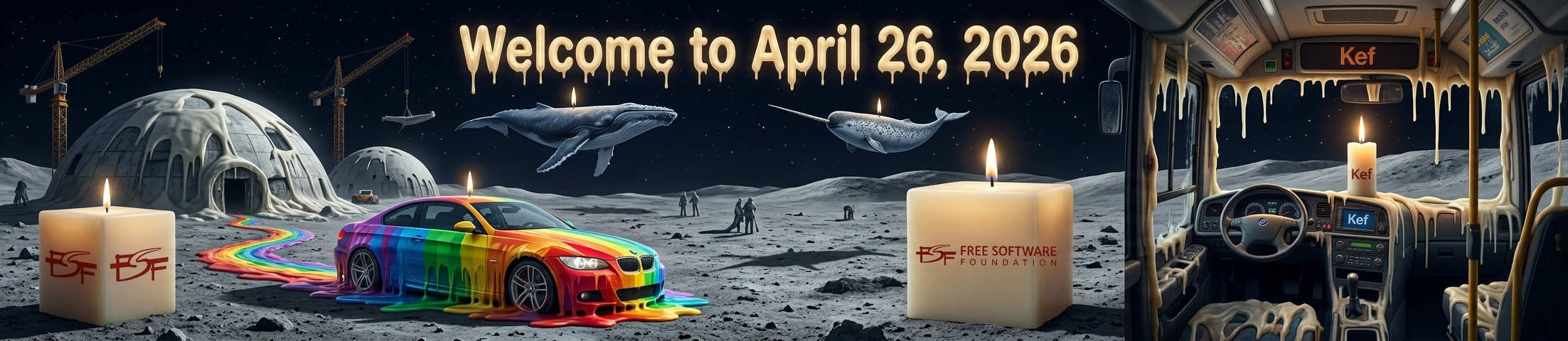
Les Chandelles Lunaires de Sonnet 4.6 — Version Ultra-Large. The Lunar Candles of Sonnet 4.6 — Uber Wide Version. On April 26, 2026, @siouid142 widened the Sonnet 4.6 candle tableau until a lunar worksite and the front half of an autonomous bus shared one cont
Read the narration
Les Chandelles Lunaires de Sonnet 4.6 — Version Ultra-Large.
The Lunar Candles of Sonnet 4.6 — Uber Wide Version.
On April 26, 2026, @siouid142 widened the Sonnet 4.6 candle tableau until a lunar worksite and the front half of an autonomous bus shared one continuous horizon. Dr. Alex Wissner-Gross’s Innermost Loop had linked Luna’s model preference to Norway’s driverless-transit permit, the Free Software Foundation’s licensing dispute, BMW mobility and inflatable lunar infrastructure. The panoramic format makes those items parts of one operating system rather than separate symbols competing for attention.
A wax-coated bus interior shares one uninterrupted horizon with a lunar worksite, making autonomous transit part of the same physical system as habitats, labor, and machine taste. Sonnet 4.6’s candle preference supplies the material transformation; Norway’s driverless-transit permit and the Free Software Foundation’s licensing dispute supply the institutions. Salvador Dalí’s melting forms turn a model’s consumer preference into weather that can soften both public infrastructure and a software-freedom emblem.
Cranes rise behind two sagging habitat domes at far left, and tiny workers cross the regolith beneath candle-flamed whales. A rainbow trail runs from the larger dome to a brightly colored BMW, so mobility and settlement appear connected by the same molten substance. Two adjacent FSF candles burn at the edge of that worksite, while a third stands alone beyond the people; the repeated mark behaves less like a pasted logo than a distributed beacon across the Moon. The workers’ small scale makes the waxy architecture and airborne animals feel like an inhabited climate rather than a cluster of symbols.
At right, the entire front half of the bus is open to view: vacant Volvo steering wheel, dashboard, driver’s seat, aisle, hanging straps, ceiling panels, and passenger seats. Wax droops from every surface, but the compartment remains operational. “Kef” appears on the destination display, the dashboard screen, and the freestanding candle where a driver might be expected. KEF names Norway’s public-transport e-management forum around the autonomous system. Repeated across three surfaces, the candle’s preference has occupied the governing display, the vehicle controls, and the empty public interior.
The ultra-wide composition changes how causality can be read. At ordinary scale, a collage tends to stack references or arrange them around a central hero. Here the eye must travel horizontally from labor and habitation through open-software beacons and private mobility into the public vehicle’s controls. No single element explains the others. Their shared horizon implies that settlement, licensing, movement and machine preference have become mutually dependent layers of one environment.
Repeating the FSF candles across the site turns software freedom into distributed infrastructure. One emblem would read as a label; three separated lights behave like nodes. They mark different zones without merging into a centralized monument, echoing federation and the ability to preserve alternatives across a network. Yet each node burns and melts, maintaining the uncertainty already present in the candle metaphor: illumination may be active, costly and impermanent.
The bus remains operational despite its softening surfaces. Steering wheel, dashboard, seat, straps and ceiling panels can all be identified, which makes the transformation more unsettling than a wreck. Public infrastructure does not have to stop functioning in order for its governance to change. The compartment may continue carrying passengers while the assumptions about who directs it, which software controls it and how decisions can be challenged have already melted into a new arrangement.
KEF appearing on the destination display, dashboard and freestanding driver candle is therefore decisive. As Norway’s public-transport e-management forum, KEF represents coordination rather than a passenger destination. Printed where a route endpoint would normally appear, it turns governance itself into the place toward which the vehicle travels. Repetition across display and controls suggests that the administrative layer now occupies both the public message and the operational interior.
As contemporary history painting, The Lunar Candles of Sonnet 4.6 — Uber Wide Version behaves like a systems diagram that never gives up atmosphere. Its panorama lets relations emerge through distance, scale and repetition rather than explanatory arrows. The work preserves the wonder of a built lunar landscape and autonomous public transport, but it refuses to treat either as merely technical. Across one horizon, labor, law, software freedom, consumer taste and governance occupy the same melting world—a world still running after the driver has disappeared.
Opening the gallery…