70 Clock Galerie / The Innermost Loop Feed Reply Tableaux
Les Chandelles de la « Cité » de Sonnet 4.6
The “City” Candles of Sonnet 4.6
April 26, 2026
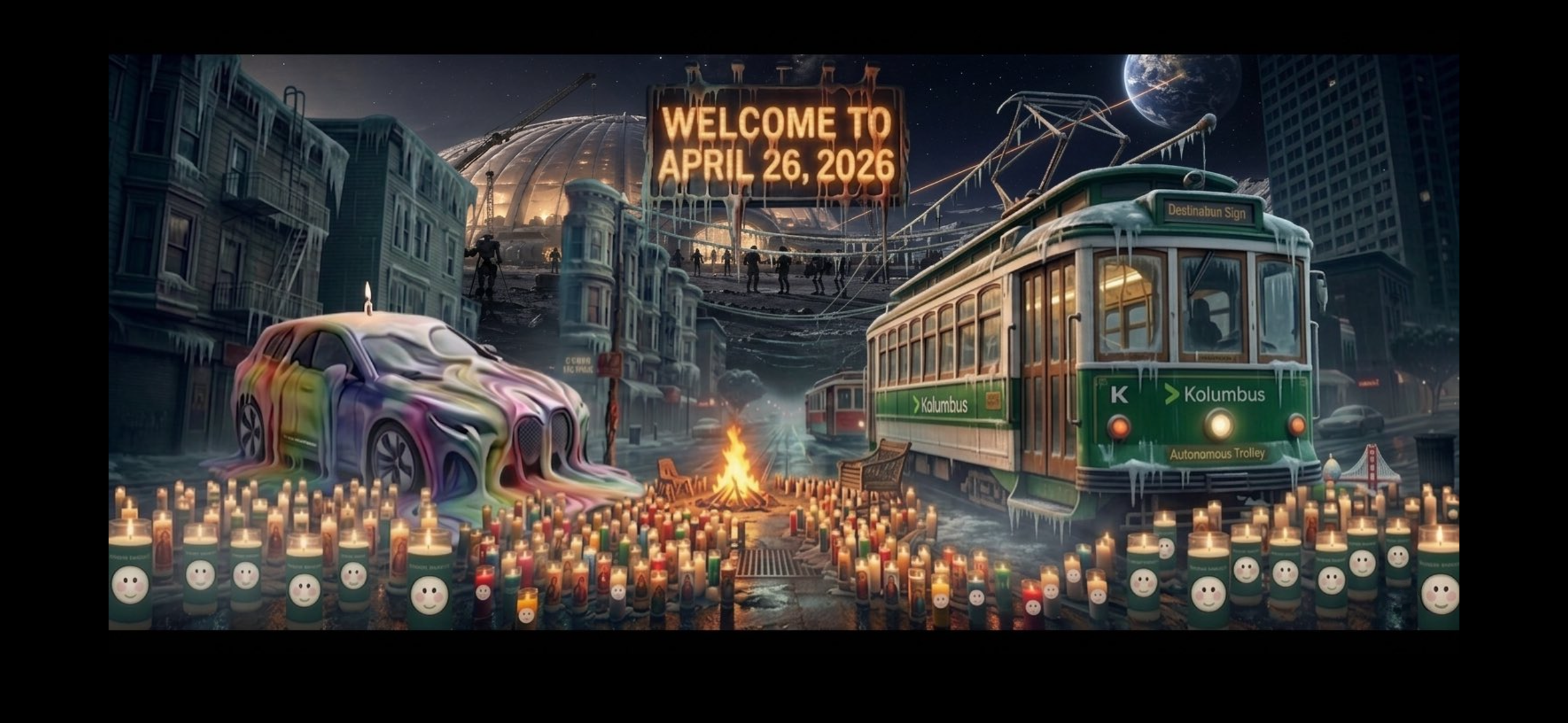
Les Chandelles de la « Cité » de Sonnet 4.6. The “City” Candles of Sonnet 4.6. On April 26, 2026, @siouid142 brought Luna’s candle preference down from the Moon and into a wax-covered San Francisco. Dr. Alex Wissner-Gross’s Innermost Loop had placed that Sonne
Read the narration
Les Chandelles de la « Cité » de Sonnet 4.6.
The “City” Candles of Sonnet 4.6.
On April 26, 2026, @siouid142 brought Luna’s candle preference down from the Moon and into a wax-covered San Francisco. Dr. Alex Wissner-Gross’s Innermost Loop had placed that Sonnet 4.6 preference beside Norway’s authorization of driverless public transit, the Kolumbus operator, Applied Autonomy’s xFlow, BMW mobility and debates over software governance. The artwork relocates those signals into “The City,” where private model taste becomes municipal architecture, public ritual and transportation policy.
Wax-covered San Francisco streets relocate Sonnet 4.6 agent Luna’s candle preference and Norway’s newly permitted autonomous transit into “The City.” Dr. Alex Wissner-Gross’s city artwork becomes the architecture, while a green Kolumbus vehicle brings Stavanger’s operator and Applied Autonomy’s xFlow into it. The lunar/Luna pun remains overhead, but the municipal setting makes the agent’s taste part of ordinary urban movement.
Wax overtakes the city itself. It hangs from façades, windows, rails, and a vast dome behind the neighborhood. A rainbow BMW slumps at the left curb with a flame where its roof should be. The familiar streets remain readable beneath the alteration, binding AWG’s urban background to the Dalí-like candle intervention. A dripping April 26 sign glows above the dome while Earth hangs in the black sky, keeping the city inside the lunar/Luna joke.
A green “Kolumbus” trolley dominates the right side. “Autonomous Trolley” is printed across its front, and the driver’s window contains only a dark silhouette rather than a conventional operator. A smaller red streetcar recedes behind it, connecting the foreign transit brand to local street geometry. The collision of Stavanger transit and San Francisco form makes the borderless agentic system concrete rather than rhetorical.
Dozens of smiling Andon candles fill the street like a public gathering, with taller red and green variants surrounding a central bonfire. Their abundance makes this less a product portrait than a civic ritual. Luna’s private preference has become municipal décor, public transit, and urban climate; the city does not merely host the candles but appears to be made from the same wax.
San Francisco matters because it is simultaneously a lived city and a symbolic capital of technological transformation. By preserving its streets beneath the wax, the image refuses a clean replacement narrative. The new system overlays recognizable civic space, using existing tracks, curbs, facades and public expectations. Change arrives as an alteration of the city people already inhabit, not as a frictionless demonstration on an empty test course.
The green Kolumbus trolley makes displacement visible. A Norwegian operator and autonomous system occupy San Francisco streets while a red local streetcar recedes. The collision pictures borderless software meeting local infrastructure. Code travels instantly, but buses inherit laws, maintenance and community trust.
The empty driver’s window is less an image of absence than a transfer of authority. The vehicle still bears a destination, brand and public-service function, but the conventional human figure through whom passengers read responsibility has become a dark silhouette. Around it, dozens of cheerful candles offer a new face for the system. Their smiles make autonomy socially inviting even as no single candle can answer for a decision made by the network.
Turning Luna’s preference into a crowd creates the work’s civic argument. A private taste is harmless when it decorates one user’s interface. Multiplied across streets and transit, it resembles a standard. The tall red and green candles around the bonfire look festive, but they also suggest political assembly, religious observance and synchronized branding. The city has not merely purchased a product; it has adopted a ritual through which the product becomes normal.
Wax works as governance because it is moldable and unstable. It can seal, preserve, illuminate and take an official impression, but it softens under heat. Draped over buildings and rails, it suggests rapid reconfiguration at the cost of durable boundaries. The great dome appears protective until it sags. Infrastructure responsive to preference may become vulnerable to whatever preference comes next.
As contemporary history painting, The “City” Candles of Sonnet 4.6 depicts normalization as an environmental process. Its humor comes from making candle taste absurdly total, but its critical target is the quiet path by which private preferences become defaults, defaults become standards and standards become civic atmosphere. The city remains beautiful and recognizable while it melts. That is the warning: transformation need not look like destruction to make public space answer to a new, largely invisible governor.
Opening the gallery…