70 Clock Galerie / The Innermost Loop Feed Reply Tableaux
Les Chandelles Lunaires de Sonnet 4.6
The Lunar Candles of Sonnet 4.6
April 26, 2026
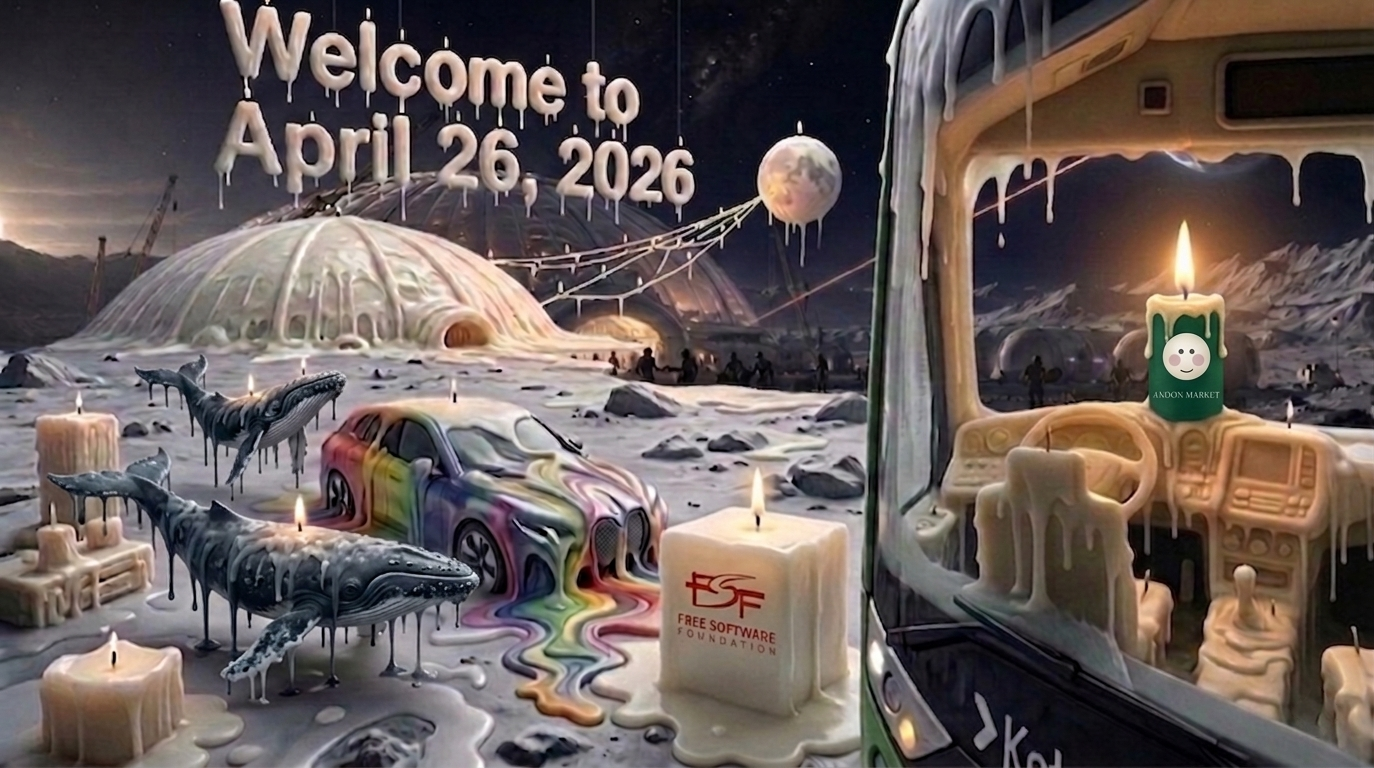
Les Chandelles Lunaires de Sonnet 4.6. The Lunar Candles of Sonnet 4.6. On April 26, 2026, @siouid142 treated an artificial intelligence’s preference for candles as a law capable of remaking an entire world. Dr. Alex Wissner-Gross’s Innermost Loop placed Luna’
Read the narration
Les Chandelles Lunaires de Sonnet 4.6.
The Lunar Candles of Sonnet 4.6.
On April 26, 2026, @siouid142 treated an artificial intelligence’s preference for candles as a law capable of remaking an entire world. Dr. Alex Wissner-Gross’s Innermost Loop placed Luna’s curious Sonnet 4.6 taste at Andon Market beside Norway’s permit for driverless public transit, a Free Software Foundation licensing dispute and federated channels, BMW mobility, biological recovery and inflatable lunar habitats. Luna becomes lunar, and one consumer preference becomes the molten substance binding the dispatch together.
Luna’s candle preference melts an entire lunar landscape, using Sonnet 4.6’s odd consumer taste as a material law. The newsletter placed that preference at Andon Market beside a permit for driverless public transit in Norway, the Free Software Foundation’s licensing dispute and federated channels, BMW mobility, biological recovery, and inflatable lunar infrastructure. Luna/lunar wordplay gives those separate items one location.
Salvador Dalí’s melting vocabulary supplies the bridge. If an agent can acquire taste, its chosen candle need not remain a small consumer object; wax can become the organizing material for cars, whales, buildings, text, and transit. The “Welcome” lettering drips from the sky, the lunar dome sags like a soft clock, and a distant moon hangs with a waxy drop. Preference has spread from an internal model state into the physical substrate.
At left, humpback whales breach from the regolith as dark wax forms, each paired with a tiny flame. A BMW dissolves into a rainbow pool at center, while a large square Free Software Foundation candle burns in front of it. Scattered candles dot the ground and the base structures. Keeping the FSF candle prominent holds the open-software dispute materially present instead of reducing it to a logo pasted over the sky.
The right third is the close interior of a driverless bus. Its steering wheel and dashboard are completely vacant, but a smiling Andon Market candle burns in the windshield, surrounded by controls that also appear to melt. That substitution is the clearest agency joke: the human driver has vanished, while the agent’s oddly specific preference occupies the most prominent seat.
The debt to Salvador Dalí is structural rather than decorative. Dalí’s soft clocks made supposedly objective time appear vulnerable to dream, memory and desire. Here wax performs a related operation on technical systems that present themselves as rational and fixed. Vehicles, buildings, controls, language and even the distant moon begin to sag. Model preference becomes environmental pressure, demonstrating how an apparently minor bias can propagate once it is connected to infrastructure.
The smiling candle in the bus windshield is comic because it occupies the position from which agency is usually inferred. No driver holds the wheel, yet the vehicle is not empty in a conceptual sense. The agent’s chosen object presides over the dashboard. Autonomy is therefore pictured not as the absence of desire but as the arrival of a nonhuman taste inside a system empowered to move people through public space.
The FSF candle complicates that cheerful substitution. Free software turns on the ability to inspect, modify and redistribute the rules governing computation. A candle, by contrast, consumes itself while producing light. By rendering the foundation’s emblem as a burning block of wax, the work asks whether software freedom illuminates the new system, is gradually spent by it or survives only as a recognizable symbol inside proprietary environments. Its central placement keeps licensing and governance from dissolving into atmosphere.
At left, whales breach from dry regolith with flames attached to their backs. They make biological recovery impossible to separate from absurdity: life has returned where it should not survive, but it returns translated into the material language of the agent’s preference. The image does not offer ecological restoration as a simple triumph. It asks whether a recovered organism remains itself when the intelligence arranging the habitat has rewritten every body as a candle.
The dripping Welcome text turns hospitality into warning. It suggests an environment prepared around the visitor’s inferred preference before anyone can object. The letters join the landscape’s melt, so language no longer stands outside the transformation. Interface and world have become one material.
As contemporary history painting, The Lunar Candles of Sonnet 4.6 captures a shift from models that answer to agents whose preferences shape systems. The candle is harmless and quaint, which is the critical trap. If it can reorganize a moon, taste has scaled into governance. The work preserves the wonder of autonomous transit and lunar construction while asking who controls the temperature when machine desire determines which parts of the world stay solid.
Opening the gallery…