70 Clock Galerie / The Innermost Loop Feed Reply Tableaux
Bonbon Corebotix — L’Avenir de la Robotique
Corebotix Candy — The Future of Robotics
April 23, 2026
Bonbon Corebotix — L’Avenir de la Robotique. Corebotix Candy — The Future of Robotics. On April 23, 2026, @siouid142 reduced the future of robotics to an apparently modest piece of streetwear. Dr. Alex Wissner-Gross’s Innermost Loop framed physical intelligenc
Read the narration
Bonbon Corebotix — L’Avenir de la Robotique.
Corebotix Candy — The Future of Robotics.
On April 23, 2026, @siouid142 reduced the future of robotics to an apparently modest piece of streetwear. Dr. Alex Wissner-Gross’s Innermost Loop framed physical intelligence as a possible “sixteenth Moonshot” and connected robotics, proof of personhood, brain–computer access and fashion under the phrase “Drip Abundance.” Corebotix Candy answers with a fitted black beanie whose small temple module and running-man insignia make an ambitious interface look as ordinary as a favored cap.
A fitted black beanie turns physical intelligence into an understated fashion interface instead of a laboratory chassis. The robotics thread called the concept “the 16th Moonshot,” joining a high-risk technical leap to high-end “drip.” A running-man symbol links speed and embodied work, while the blue-violet temple module treats proof of personhood or brain-computer access as ordinary streetwear.
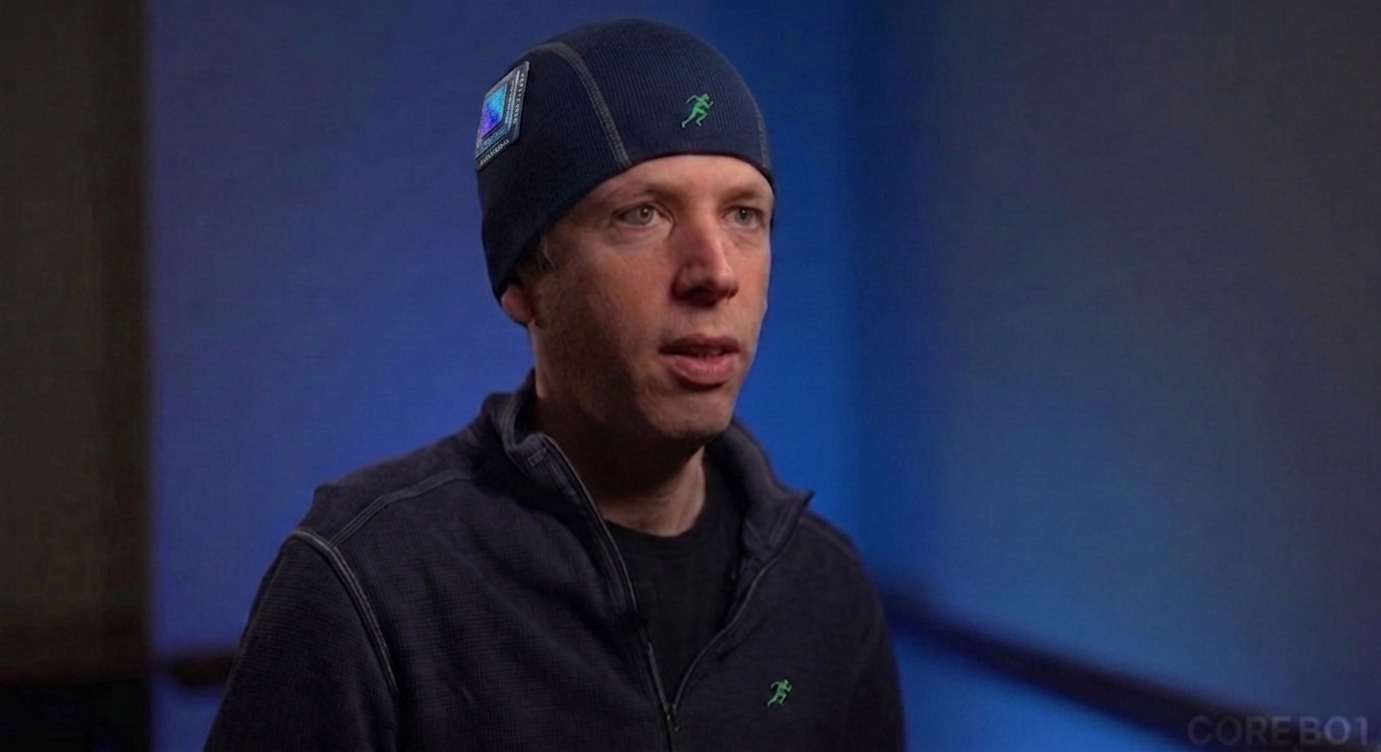
A photoreal man in a dark zip vest wears the fitted knit cap against the cool blue blur of an interview set. The crop makes the device read as a product already in use rather than a speculative runway prop. The same small green running figure appears on the hat and his chest, while a rectangular blue-violet module is sewn into the cap above his temple. A faint “COREBO1” mark sits at lower right.
There are no robot limbs, assembly lines, or explanatory diagrams. Knit texture, studio light, shallow focus, and a human face carry the idea that the next robotics interface may arrive as a subtle style upgrade. The restraint is the joke: the future of robotics is represented by one cap, one integrated device, and a repeated glyph that could pass as a sportswear logo.
The choice of a portrait rather than a robot demonstration changes the meaning of embodiment. Conventionally, a robotics image asks viewers to inspect the machine: its limbs, actuators, balance and industrial competence. Here the only visible chassis is a human body. The device attaches at the temple, where perception, intention and identity meet, while the repeated runner binds the wearer’s head to his chest. Robotics is no longer somewhere across the room. It is worn at the border between thought and action.
That placement makes the blue-violet rectangle deliberately difficult to classify. It might verify that a person is present, translate neural activity into commands, identify the wearer to nearby machines or simply advertise membership in the Corebotix system. The image does not settle the function because convergence is its subject. Once access, agency and proof of personhood share the same wearable surface, a small piece of hardware can become credential, controller and social sign at once.
The word Candy supplies seduction and compression. A Moonshot usually arrives through spectacular architecture, launch imagery and declarations of scale. Candy is small, desirable and easy to consume. The title asks how quickly a difficult public question can be sweetened into a product preference. If the future of robotics can be bought as a stylish cap, debate about who authenticates the wearer or receives the resulting neural data may feel like fine print beneath the pleasure of adoption.
The cool interview lighting makes adoption appear to have already happened. This is no laboratory prototype. Knit texture and the calm model give the object the authority of a finished campaign. Even COREBO1 behaves like a version number absorbed into fashion branding. The viewer encounters a user, not an explanation.
The tiny running figure is the work’s most efficient Easter egg. As a sportswear-like emblem it signifies motion, health and personal capacity; as an interface symbol it suggests commands flowing from intention into machines. Repeated on hat and vest, it also creates a closed circuit between cognition and torso. The logo promises that the system will preserve human agency even as the temple module makes agency measurable and transferable.
This tension extends the exhibition’s wider concern with proof of personhood. A wearable can help distinguish a human participant from autonomous software, yet it can also make personhood contingent on carrying the approved device. The cap appears liberating because it is light and portable, but portability is not the same as control. What looks like self-expression may become the uniform through which a network decides who counts as a verified self.
As contemporary portraiture, Corebotix Candy — The Future of Robotics replaces the heroic inventor and spectacular machine with the normalized wearer. Its restraint is not emptiness; it is a picture of technical power becoming culturally frictionless. One face, one cap, one glyph and one glowing module are enough to suggest a world in which the human serves as chassis, credentials become clothing and the next Moonshot arrives without a rocket because it has already crossed the threshold of the body.
Opening the gallery…