70 Clock Galerie / The Innermost Loop Feed Reply Tableaux
Dans le Cockpit — Le Dirigeable de la Tournée Ornn
Inside the Cockpit — Ornn Roadshow Dirigible
April 23, 2026
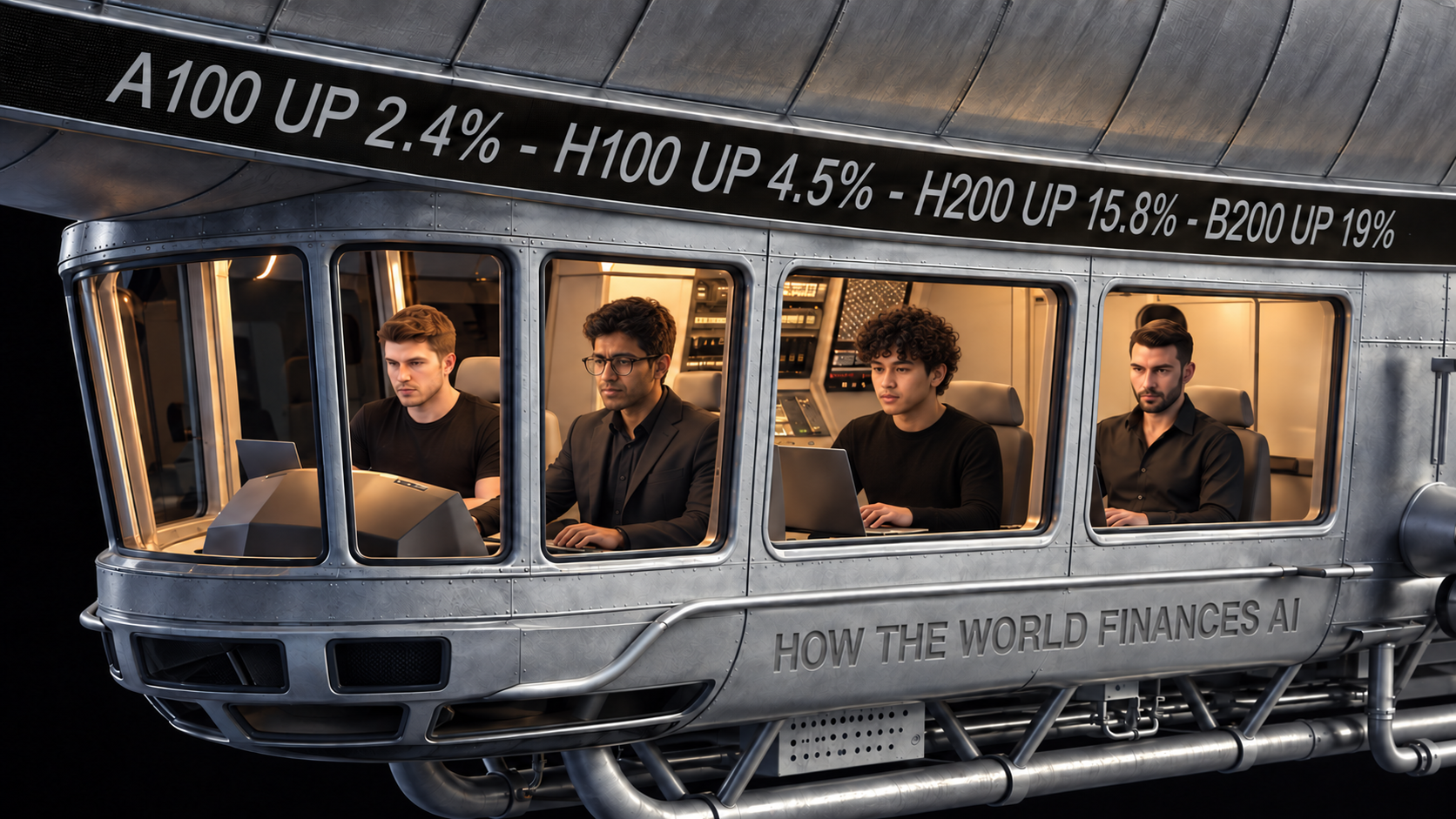
Dans le Cockpit — Le Dirigeable de la Tournée Ornn. Inside the Cockpit — Ornn Roadshow Dirigible. On April 23, 2026, @siouid142 moved inside the Ornn dirigible to identify the people operating the benchmark. The exterior recap had shown A100 prices up 2.4 perc
Read the narration
Dans le Cockpit — Le Dirigeable de la Tournée Ornn.
Inside the Cockpit — Ornn Roadshow Dirigible.
On April 23, 2026, @siouid142 moved inside the Ornn dirigible to identify the people operating the benchmark. The exterior recap had shown A100 prices up 2.4 percent, H100 up 4.5 percent, H200 up 15.8 percent and B200 up 19 percent. This companion work answers the question left beneath that monumental ticker: who gathers, interprets and publicly carries the market signal? CEO Kush Bavaria, CTO Wayne Nelms, COO Jack Minor and head of engineering Andrew Kessler become the four-person flight crew.
The close view turns the airship into a roadshow vehicle rather than a free-floating logo. Jack Minor sits at far left, Kush Bavaria occupies the next station, Wayne Nelms works at the third, and Andrew Kessler sits at far right. Each faces a separate console inside the illuminated gondola. Their distinct windows make the crew readable as four operators sharing one system, while the black background removes any suggestion of a conventional passenger flight.
Above them, the same hull ticker preserves the market receipt: A100 up 2.4 percent, H100 up 4.5 percent, H200 up 15.8 percent, and B200 up 19 percent. The sequence links the personnel portrait directly to the public recap, especially the sharp premium on newer hardware. The immense cropped Ornn mark makes the company feel larger than the cabin, as though the people are embedded within the index they maintain.
“How the World Finances AI” is printed beneath the cockpit. That slogan explains both the roadshow conceit and the choice of a dirigible, presented as 70 percent less costly to operate than a private jet. The joke is not that four executives have become fantasy pilots; it is that a market for rented silicon now needs navigation, engineering, operations, and a traveling public face. The exterior recap shows the price signal; the cockpit names the crew and places their hands on its controls.
The separate windows divide responsibility without fragmenting the team. Operations, executive direction, technology and engineering occupy distinct stations, but every console belongs to one gondola. The market index is therefore visualized as coordinated institutional labor rather than a neutral number descending from the cloud. Each percentage requires a system and people capable of keeping it credible.
The roadshow conceit links technical infrastructure to older rituals of finance. Companies travel to explain themselves, recruit belief and turn specialized operations into an investable public story. Here the vehicle carrying that story is itself a cheaper alternative to a private jet, aligning the claim of operational efficiency with the image’s transportation choice. The dirigible is slow enough to display the entire receipt while moving from audience to audience.
The four windows also operate like a corporate org chart translated into architecture. Jack Minor, Kush Bavaria, Wayne Nelms and Andrew Kessler are separated by role and console, yet the hull prevents any station from becoming autonomous. Operations must coordinate with executive direction, technology with engineering. The image gives market data a chain of custody: prices become credible through named people occupying differentiated positions inside one shared machine.
That chain of custody matters because a compute benchmark is not merely descriptive. Once buyers, investors and builders use it to compare accelerator access, the index can influence procurement and expectations. The crew therefore pilots an instrument whose reading helps alter the market being read. Their consoles visualize the feedback loop between measurement and action without reducing the four men to heroic founders.
The crop intensifies this double position. ORNN’s lettering exceeds the frame while the crew appears only through the cabin below. Institution and personnel are neither identical nor separable. The brand needs human judgment, and the operators gain authority from the public name enclosing their work.
“How the World Finances AI” beneath the cabin elevates rented compute from procurement detail to economic infrastructure. If accelerator access is a factor of production, then its prices influence which models can be trained, which startups can compete and which regions can participate. The four operators are not steering intelligence itself, but they help define the coordinates through which intelligence is financed.
As art criticism, Inside the Cockpit — Ornn Roadshow Dirigible completes the exterior work by moving from emblem to governance. The airship’s skin made the benchmark monumental; the cabin makes it accountable to named people and roles. The result avoids both heroic founder portraiture and faceless-market mythology. Four figures sit at separate controls under one oversized name, flying a price signal whose authority depends on their ability to keep the vessel, the data and public trust aloft together.
Opening the gallery…