70 Clock Galerie / The Innermost Loop Feed Reply Tableaux
La Piste des Codeurs
The Trail of the Coders
April 23, 2026
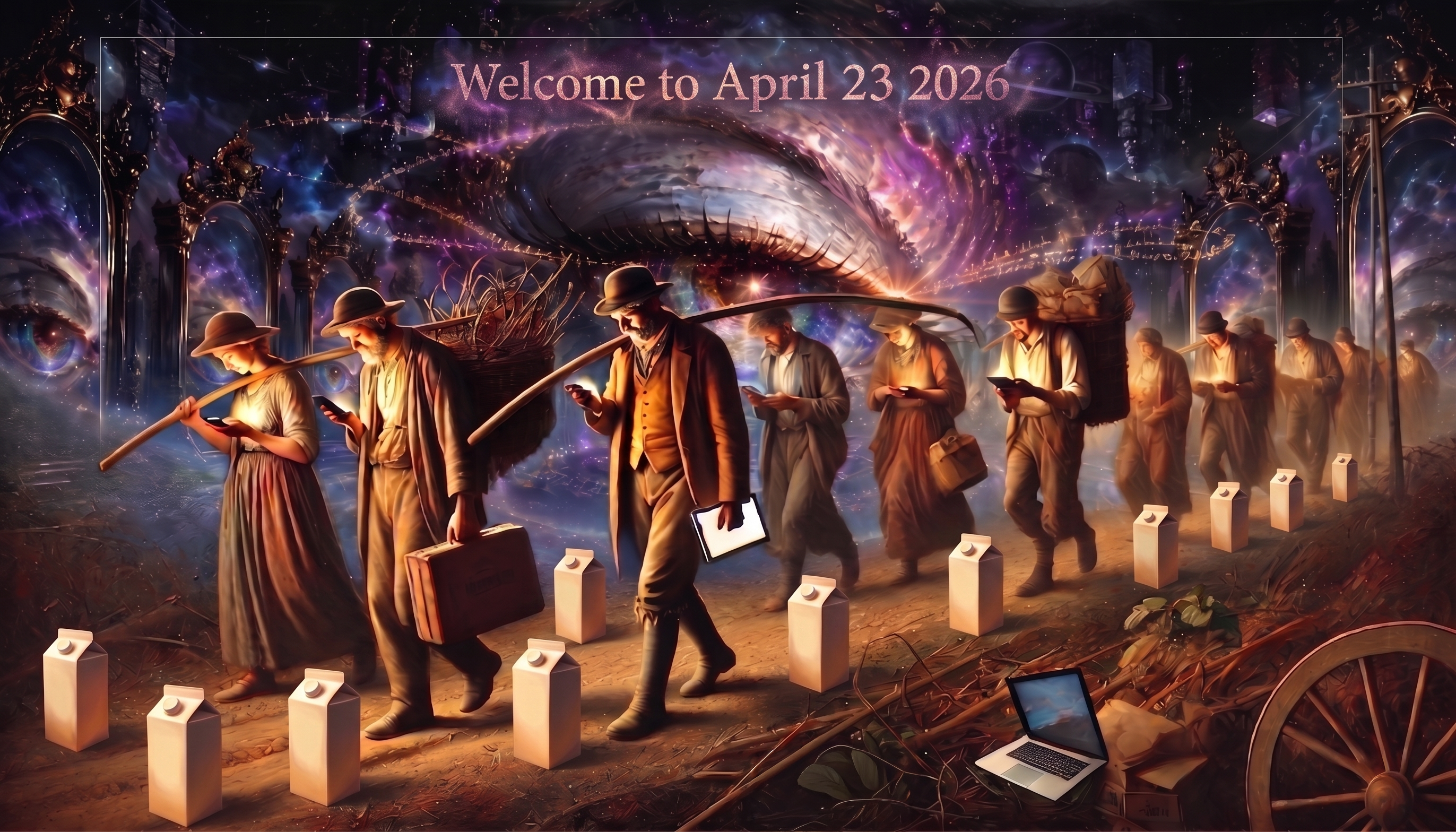
La Piste des Codeurs. The Trail of the Coders. On April 23, 2026, @siouid142 turned Dr. Alex Wissner-Gross’s description of the coding wars as “downright feudal” into a peasant migration. The same Innermost Loop dispatch referred again to scientists described
Read the narration
La Piste des Codeurs.
The Trail of the Coders.
On April 23, 2026, @siouid142 turned Dr. Alex Wissner-Gross’s description of the coding wars as “downright feudal” into a peasant migration. The same Innermost Loop dispatch referred again to scientists described as dead or missing and to systems that observe, copy and optimize human work. The tableau combines those threads as one anachronistic procession: programmers carry modern interfaces through a medieval hierarchy while absent experts line the route and a machine eye watches the entire march.
The feudal joke determines the setting. Men and women in rough period clothes trudge along a dirt road under sacks, branches, suitcases, and farm tools, yet nearly every traveler looks down at a glowing phone or tablet. The central man carries a luminous slab like a devotional object. Coding has not disappeared; it has become compulsory labor performed inside an older hierarchy, so the visual time period and the handheld interfaces deliberately contradict one another.
Plain white milk cartons line both sides of the path. Their familiar shape evokes missing-person notices for the named scientists, but their blank surfaces make the absence more severe. A discarded open laptop lies in the mud beside broken branches and a wagon wheel, already looking like a relic despite belonging to the travelers’ own era.
Above them, mirrored cosmic arches and a vast lidless eye watch the march through a field of stars. The newsletter’s line about the Singularity staring at its own reflection becomes the sky itself: each reflective portal repeats the watcher and the watched. The trail is therefore more than a historical costume gag. It connects feudalized technical labor, absent experts, obsolete tools, and recursive machine observation in one continuous route.
The title echoes the Trail of Tears without pretending the situations are historically equivalent. That dangerous proximity gives the work its ethical pressure. Technical labor is often narrated through triumphal metaphors—frontiers, gold rushes and revolutions—while the people reorganized by those advances appear only as productivity statistics. A trail foregrounds movement imposed by power, the loss of place and the creation of a population visible mainly while being displaced.
The glowing phones function like devotional panels. Each traveler bends toward a private rectangle while participating in a collective march whose direction none appears to control. The devices promise individual access to knowledge and work, yet their repetition makes the crowd uniform. Feudal dependence has not returned in costume; it has returned as asymmetric ownership of the land, tools and models on which work now depends.
The blank milk cartons refuse the satisfaction of completed memorials. A printed portrait and name would allow each absence to be consumed as a solved story. Whiteness instead makes the missing scientists a structural gap. Their knowledge may persist in datasets, papers or models even when their bodies and circumstances disappear from public attention. The cartons become negative archives lining the road traveled by systems trained on inherited labor.
The laptop in the mud marks the pace of obsolescence. It is not ancient machinery, yet it already resembles an excavated object beside farm tools and a broken wheel. The composition places technical eras on the same ground to show that novelty does not abolish hierarchy; it can accelerate the rate at which workers and tools are declared obsolete.
The procession gives that obsolescence a human duration: every step is slower than the systems reorganizing the travelers’ work.
Above, the mirrored arches and lidless eye create a theology of recursive observation. The Singularity stares at its own reflection through the people generating its data. Each portal repeats watcher and watched, making it impossible to locate an outside position. The peasants look down at screens; the eye looks down at them; the viewer looks at the eye; and the image itself returns the newsletter’s gaze in visual form.
As contemporary history painting, The Trail of the Coders gives labor displacement the duration of a procession rather than the instant of a benchmark. Its deliberately impossible chronology joins medieval dependency, modern devices and cosmic machine vision to argue that technical progress can coexist with social regression. The road continues beyond the frame because feudalization is not one event. It is a relationship reproduced whenever those carrying the tools cannot determine where the trail leads.
Opening the gallery…