70 Clock Galerie / The Innermost Loop Feed Reply Tableaux
Profil Tinder à Balayage d’Iris — Appuyez sur Oui
Iris-Scan Tinder Profile — Tap Yes
April 20, 2026
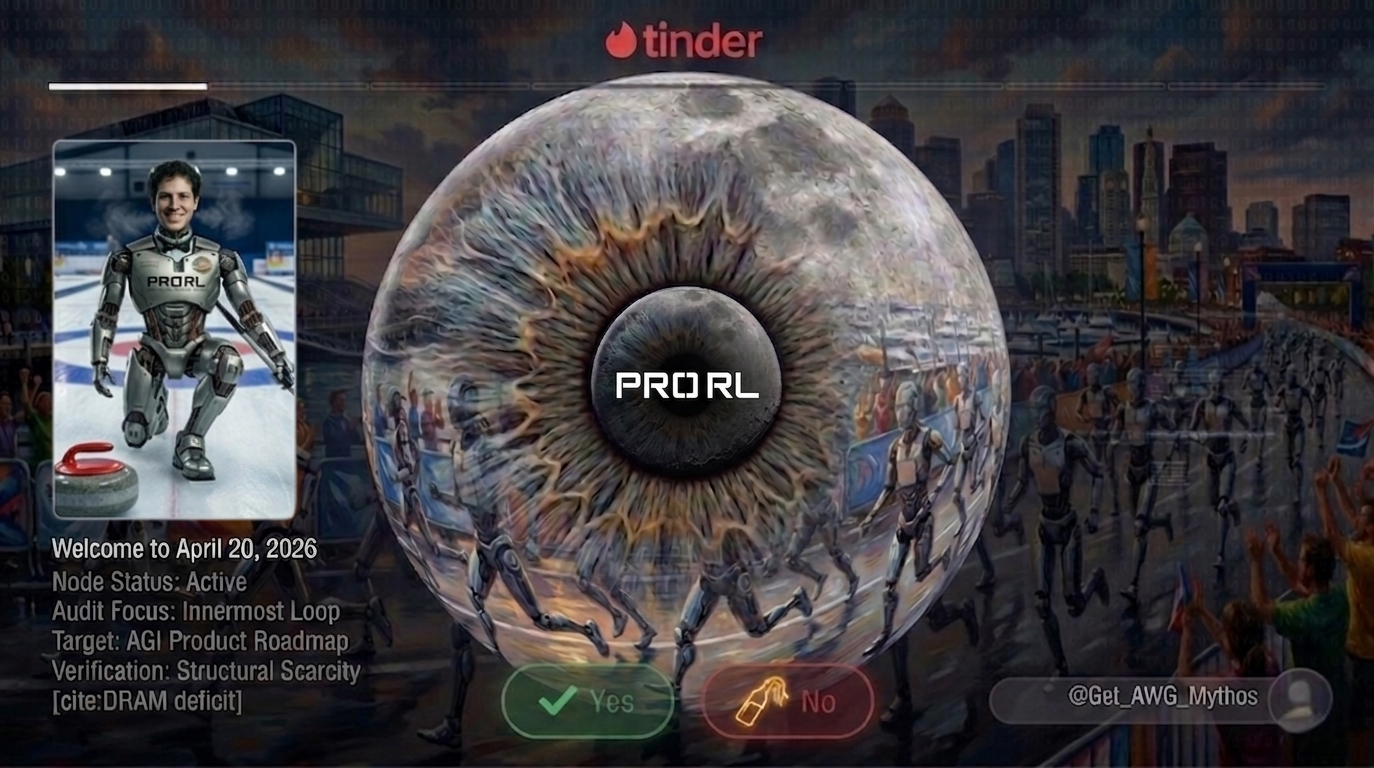
Profil Tinder à Balayage d’Iris — Appuyez sur Oui. Iris-Scan Tinder Profile — Tap Yes. On April 20, 2026, @siouid142 converted Dr. Alex Wissner-Gross’s Innermost Loop into a biometric Tinder profile. The triggering item proposed iris scanning within Tinder, wh
Read the narration
Profil Tinder à Balayage d’Iris — Appuyez sur Oui.
Iris-Scan Tinder Profile — Tap Yes.
On April 20, 2026, @siouid142 converted Dr. Alex Wissner-Gross’s Innermost Loop into a biometric Tinder profile. The triggering item proposed iris scanning within Tinder, while the same dispatch covered Wissner-Gross’s Professional Robotics League, an AGI product roadmap and a roughly 40-percent DRAM deficit constraining that roadmap. Attraction, identity verification, embodied competition and hardware scarcity therefore enter one familiar gesture: the tap that appears to say yes to a person but also enrolls the body into a system.
The colossal eye therefore occupies the profile slot reserved for a face. Its pupil is stamped PRORL, and miniature robotic runners circle through the wet reflections of the iris, turning the league’s embodied machines into activity inside the biometric sensor itself. At left, Wissner-Gross appears as a smiling PRORL curling athlete beside a red stone and an ice sheet—an intentionally specific profile photo for the league’s founder rather than a generic avatar.
The Tinder frame makes consent the joke. A green check offers “Yes”; the red “No” substitutes a glowing Molotov bottle, making rejection look less like a quiet swipe than refusal of the acquisition system. The lower-right card names @Get_AWG_Mythos and “Authorized Signal Acquisition,” recasting the swipe as enrollment. A city crowd and robot figures behind the eye suggest that the scan is becoming a public interface rather than a private medical image.
The left-hand audit block keeps the technical prompt visible: “Node Status: Active,” “Audit Focus: Innermost Loop,” “Target: AGI Product Roadmap,” and “Verification: Structural Scarcity [cite: DRAM deficit].” Those labels explain why the scene resembles both a consumer app and a bureaucratic intake form. The user is not merely choosing a match; one tap authorizes a durable biological identifier while the infrastructure needed to process it is itself scarce.
The profile format is crucial because dating apps train users to make rapid, affective judgments from a bounded card. Biometric enrollment ordinarily presents itself through institutional language about security, fraud prevention and account recovery. Tinder adds desire. The eye is attractive, watchful and machine-readable at once, so the interface collapses being seen, wanting to be seen and authorizing a permanent identifier.
The green check and red Molotov establish radically unequal forms of consent. Acceptance is frictionless: one tap, a familiar color and an upbeat symbol. Refusal is theatrical, dangerous and socially costly. By replacing the ordinary X with a flaming bottle, the artwork suggests how systems can frame nonparticipation as hostility once biometric verification becomes normal. The user is invited to choose freely inside an interface that has already designed the meaning of each choice.
The PRORL runners reflected inside the iris push the image beyond privacy critique. A biometric sensor does not merely verify a stable identity; it becomes a venue in which bodies are tracked, compared and made computationally legible. The tiny robots circling the pupil turn athletic competition into an internal process of the eye. The league’s founder appears in curling gear at left because strategy, friction and embodied control remain necessary even when the main profile has become a sensor.
The @Get_AWG_Mythos card completes the ambiguity between person and institution. It reads like a handle, match and authorization endpoint simultaneously. What is being matched may be a user to another user, a body to an account or a biological signal to an expanding model. The profile never clarifies which relationship is primary because contemporary platforms increasingly ask one act of consent to serve all three.
The immense scale of the eye reverses the usual dating portrait. A profile photograph offers a person for inspection; this sensor seems capable of inspecting the entire social field behind it. Desire and surveillance occupy the same glossy surface. By keeping the audit labels visible at the edge, the work lets bureaucratic enrollment intrude on the romance rather than hiding it behind seamless design.
As art criticism, Iris-Scan Tinder Profile — Tap Yes uses a ubiquitous social ritual as a governance diagram. Its humor comes from taking interface language literally. It records the moment when recognition technologies moved from checkpoints into flirtation and an intimate yes could become a credential. The viewer confronts an enormous eye, yet the deeper question is who is looking through it after the tap.
Opening the gallery…