70 Clock Galerie / The Innermost Loop Feed Reply Tableaux
Hommage à Rosalind Franklin — Société des Scientifiques Morts ou Disparus
Homage to Rosalind Franklin — Dead or Missing Scientist Society
April 17, 2026
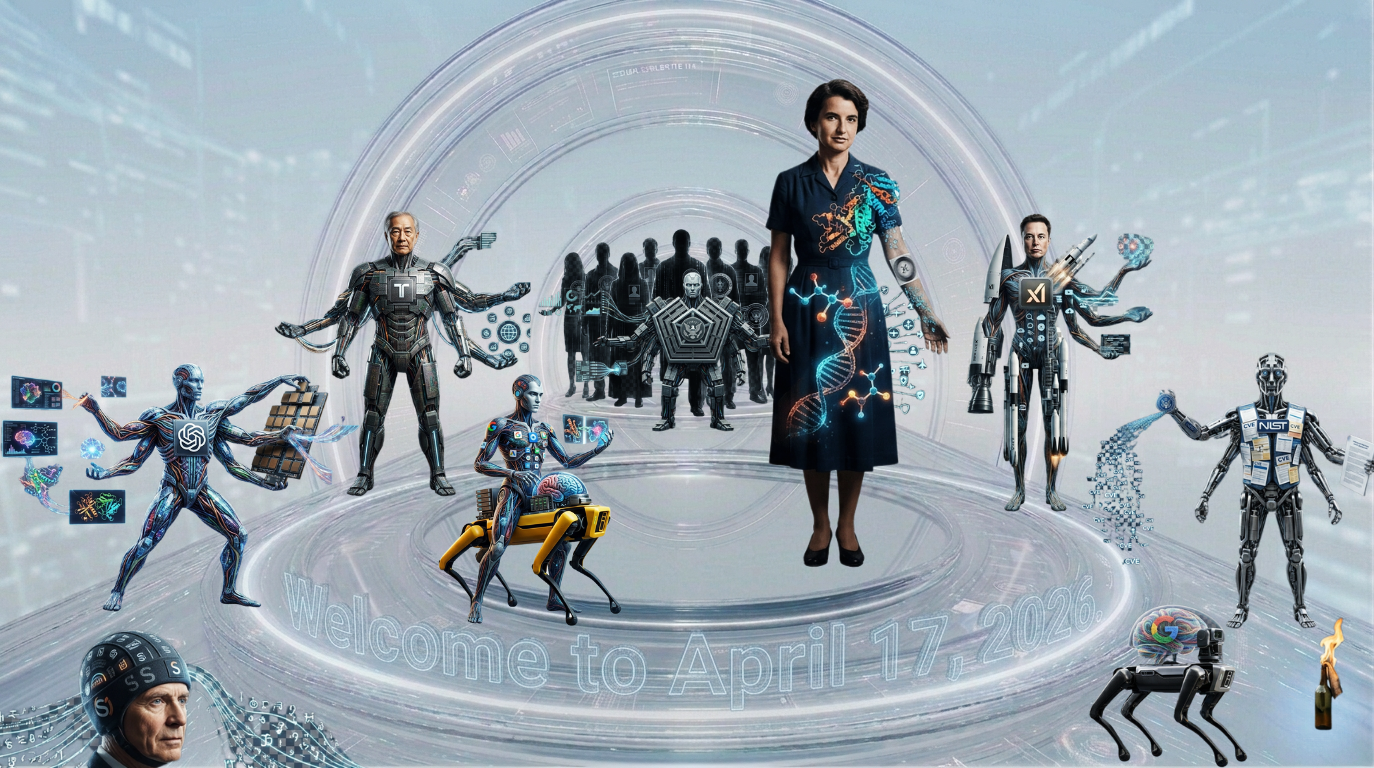
Hommage à Rosalind Franklin — Société des Scientifiques Morts ou Disparus. Homage to Rosalind Franklin — Dead or Missing Scientist Society. On April 17, 2026, @siouid142 created this homage as a same-day reply to Dr. Alex Wissner-Gross’s Innermost Loop. GPT-Ro
Read the narration
Hommage à Rosalind Franklin — Société des Scientifiques Morts ou Disparus.
Homage to Rosalind Franklin — Dead or Missing Scientist Society.
On April 17, 2026, @siouid142 created this homage as a same-day reply to Dr. Alex Wissner-Gross’s Innermost Loop. GPT-Rosalind supplied the central trigger: a frontier model for drug discovery and protein engineering bearing the name of Rosalind Franklin, whose X-ray diffraction work was indispensable to revealing DNA’s structure but whose recognition arrived late. The dispatch placed that scientific inheritance beside TSMC’s four-trillion-dollar milestone, Cerebras wafer-scale compute, Gemini Robotics-ER 1.6, classified federal deployment, a 263-percent rise in vulnerability notices and Sabi’s thought-to-text beanie. The tableau organizes those forces around Franklin rather than allowing the new model to consume her name without history.
She is not a historical cameo. Her period dress opens into colored DNA helices, molecular chains, and folded proteins. Behind her, a Pentagon-marked humanoid stands before ten dark silhouettes, joining Google’s classified-government talks to the scientists, engineers, and military leaders described as dead or missing.
The silicon powers orbit her in identifiable bodies. A four-armed Cerebras figure with an OpenAI emblem presents wafer-size chips; a silver TSMC figure wears the large “T”; and an xAI/SpaceX figure carries rocket hardware. In front, a humanoid rides a yellow quadruped while a separate Boston Dynamics Spot bears a Gemini brain. At far right, a NIST-vested robot pours a stream of CVE tiles, translating the reported 263 percent rise in vulnerability notices into physical exhaust.
The smallest callbacks complete the argument. A flaming bottle beside Spot recalls the attack at Sam Altman’s home, while the cropped head at lower left wears the Sabi sensor cap and emits characters as if internal speech were becoming text. Even the date is etched around the circular floor like a status ring. Biology, compute, state power, security risk, and interface hardware all revolve around Franklin because the day’s most advanced model began with a scientist whose recognition arrived late.
The circular composition resembles a scientific seal, memorial medallion and command interface at once. Franklin occupies the center because the surrounding systems depend on the conversion of observation into structure. Her diffraction images made a hidden biological geometry legible; the contemporary models and machines around her perform related acts at vastly different scales, inferring proteins, translating thought, controlling robots and identifying software weakness. The mandala treats those acts not as disconnected products but as descendants of a shared epistemic ambition.
The title’s Dead or Missing Scientist Society changes the mood from celebration to accounting. The ten dark figures behind the Pentagon-marked humanoid connect contemporary institutional secrecy to a longer history in which scientific labor can be obscured, appropriated or remembered only after the people who performed it are absent. Franklin’s placement at the center repairs one omission symbolically while warning that new systems may produce others. Naming a model after a scientist is not the same as preserving the conditions under which scientists can receive credit, exercise judgment and remain visible.
The date inscribed around the floor makes the mandala a status ring as well as a memorial. It fixes a crowded technological present to one day, refusing the timelessness of both corporate mythology and posthumous honor. The ring also resembles the aperture of an instrument: each surrounding development is a reading gathered around Franklin’s image. History, in this construction, is not background. It is the calibration surface against which claims of novelty must be measured.
The contrast between Franklin’s period dress and the machinery orbiting her is therefore not nostalgic. Her fabric opens into helices, chains and folded proteins, allowing scientific representation to pass directly into the visual language of contemporary computation. The transformation shows continuity without claiming equivalence. A protein model bearing her name can accelerate discovery, but the image insists that acceleration does not cancel the slower human histories embedded in its training, naming and institutional use.
As contemporary history painting, Homage to Rosalind Franklin refuses the clean futurism of a model launch. It makes the honored scientist physically support a field of corporate titans, defense systems, robots and security failures, then asks whether recognition can keep pace with appropriation. The work celebrates scientific continuity while treating memory as infrastructure. In this mandala, the future does not simply stand on the shoulders of the past; it circles a woman whose image reminds every new system that discovery has authors, omissions and debts.
Opening the gallery…